Work, Energy and power — Chapter Summary
ICSE · Class 10 · Physics
Summary of Work, Energy and power for ICSE Class 10 Physics. Key concepts: Work is done when a body, Work is maximum and positive and The SI unit of work.
Interactive on Super Tutor
Studying Work, Energy and power? Get the full interactive chapter.
Quizzes, flashcards, AI doubt-solver and a step-by-step study plan — built for chapter summary and more.
Free trial, no card needed.
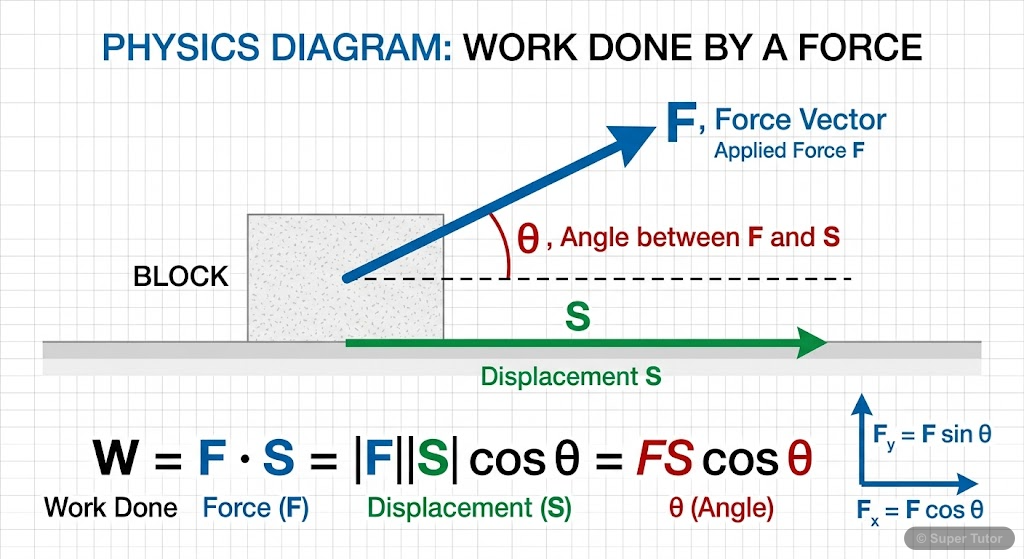
One of 16 illustrations for Work, Energy and power in Super Tutor — alongside flashcards, concept maps and practice questions.
See them allOverview
Work is done only when a force acts on a body and the body is displaced. Work, energy, and power are closely connected ideas in physics. Work measures the effect of a force through displacement, energy is the capacity to do work, and power is the rate at which work is done. The chapter also explains
Key Concepts
Work is done when a body
Work is done when a body is displaced under the influence of an applied force. Mathematically, W = F·d. If the force and displacement are in the same
Work is maximum and positive when
Work is maximum and positive when force and displacement are in the same direction, so θ = 0° and W = Fs. Work is zero when θ = 90° or when displaceme
The SI unit of work
The SI unit of work is joule. One joule is the work done by a force of one newton in displacing a body by one metre. The CGS unit is erg. One erg is t
Power is the rate of doing
Power is the rate of doing work. Its formula is P = W/t. It also has the form P = F × v, or P = F·v cosθ. Power is a scalar quantity and depends on bo
The SI unit of power
The SI unit of power is watt. If one joule of work is done in one second, the power is one watt. Larger units include kilowatt, megawatt, microwatt, a
Learning Objectives
- Define work, energy, and power correctly
- Understand the conditions for positive, zero, and negative work
- Use the formulas W = F·d, W = F cosθ · s, P = W/t, K = 1/2 mv^2, and U = mgh
- Recognise SI and CGS units of work, power, and energy
- Relate work to area under force-displacement graphs
Frequently Asked Questions
What are the important topics in Work, Energy and power for ICSE Class 10 Physics?
How should I revise Work, Energy and power for the ICSE Class 10 board exam?
Sources & Official References
Content is aligned to the official syllabus. Refer to the board website for the latest curriculum.
More resources for Work, Energy and power
Practice Quiz
Test yourself with a quick quiz
Important Questions
Exam-style questions with answers
Revision Notes
Key points for last-minute revision
Formula Sheet
The chapter's formulas in one place
Concept Maps
See how topics connect
Study Plan
Step-by-step plan for this chapter
Flashcards
Quick-fire cards for active recall
Syllabus
What topics to cover
For serious students
Get the full Work, Energy and power chapter — start free.
Quizzes, flashcards, an AI doubt solver and a study plan for ICSE Class 10 Physics. Free to start, no card needed.