Electromagnetism — Concept Maps
ICSE · Class 10 · Physics
4 concept maps of Electromagnetism for ICSE Class 10 Physics, each also written out as a text outline. Part of the ICSE Class 10 Physics syllabus.
Interactive on Super Tutor
Studying Electromagnetism? Get the full interactive chapter.
Quizzes, flashcards, AI doubt-solver and a step-by-step study plan — built for concept maps and more.
Free trial, no card needed.
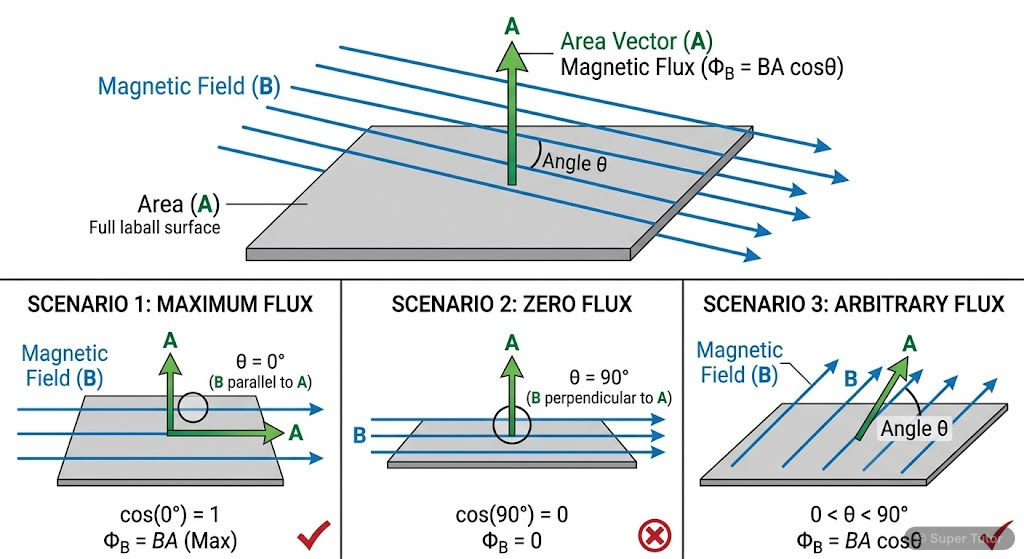
One of 26 illustrations for Electromagnetism in Super Tutor — alongside flashcards, concept maps and practice questions.
See them allElectromagnetism Concept Hierarchy
The map in words
- Electromagnetism
- Magnetic Effects
- Straight Wire
- Right Hand Rule
- Solenoid
- Magnetic Field
- Electromagnet
- Soft Iron Core
- Straight Wire
- Force and Motion
- Fleming Left Hand
- DC Motor
- Torque
- Electromagnetic Induction
- Faraday Laws
- Lenz Law
- Fleming Right Hand
- AC Generation
- AC Generator
- Frequency
- Sinusoidal EMF
- Transformer
- Step Up
- Step Down
- Turn Ratio
- Energy Loss
- Magnetic Effects
Electromagnetism — Complete Chapter Mind Map
The map in words
- Electromagnetism
- Magnetic Effect of Current
- Oersted Experiment 1820
- Straight Wire
- Concentric circles
- Right Hand Thumb Rule
- Circular Loop
- B at centre = mu0NI by 2R
- Clockwise = South Pole
- Solenoid
- B = mu0nI
- Uniform field inside
- Electromagnets
- Bar Electromagnet
- Soft iron core
- Temporary magnet
- Horseshoe Electromagnet
- Opposite poles at ends
- Used in DC motor
- Permanent Magnet
- Steel core
- High retentivity
- Electric Bell
- Make and break circuit
- Armature and Gong
- Bar Electromagnet
- Force on Conductor
- F = BIL sinθ
- Unit Tesla
- Flemings Left Hand Rule
- Forefinger = B field
- Middle = Current
- Thumb = Force
- DC Motor
- Electrical to Mechanical
- Split Ring Commutator
- Armature Coil
- Electromagnetic Induction
- Faradays Laws
- First Law Change in flux
- Second Law e = NdPhi by dt
- Magnetic Flux
- Phi = BAcosTheta
- Unit Weber
- Flemings Right Hand Rule
- Thumb = Motion
- Forefinger = B field
- Middle = Induced current
- Lenzs Law
- Opposes change
- Energy conservation
- Faradays Laws
- AC Generator
- Mechanical to Electrical
- Slip Rings
- e0 = 2 pi NBAn
- Frequency 50 Hz India
- Transformer
- Mutual Induction
- Step Up Ns greater Np
- Step Down Ns less Np
- Turn ratio = Ns by Np
- Energy Losses
- Copper loss
- Eddy current loss
- Hysteresis loss
- Flux leakage
- Magnetic Effect of Current
Which Fleming Rule to Use — Decision Guide
The map in words
- Electromagnetic Problem
- What are you finding?
- Direction of FORCE on conductor: Motor Effect
- Use FLEMINGS LEFT HAND RULE
- Forefinger points along FIELD B
- Middle finger points along CURRENT I
- THUMB shows FORCE direction
- Device is a MOTOR
- Use FLEMINGS LEFT HAND RULE
- Direction of INDUCED CURRENT: Generator Effect
- Use FLEMINGS RIGHT HAND RULE
- Forefinger points along FIELD B
- THUMB points along MOTION direction
- MIDDLE FINGER shows INDUCED CURRENT
- Device is a GENERATOR
- Use FLEMINGS RIGHT HAND RULE
- Direction of FORCE on conductor: Motor Effect
- What are you finding?
Electromagnetism is the interaction between electric currents and magnetic fields, including magnetic effect of current, force on current-carrying conductors, electromagnetic induction, generators, and transformers.
The map in words
- Electromagnetism is the interaction between electric currents and magnetic fields, including magnetic effect of current, force on current-carrying conductors, electromagnetic induction, generators, and transformers.
- Magnetic Effect of Electric Current
- Electromagnet
- Permanent Magnet
- Force on Current-Carrying Conductor
- D.C. Motor
- Electromagnetic Induction
- A.C. Generator
- Direct Current and Alternating Current
Explore these maps interactively
Explore DiagramsFrequently Asked Questions
What are the important topics in Electromagnetism for ICSE Class 10 Physics?
What do the concept maps for Electromagnetism show?
How should I revise Electromagnetism for the ICSE Class 10 board exam?
Sources & Official References
Content is aligned to the official syllabus. Refer to the board website for the latest curriculum.
More resources for Electromagnetism
Practice Quiz
Test yourself with a quick quiz
Important Questions
Exam-style questions with answers
Revision Notes
Key points for last-minute revision
Chapter Summary
Understand the chapter at a glance
Study Plan
Step-by-step plan for this chapter
Flashcards
Quick-fire cards for active recall
Syllabus
What topics to cover
For serious students
Get the full Electromagnetism chapter — start free.
Quizzes, flashcards, an AI doubt solver and a study plan for ICSE Class 10 Physics. Free to start, no card needed.