Work, Energy and power — Concept Maps
ICSE · Class 10 · Physics
4 concept maps of Work, Energy and power for ICSE Class 10 Physics, each also written out as a text outline. Part of the ICSE Class 10 Physics syllabus.
Interactive on Super Tutor
Studying Work, Energy and power? Get the full interactive chapter.
Quizzes, flashcards, AI doubt-solver and a step-by-step study plan — built for concept maps and more.
Free trial, no card needed.
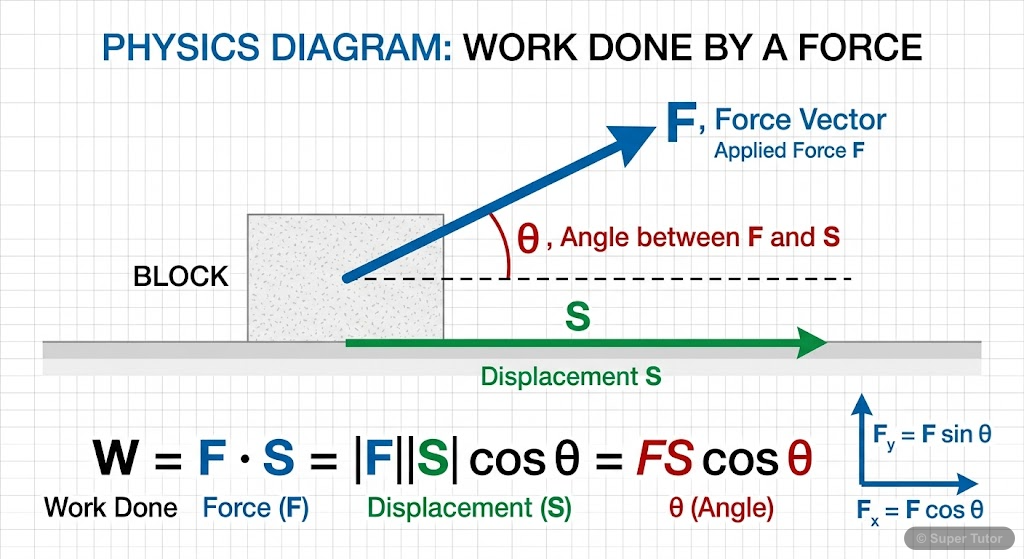
One of 16 illustrations for Work, Energy and power in Super Tutor — alongside flashcards, concept maps and practice questions.
See them allWork, Energy and Power — Chapter Concept Map
The map in words
- Work Energy Power
- Work
- Definition
- W = Fs cos theta
- Conditions
- Positive Work
- Zero Work
- Negative Work
- Units
- Joule SI
- Erg CGS
- 1J = 10 power 7 erg
- Definition
- Power
- Definition
- Rate of doing work
- Formula
- P = W over t
- P = F times v
- Units
- Watt SI
- Horsepower
- 1HP = 746W
- Definition
- Energy
- Definition
- Capacity to do work
- Mechanical Energy
- Kinetic Energy
- KE = half mv squared
- Work Energy Theorem
- Potential Energy
- PE = mgh gravitational
- Elastic PE
- Kinetic Energy
- Other Forms
- Solar
- Chemical
- Electrical
- Nuclear
- Heat
- Units
- Joule
- kWh = 3.6 x 10power6 J
- eV = 1.6 x 10power minus19 J
- Definition
- Conservation of Energy
- Law Statement
- Neither created nor destroyed
- Free Fall Verification
- Point A top PE max KE zero
- Point B middle both present
- Point C ground KE max PE zero
- Pendulum Example
- Law Statement
- Work
Is Work Done? — Decision Tree for Common Scenarios
The map in words
- Apply Force on Body
- Is there any Displacement?
- No s = 0: W = 0\nNo Work Done
- Yes s is not zero: Angle between Force\nand Displacement?
- Theta = 0 degrees: W = F x s\nMaximum Positive Work
- Example: Free fall\ngravity aids motion
- Theta = 90 degrees: W = 0\nZero Work Done
- Example: Coolie on platform\nload weight perpendicular
- 0 less than Theta less than 90: W = Fs cos Theta\nPositive Work
- Example: Pulling cart\nat an angle
- 90 less than Theta up to 180: W = Fs cos Theta\nNegative Work
- Example: Friction opposes\nmotion of sliding block
- Theta = 0 degrees: W = F x s\nMaximum Positive Work
- Is there any Displacement?
Work, Energy and Power — Complete Chapter Mind Map
The map in words
- Work Energy Power
- WORK
- Definition
- Force AND Displacement needed
- Formula
- W = Fs cosθ
- Cases
- θ=0 Maximum Work
- θ=90 Zero Work
- θ=180 Negative Work
- Units
- SI Joule
- CGS erg
- 1J = 10 to 7 erg
- Definition
- POWER
- Definition
- Rate of doing work
- Formula
- P = W divided by t
- P = F times v
- Units
- SI Watt
- 1 HP = 746 W
- Definition
- ENERGY
- Definition
- Capacity to do work
- Units
- Joule erg kWh eV calorie
- Mechanical Energy
- Kinetic Energy
- Formula half mv squared
- Types Translational Rotational Vibrational
- KE = P squared by 2m
- Potential Energy
- Gravitational mgh
- Elastic deformation
- Kinetic Energy
- Other Forms
- Solar Heat Light
- Chemical Electrical Nuclear
- Sound Wind Hydro
- Definition
- CONSERVATION
- Total Energy = Constant
- KE plus PE = constant
- Pendulum example
- Freely falling body
- WORK
Work, energy and power describe how force causes displacement, how fast work is done, and how energy is stored, transferred, and conserved
The map in words
- Work, energy and power describe how force causes displacement, how fast work is done, and how energy is stored, transferred, and conserved
- Work
- Power
- Energy
- Mechanical Energy
- Kinetic Energy
- Potential Energy
- Conservation of Energy
- Other Forms of Energy
Explore these maps interactively
Explore DiagramsFrequently Asked Questions
What are the important topics in Work, Energy and power for ICSE Class 10 Physics?
What do the concept maps for Work, Energy and power show?
How should I revise Work, Energy and power for the ICSE Class 10 board exam?
Sources & Official References
Content is aligned to the official syllabus. Refer to the board website for the latest curriculum.
More resources for Work, Energy and power
Practice Quiz
Test yourself with a quick quiz
Important Questions
Exam-style questions with answers
Revision Notes
Key points for last-minute revision
Formula Sheet
The chapter's formulas in one place
Chapter Summary
Understand the chapter at a glance
Study Plan
Step-by-step plan for this chapter
Flashcards
Quick-fire cards for active recall
Syllabus
What topics to cover
For serious students
Get the full Work, Energy and power chapter — start free.
Quizzes, flashcards, an AI doubt solver and a study plan for ICSE Class 10 Physics. Free to start, no card needed.