Machines — Concept Maps
ICSE · Class 10 · Physics
4 concept maps of Machines for ICSE Class 10 Physics, each also written out as a text outline. Part of the ICSE Class 10 Physics syllabus.
Interactive on Super Tutor
Studying Machines? Get the full interactive chapter.
Quizzes, flashcards, AI doubt-solver and a step-by-step study plan — built for concept maps and more.
Free trial, no card needed.
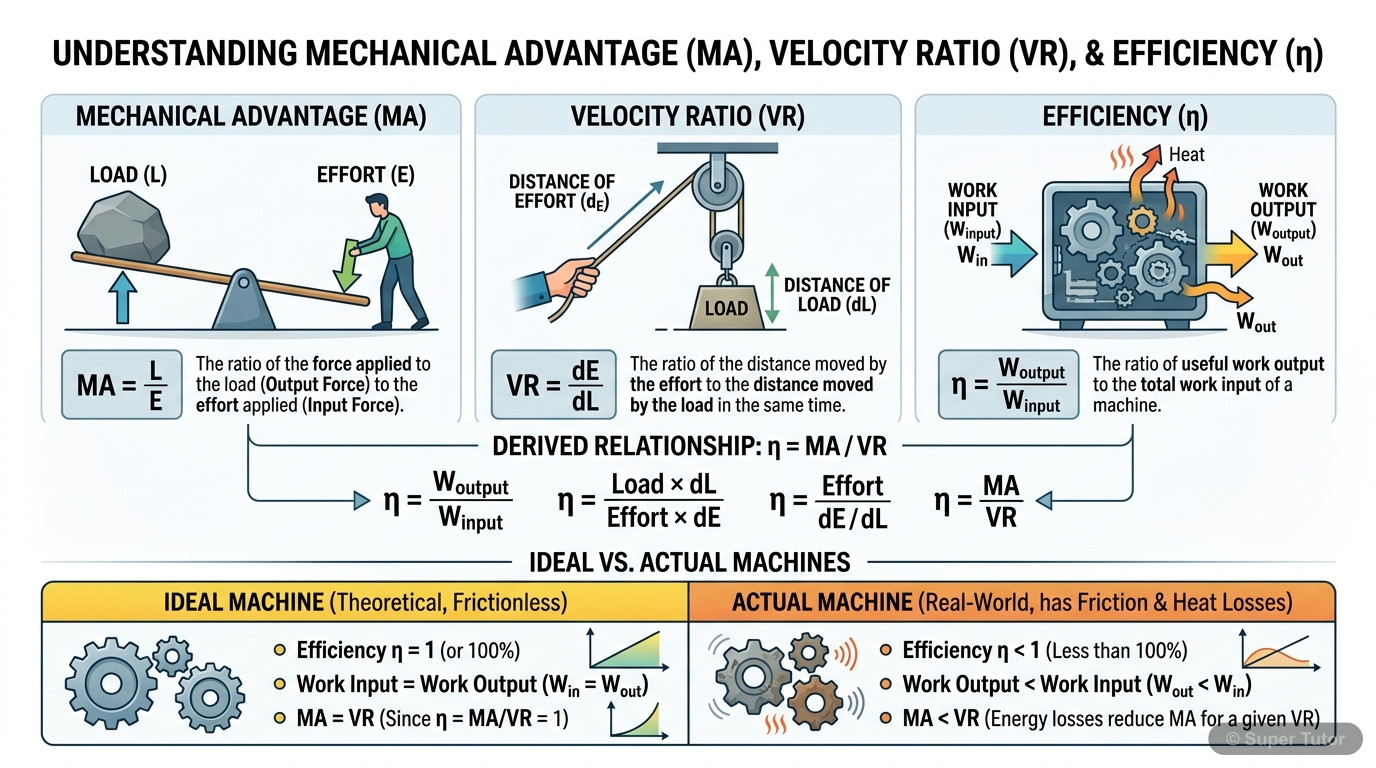
One of 11 illustrations for Machines in Super Tutor — alongside flashcards, concept maps and practice questions.
See them allCommon Misconceptions in Machines — Topic Map
The map in words
- Machines Misconceptions
- Efficiency
- Cannot exceed 100 percent
- Not always 100 percent
- Decreases with friction
- Velocity Ratio
- Fixed by geometry only
- Unaffected by friction
- Unaffected by pulley weight
- Mechanical Advantage
- Depends on friction
- MA less than VR for real machines
- MA equals VR only for ideal machines
- Levers
- Class decided by F L E positions
- Class II MA always greater than 1
- Class III levers are useful
- Class III gives speed gain
- Pulleys
- Fixed pulley changes direction only
- Movable pulley multiplies force
- Block and tackle uses total pulleys
- More pulleys reduce efficiency
- Efficiency
Complete Concept Map of Chapter: Machines
The map in words
- MACHINES
- Types
- Simple Machine
- Lever
- Pulley
- Screw
- Inclined Plane
- Complex Machine
- Bicycle
- Sewing Machine
- Simple Machine
- Key Parameters
- Mechanical Advantage
- MA = Load divided by Effort
- MA greater than 1 is Force Multiplier
- MA less than 1 is Speed Multiplier
- Velocity Ratio
- VR = dE divided by dL
- Geometry Only
- Unaffected by Friction
- Efficiency
- Eta = MA divided by VR
- Ideal = 100 percent
- Actual is less than 100 percent
- Mechanical Advantage
- Levers
- Class I
- Fulcrum in Middle
- Scissors Crowbar Seesaw
- MA can be any value
- Class II
- Load in Middle
- Wheelbarrow Nutcracker
- MA always greater than 1
- Class III
- Effort in Middle
- Forearm Fishing Rod
- MA always less than 1
- Class I
- Pulleys
- Single Fixed
- MA = 1
- Direction Change Only
- Single Movable
- MA = 2
- Force Multiplier
- Combination
- MA = 2 to power n
- n Movable Pulleys
- Block and Tackle
- MA = n Total Pulleys
- Weight Reduces MA
- Single Fixed
- Types
Chapter Concept Hierarchy – Machines
The map in words
- Machines
- Types of Machines
- Simple Machine
- Lever
- Pulley
- Inclined Plane
- Complex Machine
- Sewing Machine
- Bicycle
- Ideal Machine
- Output equals Input
- Efficiency 100 percent
- Actual Machine
- Output less than Input
- Efficiency less than 100 percent
- Simple Machine
- Key Quantities
- Load L
- Resistive force overcome
- Effort E
- Force applied
- Mechanical Advantage
- M.A. = L divided by E
- No unit
- Velocity Ratio
- V.R. = d_E divided by d_L
- No unit
- Efficiency eta
- eta = M.A. divided by V.R.
- Expressed as percentage
- Work Input
- Effort times d_E
- Work Output
- Load times d_L
- Load L
- Levers
- Fulcrum F
- Fixed pivot point
- Class I Lever
- Fulcrum between L and E
- M.A. can be any value
- Examples
- Scissors
- Crowbar
- Seesaw
- Class II Lever
- Load between F and E
- M.A. always greater than 1
- Examples
- Wheelbarrow
- Nutcracker
- Class III Lever
- Effort between F and L
- M.A. always less than 1
- Examples
- Forearm
- Broom
- Levers in Human Body
- Nodding Head Class I
- Rising on Toes Class II
- Forearm Raising Load Class III
- Fulcrum F
- Pulleys
- Single Fixed Pulley
- M.A. = 1
- V.R. = 1
- Changes direction of effort
- Single Movable Pulley
- M.A. = 2
- V.R. = 2
- Force multiplier
- Combination of Pulleys
- n movable pulleys
- M.A. = 2 to the power n
- V.R. = 2 to the power n
- Block and Tackle
- n total pulleys
- M.A. = n
- V.R. = n
- Effect of pulley weight
- Single Fixed Pulley
- Principle of Machine
- Effort Point
- Load Point
- Input Energy = E times d_E
- Output Energy = L times d_L
- Friction causes energy loss
- Key Formulas
- M.A. = L divided by E
- V.R. = d_E divided by d_L
- eta = M.A. divided by V.R.
- Lever M.A. = Effort Arm divided by Load Arm
- Ideal Machine M.A. = V.R.
- Types of Machines
Machines as devices that help overcome load with effort or gain speed
The map in words
- Machines as devices that help overcome load with effort or gain speed
- Machine
- Mechanical advantage
- Velocity ratio
- Efficiency
- Lever
- Pulley
- Historical note
- Applications and examples
Explore these maps interactively
Explore DiagramsFrequently Asked Questions
What are the important topics in Machines for ICSE Class 10 Physics?
What do the concept maps for Machines show?
How should I revise Machines for the ICSE Class 10 board exam?
Sources & Official References
Content is aligned to the official syllabus. Refer to the board website for the latest curriculum.
More resources for Machines
Practice Quiz
Test yourself with a quick quiz
Important Questions
Exam-style questions with answers
Revision Notes
Key points for last-minute revision
Formula Sheet
The chapter's formulas in one place
Chapter Summary
Understand the chapter at a glance
Study Plan
Step-by-step plan for this chapter
Flashcards
Quick-fire cards for active recall
Syllabus
What topics to cover
For serious students
Get the full Machines chapter — start free.
Quizzes, flashcards, an AI doubt solver and a study plan for ICSE Class 10 Physics. Free to start, no card needed.