Sound — Study Plan
ICSE · Class 10 · Physics
A step-by-step study plan for Sound, ICSE Class 10 Physics: what to learn first, what to practise and when to revise.
Interactive on Super Tutor
Studying Sound? Get the full interactive chapter.
Quizzes, flashcards, AI doubt-solver and a step-by-step study plan — built for study plan and more.
Free trial, no card needed.
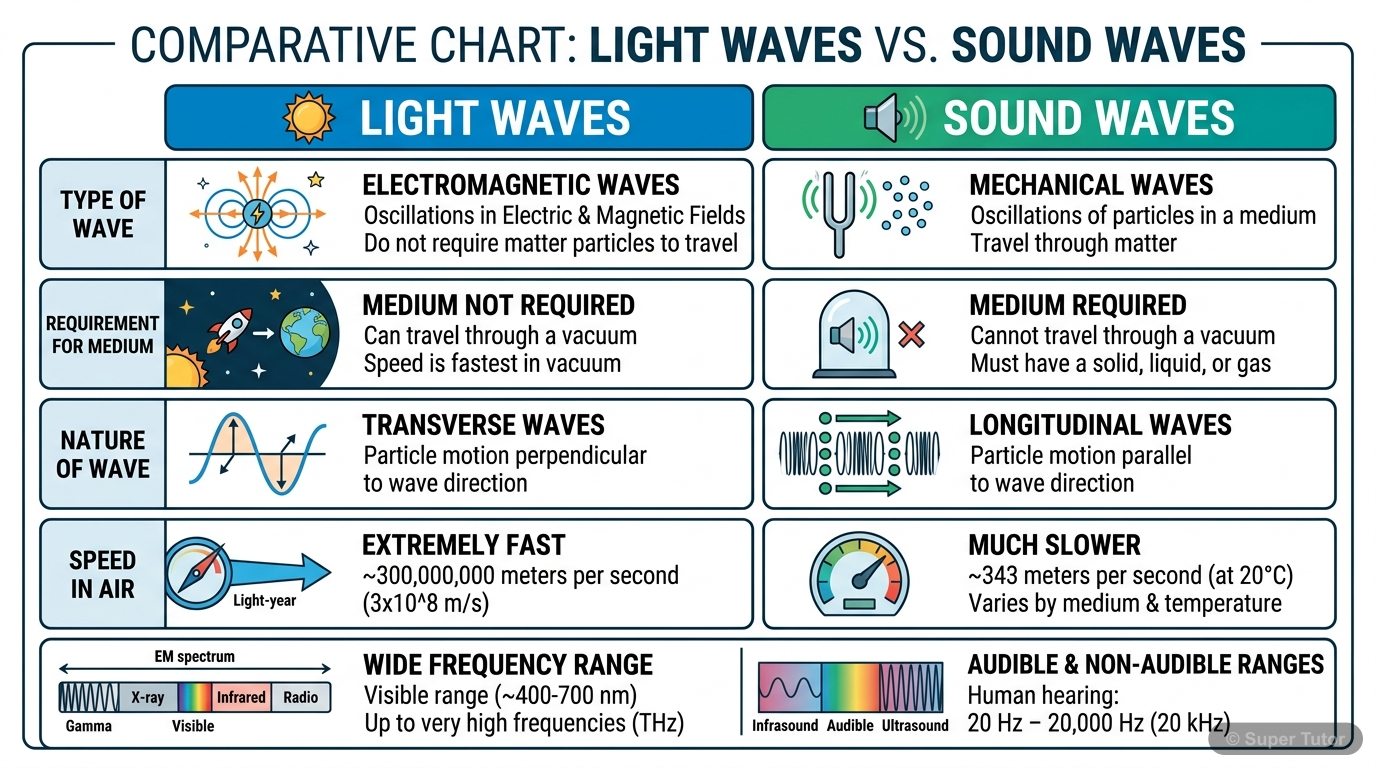
Learn better with visuals Super Tutor pairs illustrations like this with notes and quizzes for Sound.
Get startedStudy Plan
Learn the Theory
Read the textbook chapter carefully. Note down definitions, formulas and key ideas. Focus on: 1. Sound Waves and Basic Ideas, 2. Speed of Sound in Air and in Gases, 3. Reflection of Sound, Echo and Reverberation.
Practise
Solve the textbook exercises and extra practice questions. There are 42 questions available for this chapter.
Revise & Test
Revise key points without looking at your notes. Take a practice quiz and mark weak areas for another pass.
Spaced Revision
Come back to Sound after a week. Use flashcards for quick recall and try past exam questions on this chapter.
What to Focus On
- Sound waves are mechanical and longitudinal.
- Audible range of human ear is 20 Hz to 20,000 Hz.
- Sound above 20,000 Hz is ultrasonic and below 20 Hz is infrasonic.
- Reflection of sound occurs from rigid surfaces.
- The reflecting surface should be larger than the wavelength.
- Echo is heard only when the time gap is at least 0.1 s.
- Speed of sound can be found using the echo method.
- Bats, dolphins, and dogs use sound ranging.
- SONAR uses ultrasonic waves for underwater detection.
Common Mistakes to Avoid
An echo can be heard whenever sound reflects from any nearby wall.
Reverberation and echo mean the same thing.
SONAR and RADAR use the same kind of waves.
Memory Tips
Human audible range
Ultrasonic and infrasonic classification
Sound waves are longitudinal and light waves are transverse
Wave relation v = f × λ
Want a personalised study plan?
Super Tutor builds a day-by-day plan for ICSE Class 10 Physics that fits your exam date and pace.
Create My Study PlanFrequently Asked Questions
What are the important topics in Sound for ICSE Class 10 Physics?
How should I revise Sound for the ICSE Class 10 board exam?
Sources & Official References
Content is aligned to the official syllabus. Refer to the board website for the latest curriculum.
More resources for Sound
Practice Quiz
Test yourself with a quick quiz
Important Questions
Exam-style questions with answers
Revision Notes
Key points for last-minute revision
Formula Sheet
The chapter's formulas in one place
Chapter Summary
Understand the chapter at a glance
Concept Maps
See how topics connect
Flashcards
Quick-fire cards for active recall
Syllabus
What topics to cover
For serious students
Get the full Sound chapter — start free.
Quizzes, flashcards, an AI doubt solver and a study plan for ICSE Class 10 Physics. Free to start, no card needed.