Sound — Flashcards
ICSE · Class 10 · Physics
38 flashcards for Sound (ICSE Class 10 Physics) to test yourself on key terms and facts. Sample: "State the audible range of human ears."
Interactive on Super Tutor
Studying Sound? Get the full interactive chapter.
Quizzes, flashcards, AI doubt-solver and a step-by-step study plan — built for flashcards and more.
Free trial, no card needed.
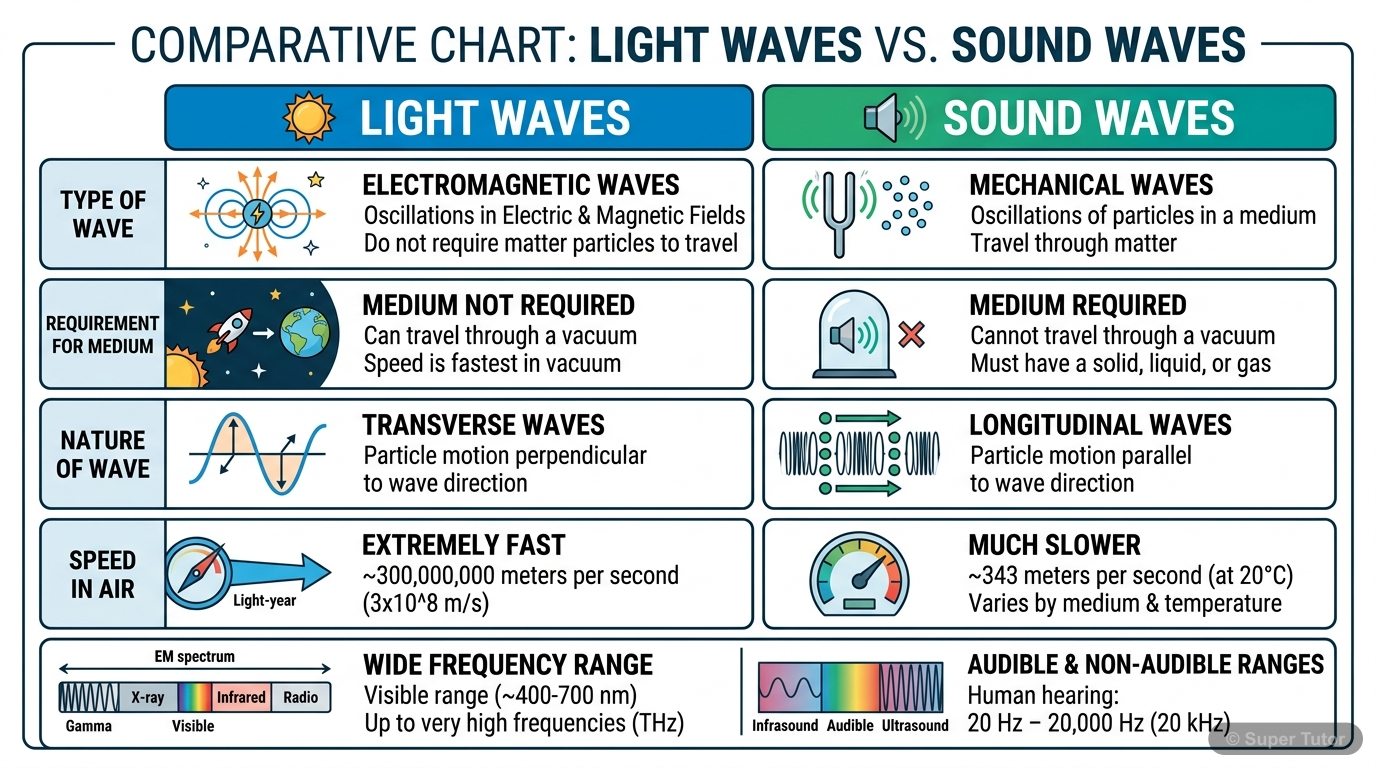
Learn better with visuals Super Tutor pairs illustrations like this with notes and quizzes for Sound.
Get startedState the audible range of human ears.
Answer
Human ears are sensitive to a limited range of frequencies from 20 Hz to 20,000 Hz. Sound below 20 Hz is infrasonic and sound above 20,000 Hz is ultrasonic.
Why are sound waves called mechanical waves?
Answer
Sound waves need a material medium for propagation. They travel through air, water, or solids, so they are mechanical waves. They cannot travel in vacuum.
State the relation between wave velocity, frequency, and wavelength.
Answer
Formula: v = f × λ Meaning: v = wave velocity, f = frequency, λ = wavelength. Unit check: m/s = Hz × m. Quick example: If f = 10 Hz and λ = 2 m, then v = 20 m/s.
A sound wave has frequency 50 Hz and wavelength 6.6 m. Find its speed.
Answer
Given: f = 50 Hz, λ = 6.6 m Formula: v = f × λ Step 1: v = 50 s⁻¹ × 6.6 m Step 2: v = 330 m/s Answer: Speed of sound = 330 m/s…
State the relation between frequency and time period.
Answer
Formula: f = 1/T Meaning: f = frequency, T = time period. Unit check: Hz = 1/s. Quick example: If T = 0.2 s, then f = 1/0.2 = 5 Hz.
A wave completes 4 oscillations in 2 seconds. Find its frequency and time period.
Answer
Given: oscillations = 4, time = 2 s Frequency: f = number of oscillations / time Step 1: f = 4/2 = 2 Hz Time period: T = 1/f Step 2: T = 1/2 = 0.5 s Answer: Frequency = 2 Hz, time period = 0.5 s…
Why do sound waves travel as longitudinal waves?
Answer
In sound waves, particles of the medium vibrate to and fro parallel to the direction of wave travel. This creates compressions and rarefactions, so sound waves are longitudinal in nature.
State the difference between light waves and sound waves.
Answer
Light waves are electromagnetic and transverse in nature. Sound waves are mechanical and longitudinal in nature. Light can travel in vacuum, but sound requires a medium. Speed of light in air is 3 × 1…
+30 more flashcards
Practise AllFrequently Asked Questions
What are the important topics in Sound for ICSE Class 10 Physics?
How many flashcards are available for Sound?
How should I revise Sound for the ICSE Class 10 board exam?
Sources & Official References
Content is aligned to the official syllabus. Refer to the board website for the latest curriculum.
More resources for Sound
Practice Quiz
Test yourself with a quick quiz
Important Questions
Exam-style questions with answers
Revision Notes
Key points for last-minute revision
Formula Sheet
The chapter's formulas in one place
Chapter Summary
Understand the chapter at a glance
Concept Maps
See how topics connect
Study Plan
Step-by-step plan for this chapter
Syllabus
What topics to cover
For serious students
Get the full Sound chapter — start free.
Quizzes, flashcards, an AI doubt solver and a study plan for ICSE Class 10 Physics. Free to start, no card needed.