Sound — Revision Notes
ICSE · Class 10 · Physics
Sound revision notes for ICSE Class 10 Physics: 4 topics in quick points. Part of the ICSE Class 10 Physics syllabus.
Interactive on Super Tutor
Studying Sound? Get the full interactive chapter.
Quizzes, flashcards, AI doubt-solver and a step-by-step study plan — built for revision notes and more.
Free trial, no card needed.
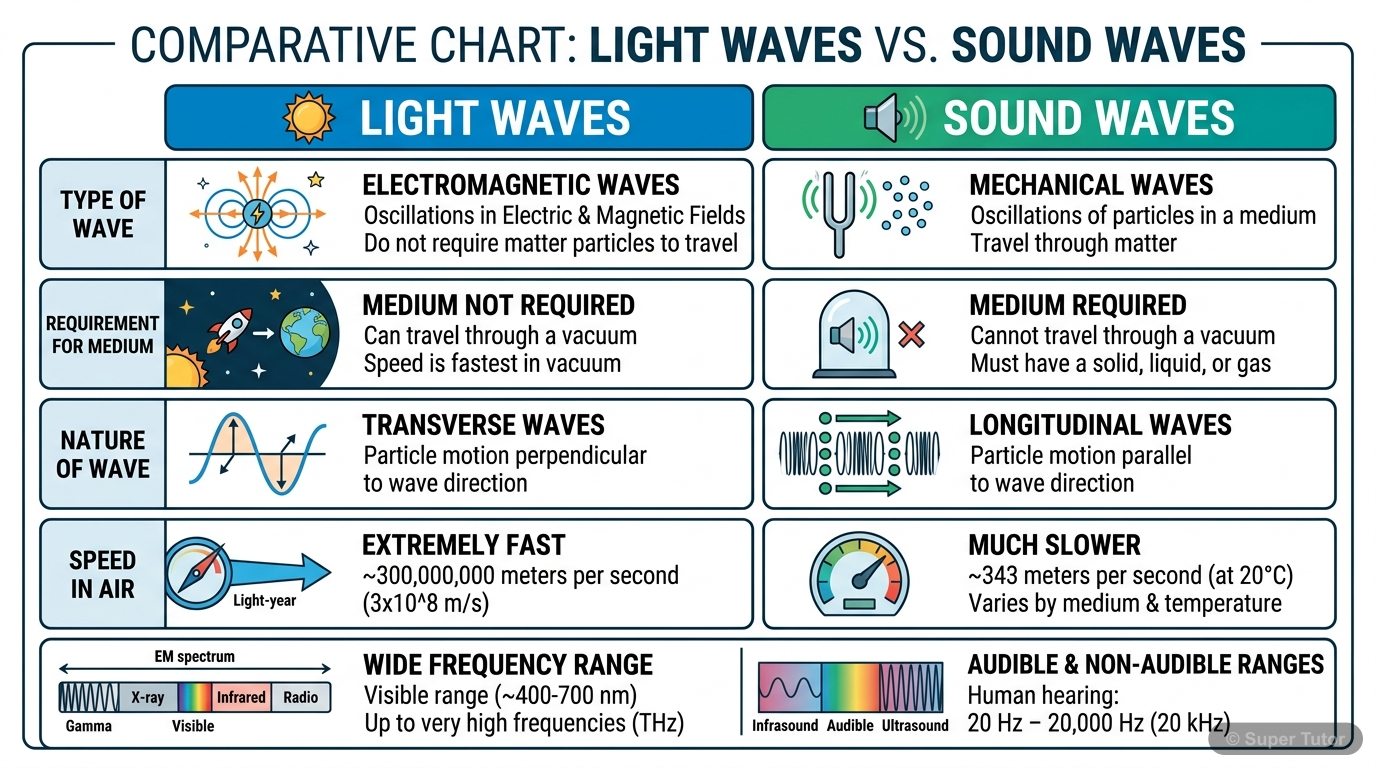
Learn better with visuals Super Tutor pairs illustrations like this with notes and quizzes for Sound.
Get startedKey Topics to Revise
1. Sound Waves and Basic Ideas
- Sound is produced by vibrating bodies.
- Sound needs a medium for propagation.
- Sound waves are mechanical and longitudinal in nature.
2. Speed of Sound in Air and in Gases
- Speed of sound in air is 330 m s⁻¹.
- Speed of light in air is 3 × 10⁸ m s⁻¹.
- Speed of sound in air depends on temperature and density.
3. Reflection of Sound, Echo and Reverberation
- Reflection of sound occurs when sound waves strike a rigid surface and return to the same medium.
- Sound obeys the laws of reflection.
- A smooth surface is not necessary for reflection of sound.
4. Uses of Echo: SONAR, RADAR, Ultrasonography and Sound Ranging
- Bats, dolphins and dogs have a higher upper audible limit than humans and use echo-based sound ranging.
- Fishermen use ultrasonic waves in water to detect fish distance.
- SONAR means Sound Navigation And Ranging.
Get complete notes with diagrams and examples
Full NotesKey Concepts
Frequently Asked Questions
What are the important topics in Sound for ICSE Class 10 Physics?
How should I revise Sound for the ICSE Class 10 board exam?
Sources & Official References
Content is aligned to the official syllabus. Refer to the board website for the latest curriculum.
More resources for Sound
Practice Quiz
Test yourself with a quick quiz
Important Questions
Exam-style questions with answers
Formula Sheet
The chapter's formulas in one place
Chapter Summary
Understand the chapter at a glance
Concept Maps
See how topics connect
Study Plan
Step-by-step plan for this chapter
Flashcards
Quick-fire cards for active recall
Syllabus
What topics to cover
For serious students
Get the full Sound chapter — start free.
Quizzes, flashcards, an AI doubt solver and a study plan for ICSE Class 10 Physics. Free to start, no card needed.