Sound — Practice Quiz
ICSE · Class 10 · Physics
Try a 4-question quiz on Sound for ICSE Class 10 Physics: tap an answer to check it and see why. 42 questions in the full chapter test.
Interactive on Super Tutor
Studying Sound? Get the full interactive chapter.
Quizzes, flashcards, AI doubt-solver and a step-by-step study plan — built for practice quiz and more.
Free trial, no card needed.
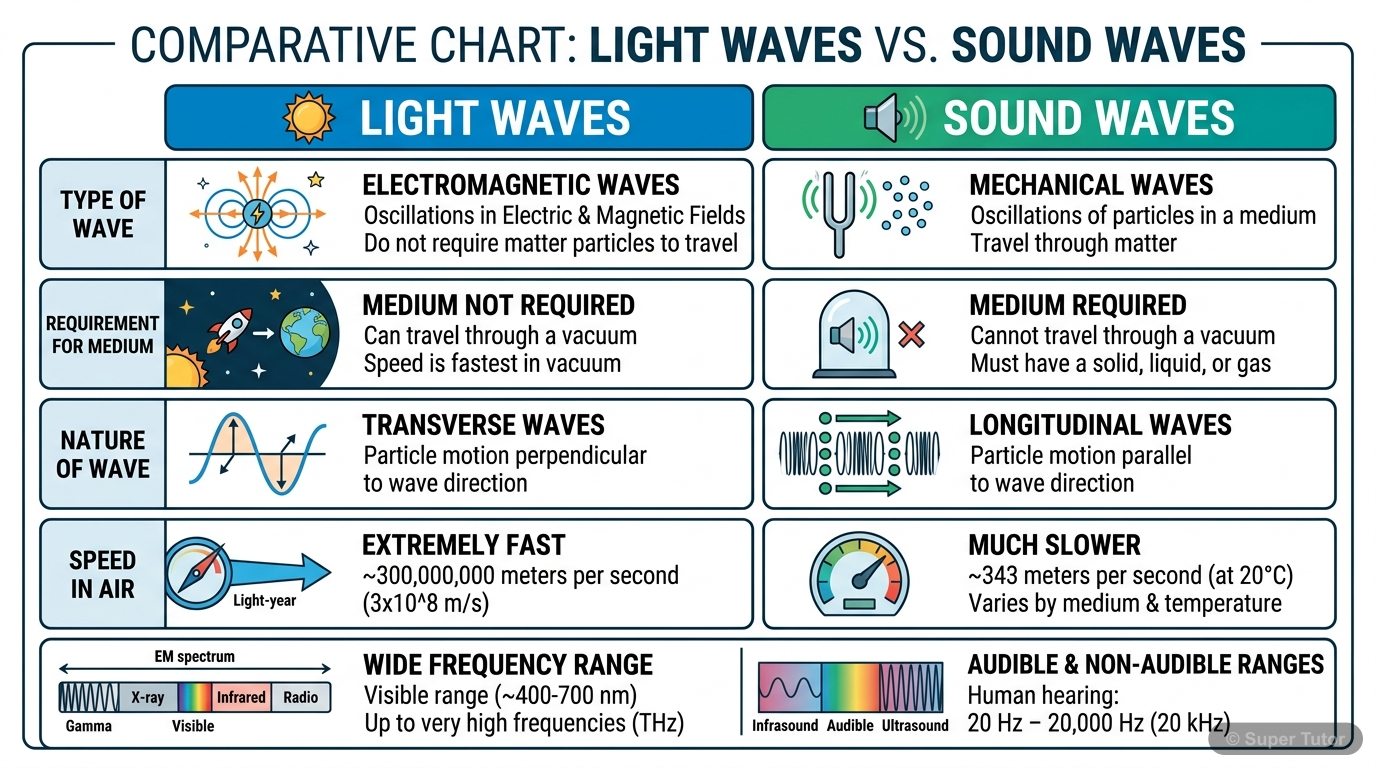
Learn better with visuals Super Tutor pairs illustrations like this with notes and quizzes for Sound.
Get startedQuick Quiz: Sound
0/4Tap an answer to check it instantly. No sign-up needed for these 4.
What is the minimum distance required between the observer and the obstacle to hear an echo distinctly?
The frequency range of human audibility is:
What happens to the amplitude in damped vibrations?
The unit of loudness is:
Sample Questions
Which of the following are characteristics of musical sound? (Select all correct answers)
Show answer
Loudness, Pitch, Quality
A musical sound is distinguished from other sounds by three characteristics: Loudness (depends on amplitude), Pitch or shrillness (depends on frequency), and Quality or Timbre (depends on waveform, allowing us to tell apart two sounds of the same loudness and pitch from different sources). Color and Texture are not physical properties used to describe sound in acoustics, so they are not correct choices.
Which of the following are examples of free vibrations? (Select all correct answers)
Show answer
Vibrations of a simple pendulum (neglecting air resistance), Vibrations of a tuning fork struck against rubber pad, Vibrations of a loaded spiral spring
Free vibrations occur without external force. Examples include simple pendulum (neglecting resistance), struck tuning fork, and loaded spring. Table vibrations and diaphragm vibrations are forced vibrations.
SONAR works on the principle of:
Show answer
Reflection of sound
SONAR (Sound Navigation and Ranging) works on the principle of reflection of sound waves. Ultrasonic waves are sent and their echoes are received to determine distance and location of objects.
Resonance occurs when:
Show answer
Applied frequency equals natural frequency
Resonance occurs when the frequency of the externally applied periodic force matches exactly with the natural frequency of vibration of the body, resulting in maximum amplitude.
+38 more questions on Sound (ICSE Class 10 Physics)
Practise AllFrequently Asked Questions
What are the important topics in Sound for ICSE Class 10 Physics?
How many practice questions are there for Sound?
Sources & Official References
Content is aligned to the official syllabus. Refer to the board website for the latest curriculum.
More resources for Sound
Important Questions
Exam-style questions with answers
Revision Notes
Key points for last-minute revision
Formula Sheet
The chapter's formulas in one place
Chapter Summary
Understand the chapter at a glance
Concept Maps
See how topics connect
Study Plan
Step-by-step plan for this chapter
Flashcards
Quick-fire cards for active recall
Syllabus
What topics to cover
For serious students
Get the full Sound chapter — start free.
Quizzes, flashcards, an AI doubt solver and a study plan for ICSE Class 10 Physics. Free to start, no card needed.