Locomotion and Movement — Important Questions
ICSE · Class 11 · Biology
59 important questions from Locomotion and Movement for ICSE Class 11 Biology, with answers. Includes multiple choice questions.
Interactive on Super Tutor
Studying Locomotion and Movement? Get the full interactive chapter.
Quizzes, flashcards, AI doubt-solver and a step-by-step study plan — built for important questions and more.
Free trial, no card needed.
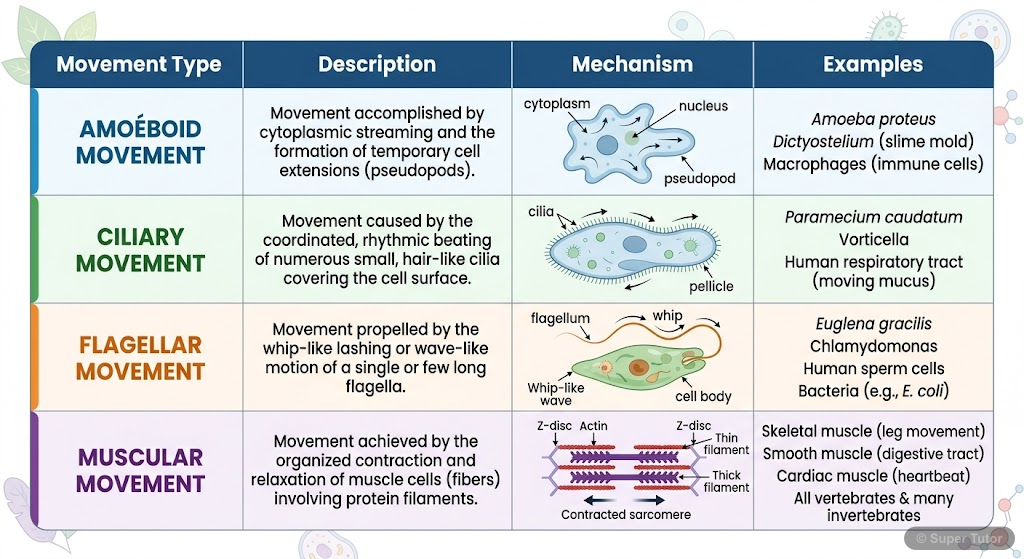
Learn better with visuals Super Tutor pairs illustrations like this with notes and quizzes for Locomotion and Movement.
Important Questions from Locomotion and Movement
What type of joint is found at the shoulder?
Show answer
d
The shoulder joint is a ball-and-socket (multiaxial) joint allowing movement in all directions. The hip joint is also a ball-and-socket joint. Therefore, the correct answer is option (4) Ball-and-socket joint.
What is the role of calcium ions (Ca²⁺) in muscle contraction?
Show answer
b
Ca²⁺ released from sarcoplasmic reticulum binds to troponin C, causing the troponin-tropomyosin complex to shift and expose the myosin-binding sites on actin filaments. Therefore, the correct answer is option (2) Bind to troponin to expose actin binding sites.
Which of the following is a hinge joint?
Show answer
d
The elbow joint is a hinge joint that allows only flexion and extension (uniaxial movement). The knee is also a hinge joint. Therefore, the correct answer is option (4) Elbow joint.
What is rigor mortis?
Show answer
Sustained muscle contraction after death due to absence of ATP
Rigor mortis is stiffening of muscles after death. Without ATP, myosin heads cannot detach from actin → muscles become rigid. Begins 3–6 hours after death. Therefore, the correct answer is option (2) Sustained muscle contraction after death due to absence of ATP.
+55 more questions on Locomotion and Movement (ICSE Class 11 Biology)
Practise AllFrequently Asked Questions
What are the important topics in Locomotion and Movement for ICSE Class 11 Biology?
How many important questions are there in Locomotion and Movement?
Sources & Official References
Content is aligned to the official syllabus. Refer to the board website for the latest curriculum.
More resources for Locomotion and Movement
For serious students
Get the full Locomotion and Movement chapter — start free.
Quizzes, flashcards, an AI doubt solver and a study plan for ICSE Class 11 Biology. Free to start, no card needed.