Locomotion and Movement — Flashcards
ICSE · Class 11 · Biology
49 flashcards for Locomotion and Movement (ICSE Class 11 Biology) to test yourself on key terms and facts. Sample: "What is locomotion?"
Interactive on Super Tutor
Studying Locomotion and Movement? Get the full interactive chapter.
Quizzes, flashcards, AI doubt-solver and a step-by-step study plan — built for flashcards and more.
Free trial, no card needed.
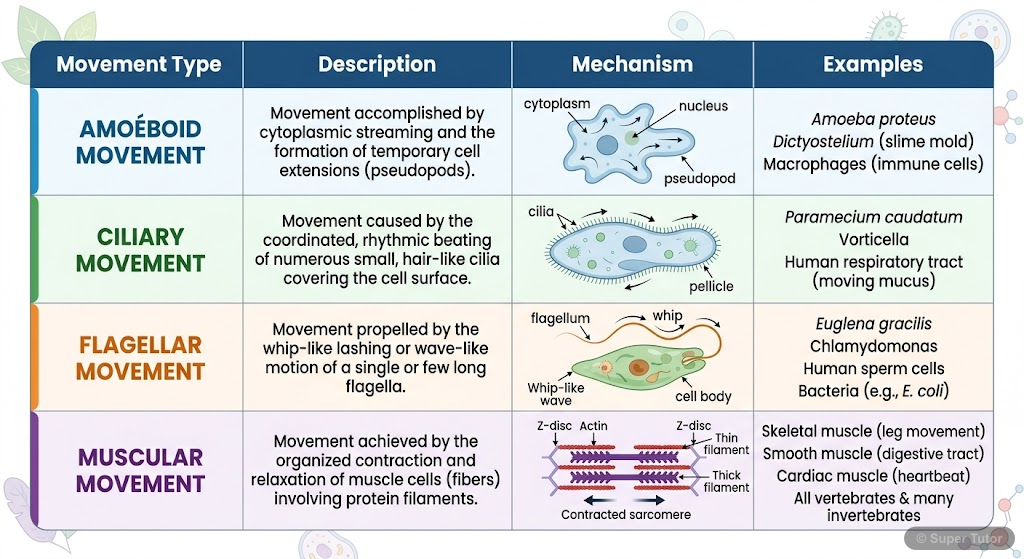
Learn better with visuals Super Tutor pairs illustrations like this with notes and quizzes for Locomotion and Movement.
What is locomotion?
Answer
Movement of the whole organism from place to place is known as locomotion. Examples include walking, running, climbing, flying, and swimming.
Why is locomotion important in animals?
Answer
Locomotion helps animals obtain food, escape predators, find mates, find shelter, reach favourable habitats, reduce competition, and avoid waste products or disease. It also helps in dispersal and rep…
What are the main types of movement in animals?
Answer
The main types of movement are amoeboid, flagellar, ciliary, and muscular movement. The first three are mainly seen in protists, while muscular movement is common in higher organisms.
How does amoeboid movement occur in Amoeba?
Answer
Amoeba changes shape by forming temporary cytoplasmic projections called pseudopodia. These pseudopodia help in both locomotion and feeding.
What is flagellar movement?
Answer
Flagella are locomotory organelles of flagellated protists. They are thread-like projections on the cell surface, and movement by flagella is called flagellar movement. It is best seen in Euglena.
What is ciliary movement?
Answer
Cilia are small, highly vibratile ectoplasmic processes similar to flagella in basic structure. Their movement is synchronous and coordinated, and the movement caused by cilia is called ciliary moveme…
How do locomotion and posture depend on body systems in higher vertebrates?
Answer
In higher vertebrates, movement and locomotion depend on coordinated activity of the muscular, skeletal, and nervous systems. Muscles act as machines that convert chemical energy into mechanical energ…
What are the major functions of the skeleton?
Answer
The skeleton gives support and shape to the body, protects internal organs, helps in movement by acting as levers, stores minerals such as calcium and phosphorus, stores fat in yellow marrow, and form…
+41 more flashcards
Practise AllFrequently Asked Questions
What are the important topics in Locomotion and Movement for ICSE Class 11 Biology?
How many flashcards are available for Locomotion and Movement?
How should I revise Locomotion and Movement for Class 11 exams?
Sources & Official References
Content is aligned to the official syllabus. Refer to the board website for the latest curriculum.
More resources for Locomotion and Movement
Practice Quiz
Test yourself with a quick quiz
Important Questions
Exam-style questions with answers
Revision Notes
Key points for last-minute revision
Chapter Summary
Understand the chapter at a glance
Concept Maps
See how topics connect
Study Plan
Step-by-step plan for this chapter
Syllabus
What topics to cover
For serious students
Get the full Locomotion and Movement chapter — start free.
Quizzes, flashcards, an AI doubt solver and a study plan for ICSE Class 11 Biology. Free to start, no card needed.