Locomotion and Movement — Syllabus
ICSE · Class 11 · Biology
What Locomotion and Movement covers in ICSE Class 11 Biology: 4 topics, for the 2026-27 session. Part of the ICSE Class 11 Biology syllabus.
Interactive on Super Tutor
Studying Locomotion and Movement? Get the full interactive chapter.
Quizzes, flashcards, AI doubt-solver and a step-by-step study plan — built for syllabus and more.
Free trial, no card needed.
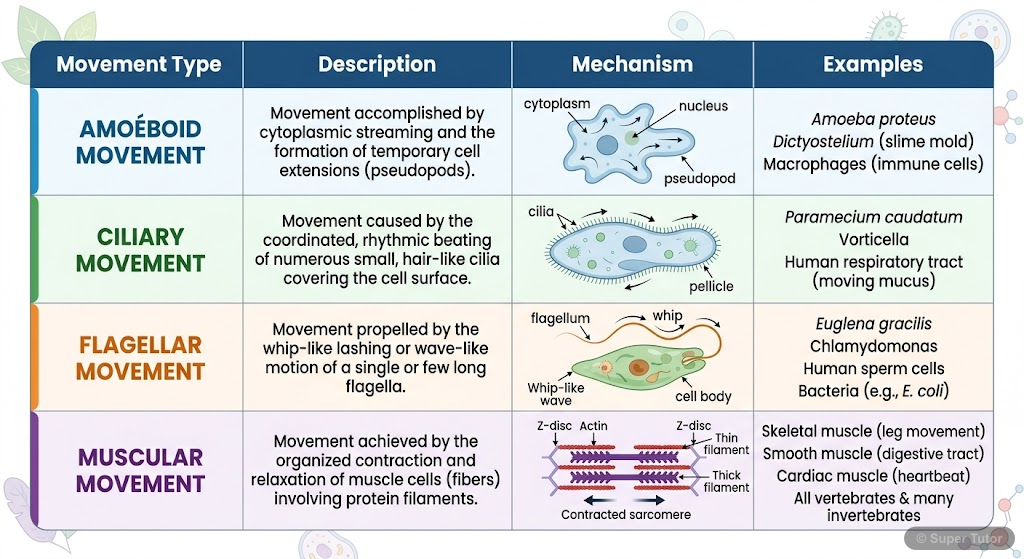
Learn better with visuals Super Tutor pairs illustrations like this with notes and quizzes for Locomotion and Movement.
Topics in Locomotion and Movement
1. Types of Movement
- Movement is mainly of four types: amoeboid, flagellar, ciliary, and muscular.
- Amoeboid movement is seen in Amoeba. Temporary cytoplasmic projections called pseudopodia help in locomotion and feeding.
- Flagellar movement is best seen in Euglena. Flagella are thread-like projections on the cell surface and act as locomotory organelles.
2. Human Skeleton and Its Functions
- There are 206 major bones in the human body.
- The axial skeleton has 80 bones and includes the skull, vertebral column, and rib cage.
- The appendicular skeleton includes the bones of the limbs and the girdles that attach them to the axial skeleton.
3. Skull, Vertebral Column, and Rib Cage
- The human skull has 28 bones.
- Eight skull bones are fused to form the cranium, which covers the brain.
- The face consists of 14 bones.
4. Limbs and Girdles
- Each limb is composed of 30 bones.
- The upper limb includes humerus, ulna, radius, carpals, metacarpals, and phalanges.
- The humerus is the long bone of the upper arm. Its upper end fits into the glenoid cavity of the pectoral girdle.
Key Concepts
Central concept: Locomotion and Movement
Work through every topic in Locomotion and Movement with notes and quizzes
Start This ChapterFrequently Asked Questions
What are the important topics in Locomotion and Movement for ICSE Class 11 Biology?
How should I revise Locomotion and Movement for Class 11 exams?
Sources & Official References
Content is aligned to the official syllabus. Refer to the board website for the latest curriculum.
More resources for Locomotion and Movement
Practice Quiz
Test yourself with a quick quiz
Important Questions
Exam-style questions with answers
Revision Notes
Key points for last-minute revision
Chapter Summary
Understand the chapter at a glance
Concept Maps
See how topics connect
Study Plan
Step-by-step plan for this chapter
Flashcards
Quick-fire cards for active recall
For serious students
Get the full Locomotion and Movement chapter — start free.
Quizzes, flashcards, an AI doubt solver and a study plan for ICSE Class 11 Biology. Free to start, no card needed.