Locomotion and Movement — Chapter Summary
ICSE · Class 11 · Biology
Summary of Locomotion and Movement for ICSE Class 11 Biology. Part of the ICSE Class 11 Biology syllabus. Locomotion and movement are basic.
Interactive on Super Tutor
Studying Locomotion and Movement? Get the full interactive chapter.
Quizzes, flashcards, AI doubt-solver and a step-by-step study plan — built for chapter summary and more.
Free trial, no card needed.
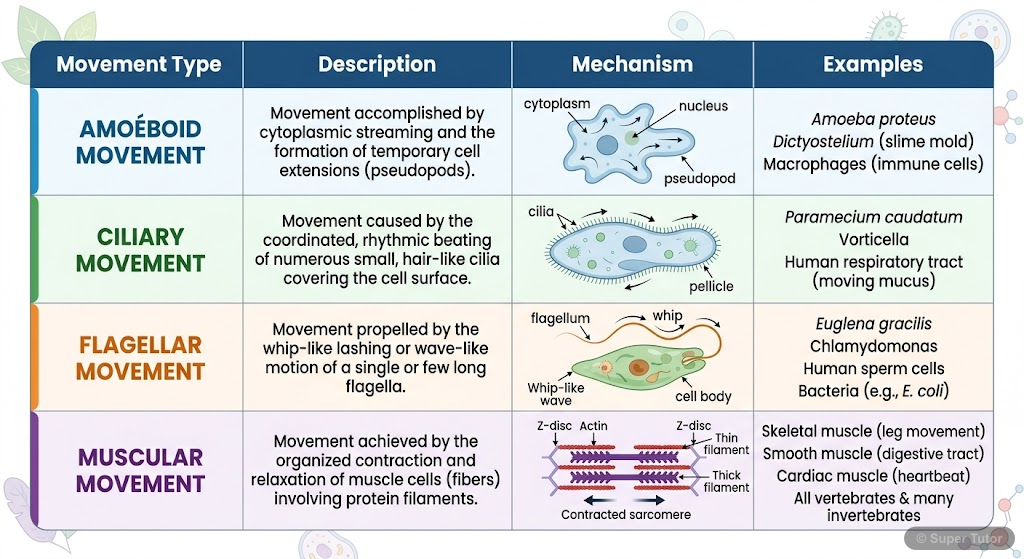
Learn better with visuals Super Tutor pairs illustrations like this with notes and quizzes for Locomotion and Movement.
Overview
Locomotion and movement are basic characteristics of living organisms. Movement may occur at the cellular level, as in amoeboid, ciliary, and flagellar movement, or at the level of the whole body, as in locomotion. In higher vertebrates, locomotion depends on the coordinated action of the skeletal,
Key Concepts
Movement of the whole organism from
Movement of the whole organism from place to place is known as locomotion. It helps in obtaining food, escaping predators, finding mates, and locating
The main types are amoeboid
The main types are amoeboid, flagellar, ciliary, and muscular movement. Amoeboid movement uses pseudopodia, flagellar movement uses flagella, ciliary
Amoeba changes its shape by forming
Amoeba changes its shape by forming temporary cytoplasmic projections called pseudopodia. These projections help in locomotion and feeding.
Flagella are thread
Flagella are thread-like locomotory organelles of flagellated protists. This movement is best seen in Euglena.
Cilia are small vibratile ectoplasmic processes
Cilia are small vibratile ectoplasmic processes. Their movement is synchronous and coordinated. It helps in the movement of substances inside the body
Learning Objectives
- Understand the meaning of locomotion and the main types of movement
- Distinguish between amoeboid, flagellar, ciliary, and muscular movement
- Describe the organisation of the human skeleton and its major parts
- Identify the types of bones, joints, and limb girdles
- Explain the structure and function of skeletal muscles
Frequently Asked Questions
What are the important topics in Locomotion and Movement for ICSE Class 11 Biology?
How should I revise Locomotion and Movement for Class 11 exams?
Sources & Official References
Content is aligned to the official syllabus. Refer to the board website for the latest curriculum.
More resources for Locomotion and Movement
For serious students
Get the full Locomotion and Movement chapter — start free.
Quizzes, flashcards, an AI doubt solver and a study plan for ICSE Class 11 Biology. Free to start, no card needed.