Neural Control and Coordination — Study Plan
ICSE · Class 11 · Biology
A step-by-step study plan for Neural Control and Coordination, ICSE Class 11 Biology: what to learn first, what to practise and when to revise.
Interactive on Super Tutor
Studying Neural Control and Coordination? Get the full interactive chapter.
Quizzes, flashcards, AI doubt-solver and a step-by-step study plan — built for study plan and more.
Free trial, no card needed.
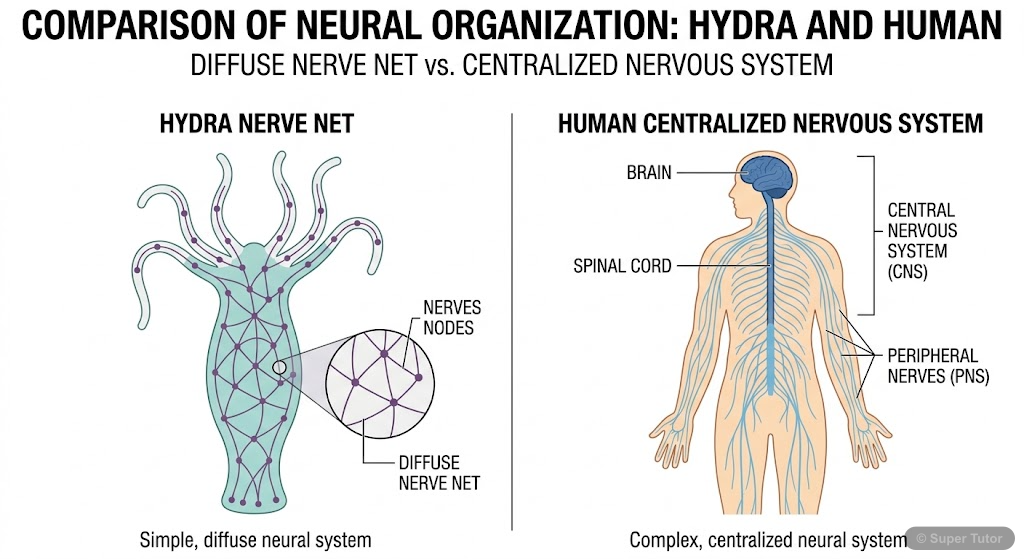
Learn better with visuals Super Tutor pairs illustrations like this with notes and quizzes for Neural Control and Coordination.
Study Plan
Learn the Theory
Read the textbook chapter carefully. Note down definitions, formulas and key ideas. Focus on: 1. Overview of the Neural System, 2. Brain: Structure and Major Parts, 3. Spinal Cord and Spinal Nerves.
Practise
Solve the textbook exercises and extra practice questions. There are 64 questions available for this chapter.
Revise & Test
Revise key points without looking at your notes. Take a practice quiz and mark weak areas for another pass.
Spaced Revision
Come back to Neural Control and Coordination after a week. Use flashcards for quick recall and try past exam questions on this chapter.
What to Focus On
- Coordination means interaction between organs so that functions are complementary.
- The nervous system is the fastest communication system in the body.
- Neurons detect, receive, and transmit stimuli.
- CNS consists of brain and spinal cord.
- Three meninges protect the CNS: piamater, arachnoidmater, and duramater.
- CSF lies between piamater and arachnoidmater.
- Brain has three regions: forebrain, midbrain, hindbrain.
- Forebrain = cerebrum + thalamus + hypothalamus.
- Cerebrum has two hemispheres joined by corpus callosum.
Common Mistakes to Avoid
The forebrain has only two parts: cerebrum and hypothalamus.
The auditory area is in the temporal lobe because hearing is usually linked with the temporal region.
Cerebral control and cerebellar control both act on the same side of the body.
Memory Tips
Forebrain parts
Cerebrum functions and lobes
Contralateral cerebral control
Thalamus and hypothalamus relation
Want a personalised study plan?
Super Tutor builds a day-by-day plan for ICSE Class 11 Biology that fits your exam date and pace.
Create My Study PlanFrequently Asked Questions
What are the important topics in Neural Control and Coordination for ICSE Class 11 Biology?
How should I revise Neural Control and Coordination for Class 11 exams?
Sources & Official References
Content is aligned to the official syllabus. Refer to the board website for the latest curriculum.
More resources for Neural Control and Coordination
Practice Quiz
Test yourself with a quick quiz
Important Questions
Exam-style questions with answers
Revision Notes
Key points for last-minute revision
Formula Sheet
The chapter's formulas in one place
Chapter Summary
Understand the chapter at a glance
Concept Maps
See how topics connect
Flashcards
Quick-fire cards for active recall
Syllabus
What topics to cover
For serious students
Get the full Neural Control and Coordination chapter — start free.
Quizzes, flashcards, an AI doubt solver and a study plan for ICSE Class 11 Biology. Free to start, no card needed.