Animal Kingdom — Study Plan
ICSE · Class 11 · Biology
A step-by-step study plan for Animal Kingdom, ICSE Class 11 Biology: what to learn first, what to practise and when to revise.
Interactive on Super Tutor
Studying Animal Kingdom? Get the full interactive chapter.
Quizzes, flashcards, AI doubt-solver and a step-by-step study plan — built for study plan and more.
Free trial, no card needed.
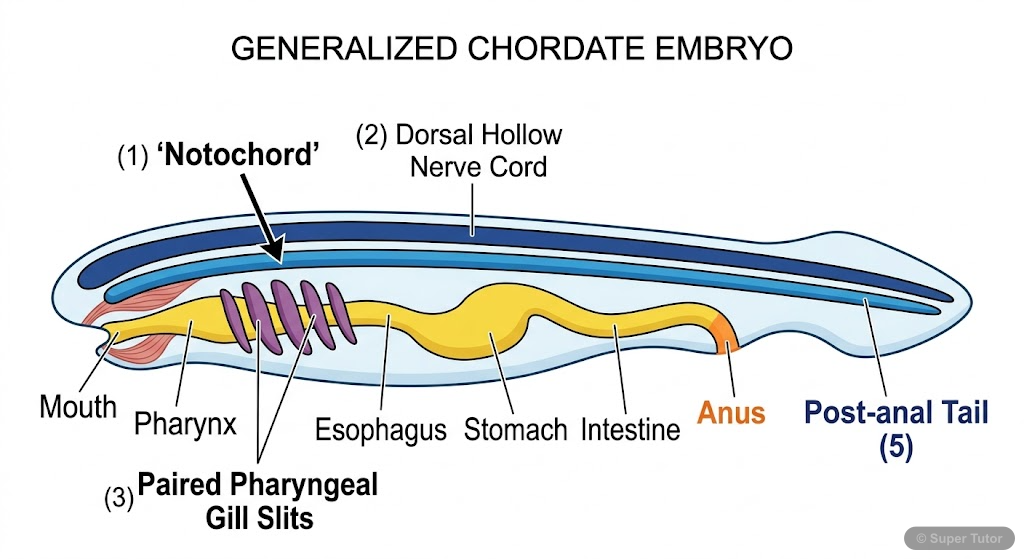
Learn better with visuals Super Tutor pairs illustrations like this with notes and quizzes for Animal Kingdom.
Study Plan
Learn the Theory
Read the textbook chapter carefully. Note down definitions, formulas and key ideas. Focus on: Animal Construction and Basic Body Plans, Coelom, Development, and Segmentation, Phylum Porifera, Coelenterata, and Ctenophora.
Practise
Solve the textbook exercises and extra practice questions. There are 103 questions available for this chapter.
Revise & Test
Revise key points without looking at your notes. Take a practice quiz and mark weak areas for another pass.
Spaced Revision
Come back to Animal Kingdom after a week. Use flashcards for quick recall and try past exam questions on this chapter.
What to Focus On
- Animal classification depends on body plan, symmetry, coelom, development, and segmentation.
- Sponges show cellular level organisation.
- Coelenterates show tissue level organisation.
- Asymmetry means no plane divides the body into equal halves.
- Spherical symmetry allows division by any plane through the centre.
- Radial symmetry has oral and aboral ends, but no left-right sides.
- Coelom is a fluid-filled body cavity between gut and body wall.
- It acts as a hydrostatic skeleton and shock absorber.
- A true coelom is lined by mesodermal peritoneum.
Common Mistakes to Avoid
All animals with a backbone are chordates, but all chordates are also vertebrates.
Hemichordata is a subphylum of Chordata because it once looked like it had a notochord.
A pseudocoelom is a true coelom because it is a body cavity.
Memory Tips
Animal kingdom basics: multicellular, eukaryotic, heterotrophic, cell walls absent, over a million species
Levels of organisation: cellular, tissue, organ, organ system
Cell aggregate plan
Blind-sac plan
Want a personalised study plan?
Super Tutor builds a day-by-day plan for ICSE Class 11 Biology that fits your exam date and pace.
Create My Study PlanFrequently Asked Questions
What are the important topics in Animal Kingdom for ICSE Class 11 Biology?
How should I revise Animal Kingdom for Class 11 exams?
Sources & Official References
Content is aligned to the official syllabus. Refer to the board website for the latest curriculum.
More resources for Animal Kingdom
Practice Quiz
Test yourself with a quick quiz
Important Questions
Exam-style questions with answers
Revision Notes
Key points for last-minute revision
Chapter Summary
Understand the chapter at a glance
Concept Maps
See how topics connect
Flashcards
Quick-fire cards for active recall
Syllabus
What topics to cover
For serious students
Get the full Animal Kingdom chapter — start free.
Quizzes, flashcards, an AI doubt solver and a study plan for ICSE Class 11 Biology. Free to start, no card needed.