Excretory Products and Their Elimination — Study Plan
ICSE · Class 11 · Biology
A step-by-step study plan for Excretory Products and Their Elimination, ICSE Class 11 Biology: what to learn first, what to practise and when to revise.
Interactive on Super Tutor
Studying Excretory Products and Their Elimination? Get the full interactive chapter.
Quizzes, flashcards, AI doubt-solver and a step-by-step study plan — built for study plan and more.
Free trial, no card needed.
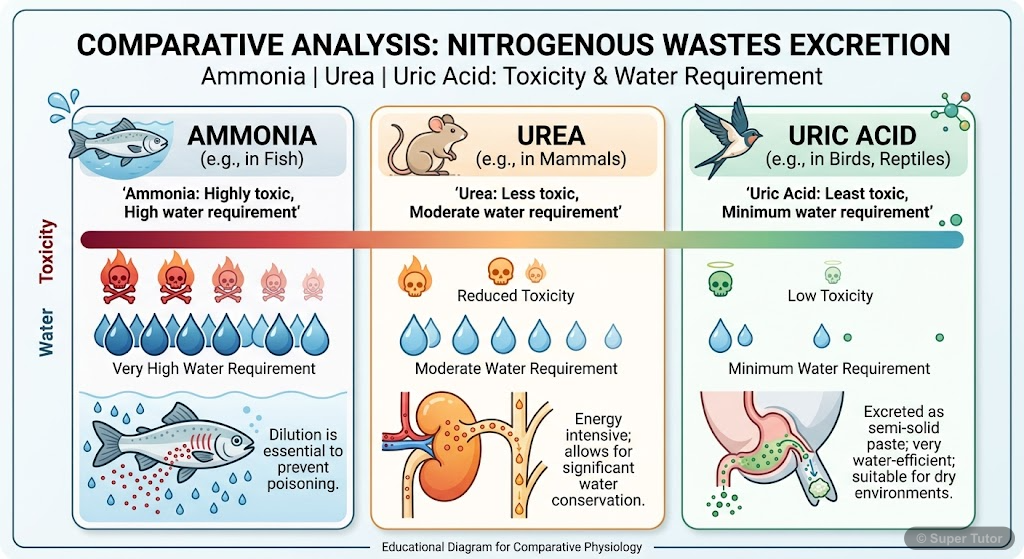
One of 14 illustrations for Excretory Products and Their Elimination in Super Tutor — alongside flashcards, concept maps and practice questions.
Study Plan
Learn the Theory
Read the textbook chapter carefully. Note down definitions, formulas and key ideas. Focus on: 1. Nitrogenous Waste and Modes of Excretion, 2. Human Excretory System: Kidney, Ureter, Bladder, Urethra, 3. Nephron and Renal Corpuscle.
Practise
Solve the textbook exercises and extra practice questions. There are 56 questions available for this chapter.
Revise & Test
Revise key points without looking at your notes. Take a practice quiz and mark weak areas for another pass.
Spaced Revision
Come back to Excretory Products and Their Elimination after a week. Use flashcards for quick recall and try past exam questions on this chapter.
What to Focus On
- Excretion removes metabolic wastes from the body.
- Carbon dioxide is removed through respiration.
- Ammonia, urea, and uric acid are the main nitrogenous wastes.
- Nitrogen excretion can change with habitat and physiological state.
- Some amphibians and fish switch from ammonia excretion to urea excretion under certain conditions.
- Tadpoles change from ammonotelism to ureotelism during metamorphosis.
- Kidneys are paired retroperitoneal organs.
- Each kidney is about 150 g in mass.
- The cortex is the outer region and the medulla is the inner region.
Common Mistakes to Avoid
The nephron and the renal corpuscle are the same structure.
The ascending limb of the loop of Henle reabsorbs water, while the descending limb does not.
ADH is secreted by the posterior pituitary and formed there too.
Memory Tips
Types of nitrogen excretion
Ammonia, urea, and uric acid toxicity order
Urea formation by ornithine cycle
Ammonotelism
Want a personalised study plan?
Super Tutor builds a day-by-day plan for ICSE Class 11 Biology that fits your exam date and pace.
Create My Study PlanFrequently Asked Questions
What are the important topics in Excretory Products and Their Elimination for ICSE Class 11 Biology?
How should I revise Excretory Products and Their Elimination for Class 11 exams?
Sources & Official References
Content is aligned to the official syllabus. Refer to the board website for the latest curriculum.
More resources for Excretory Products and Their Elimination
Practice Quiz
Test yourself with a quick quiz
Important Questions
Exam-style questions with answers
Revision Notes
Key points for last-minute revision
Chapter Summary
Understand the chapter at a glance
Concept Maps
See how topics connect
Flashcards
Quick-fire cards for active recall
Syllabus
What topics to cover
For serious students
Get the full Excretory Products and Their Elimination chapter — start free.
Quizzes, flashcards, an AI doubt solver and a study plan for ICSE Class 11 Biology. Free to start, no card needed.