Structural Organisation in Animals (Frog) — Study Plan
ICSE · Class 11 · Biology
A step-by-step study plan for Structural Organisation in Animals (Frog), ICSE Class 11 Biology: what to learn first, what to practise and when to revise.
Interactive on Super Tutor
Studying Structural Organisation in Animals (Frog)? Get the full interactive chapter.
Quizzes, flashcards, AI doubt-solver and a step-by-step study plan — built for study plan and more.
Free trial, no card needed.
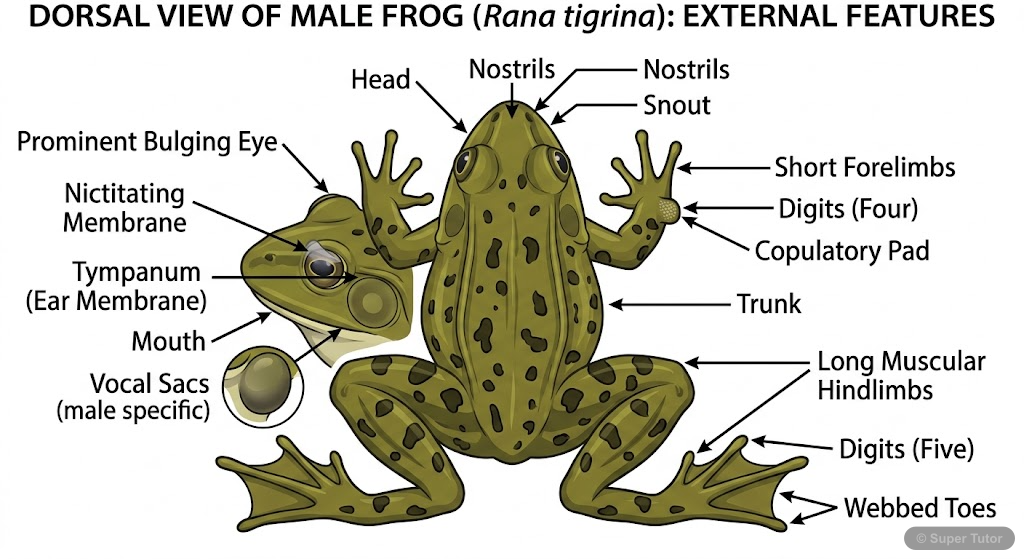
Learn better with visuals Super Tutor pairs illustrations like this with notes and quizzes for Structural Organisation in Animals (Frog).
Study Plan
Learn the Theory
Read the textbook chapter carefully. Note down definitions, formulas and key ideas. Focus on: 1. Classification, Habitat and External Features, 2. Feeding, Mouth and Alimentary Canal, 3. Digestive Glands and Digestion.
Practise
Solve the textbook exercises and extra practice questions. There are 90 questions available for this chapter.
Revise & Test
Revise key points without looking at your notes. Take a practice quiz and mark weak areas for another pass.
Spaced Revision
Come back to Structural Organisation in Animals (Frog) after a week. Use flashcards for quick recall and try past exam questions on this chapter.
What to Focus On
- Rana tigrina is the Indian bull frog.
- Frog is a vertebrate amphibian and a poikilotherm.
- Adult frogs are tailless, while larvae have tails.
- Skin is thin, smooth, moist, and slippery due to mucus.
- Dorsal colour is olive green with dark spots; ventral side is pale yellow.
- Adult frog has head and trunk only; no neck or tail.
- Skin is an important accessory organ of respiration.
- Mucus keeps the skin moist and slippery.
- Water is absorbed through the skin, not by drinking.
Common Mistakes to Avoid
Frog heart has four chambers like the human heart.
Amplexus is actual copulation in frogs.
Vocal sacs and copulatory pads are found in both male and female frogs.
Memory Tips
Taxonomic classification of Rana tigrina
Three main parts of the frog brain
Parts of the forebrain
Respiratory modes in adult frog
Want a personalised study plan?
Super Tutor builds a day-by-day plan for ICSE Class 11 Biology that fits your exam date and pace.
Create My Study PlanFrequently Asked Questions
What are the important topics in Structural Organisation in Animals (Frog) for ICSE Class 11 Biology?
How should I revise Structural Organisation in Animals (Frog) for Class 11 exams?
Sources & Official References
Content is aligned to the official syllabus. Refer to the board website for the latest curriculum.
More resources for Structural Organisation in Animals (Frog)
Practice Quiz
Test yourself with a quick quiz
Important Questions
Exam-style questions with answers
Revision Notes
Key points for last-minute revision
Chapter Summary
Understand the chapter at a glance
Concept Maps
See how topics connect
Flashcards
Quick-fire cards for active recall
Syllabus
What topics to cover
For serious students
Get the full Structural Organisation in Animals (Frog) chapter — start free.
Quizzes, flashcards, an AI doubt solver and a study plan for ICSE Class 11 Biology. Free to start, no card needed.