Redox Reactions — Important Questions
ICSE · Class 11 · Chemistry
96 important questions from Redox Reactions for ICSE Class 11 Chemistry, with answers. Includes multiple choice, multiple correct and true false questions.
Interactive on Super Tutor
Studying Redox Reactions? Get the full interactive chapter.
Quizzes, flashcards, AI doubt-solver and a step-by-step study plan — built for important questions and more.
Free trial, no card needed.
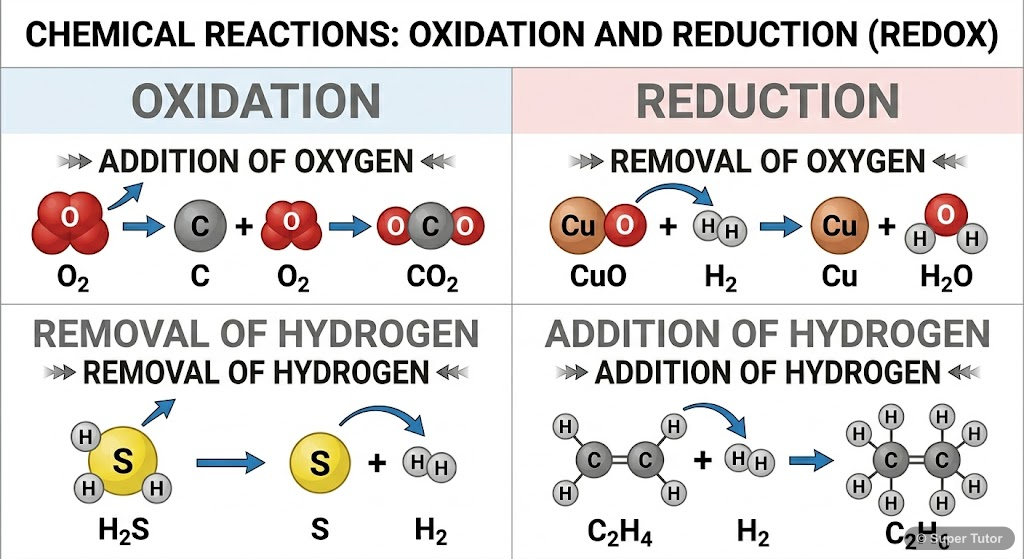
One of 6 illustrations for Redox Reactions in Super Tutor — alongside flashcards, concept maps and practice questions.
Important Questions from Redox Reactions
Which of the following reactions is an example of a disproportionation reaction?
Show answer
2H₂O₂ → 2H₂O + O₂
A disproportionation reaction is one where the SAME element in the SAME substance is simultaneously oxidised and reduced. In 2H₂O₂ → 2H₂O + O₂: Oxygen in H₂O₂ has O.N. = −1. In H₂O, O has O.N. = −2 (reduction). In O₂, O has O.N. = 0 (oxidation). So oxygen goes from −1 to both −2 and 0 simultaneously – this is disproportionation. Option A is a displacement reaction. Option C is a combination reaction. Option D is also a combination reaction. None of these involve one element being both oxidised and reduced simultaneously.
What is the oxidation number of sulphur in H₂SO₄?
Show answer
+6
Let the oxidation number of S = x. In H₂SO₄: H has O.N. = +1 (two H atoms: +2 total). O has O.N. = −2 (four O atoms: −8 total). Since H₂SO₄ is a neutral molecule: (+2) + x + (−8) = 0 → x − 6 = 0 → x = +6. So sulphur in H₂SO₄ has oxidation number +6. Option A (+4) is the O.N. of S in SO₂ and H₂SO₃ – a common student confusion. Option B (+2) is incorrect and does not satisfy the equation. Option D (−2) is the O.N. of S in H₂S (sulphide) where S is fully reduced.
In the reaction 2Mg(s) + O₂(g) → 2MgO(s), what happens to magnesium?
Show answer
Mg is oxidised and acts as a reducing agent
In 2Mg + O₂ → 2MgO: Mg starts with oxidation number 0 (free element). In MgO, Mg exists as Mg²⁺ with oxidation number +2. Since the oxidation number INCREASES from 0 to +2, Mg undergoes OXIDATION. The substance that gets oxidised LOSES electrons and is called the REDUCING AGENT. So Mg is oxidised and acts as a reducing agent. Option A is completely opposite. Option C incorrectly combines reduction with reducing agent. Option D is wrong because Mg clearly changes from O.N. 0 to +2.
According to the classical definition, which of the following is an example of oxidation?
Show answer
S + O₂ → SO₂ (sulphur adds oxygen)
According to the classical definition, oxidation is the process in which a substance adds oxygen or loses hydrogen. In S + O₂ → SO₂, sulphur is adding oxygen to form SO₂. This is oxidation by the classical definition. Option A (CuO + C → Cu + CO): Here C is removing oxygen from CuO. C undergoes oxidation (it adds O to form CO), while Cu is REDUCED (loses oxygen). Option B: Cl₂ adding hydrogen is reduction of Cl₂. Option D: Iron oxide losing oxygen is reduction. The classical and modern concepts both agree that S + O₂ → SO₂ is oxidation of sulphur.
+92 more questions on Redox Reactions (ICSE Class 11 Chemistry)
Practise AllFrequently Asked Questions
What are the important topics in Redox Reactions for ICSE Class 11 Chemistry?
How many important questions are there in Redox Reactions?
Sources & Official References
Content is aligned to the official syllabus. Refer to the board website for the latest curriculum.
More resources for Redox Reactions
Practice Quiz
Test yourself with a quick quiz
Revision Notes
Key points for last-minute revision
Formula Sheet
The chapter's formulas in one place
Chapter Summary
Understand the chapter at a glance
Concept Maps
See how topics connect
Study Plan
Step-by-step plan for this chapter
Flashcards
Quick-fire cards for active recall
Syllabus
What topics to cover
For serious students
Get the full Redox Reactions chapter — start free.
Quizzes, flashcards, an AI doubt solver and a study plan for ICSE Class 11 Chemistry. Free to start, no card needed.