Chemical Bonding and Molecular Structure — Important Questions
ICSE · Class 11 · Chemistry
109 important questions from Chemical Bonding and Molecular Structure for ICSE Class 11 Chemistry, with answers. Includes multiple choice questions.
Interactive on Super Tutor
Studying Chemical Bonding and Molecular Structure? Get the full interactive chapter.
Quizzes, flashcards, AI doubt-solver and a step-by-step study plan — built for important questions and more.
Free trial, no card needed.
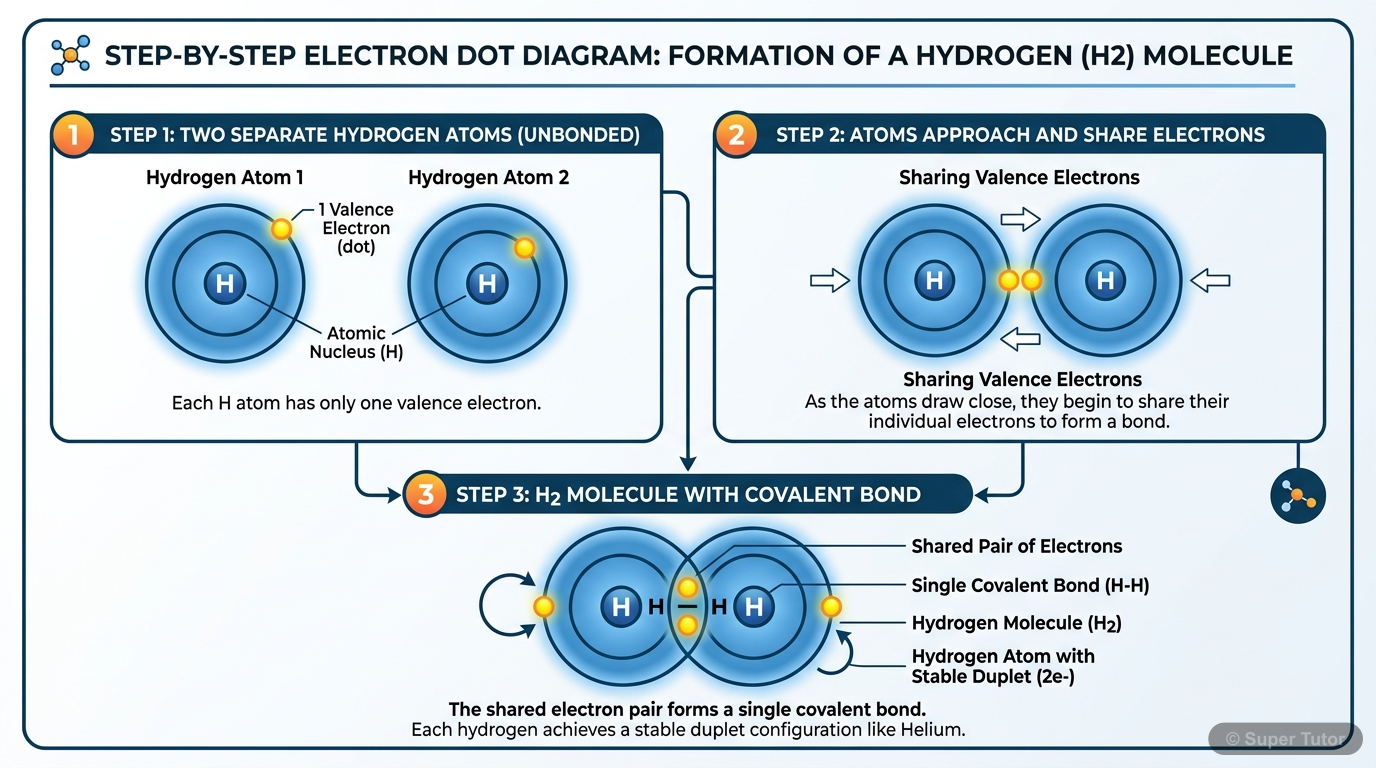
Learn better with visuals Super Tutor pairs illustrations like this with notes and quizzes for Chemical Bonding and Molecular Structure.
Important Questions from Chemical Bonding and Molecular Structure
Which of the following statements about hydrogen bonding is CORRECT?
Show answer
Ice is less dense than liquid water due to hydrogen bonding
Step 1: In ice, each H₂O molecule forms 4 hydrogen bonds in a tetrahedral arrangement, creating an open cage-like lattice structure with vacant spaces. Step 2: This open structure means for a given mass, ice occupies MORE volume than liquid water → lower density. Hence ice floats on water. Step 3: Option A is wrong — HCl does NOT show H-bonding because Cl is large in size (despite being electronegative). Small size is required for effective H-bonding. Step 4: Option B is wrong — H-bond energy is only 3.5–40 kJ/mol while covalent bonds are ~400 kJ/mol. H-bonds are much weaker. Step 5: Option D
The dipole moment of BF₃ is zero. This indicates that BF₃ has:
Show answer
Trigonal planar geometry
Step 1: B–F bonds are polar (F is more electronegative than B), so each bond has a dipole moment. Step 2: The net dipole moment of the molecule is the vector sum of all individual bond dipoles. Step 3: In trigonal planar geometry, the three B–F bonds are at 120° to each other. The resultant of any two bond dipoles exactly cancels the third one. Step 4: This vector cancellation gives a net dipole moment of ZERO, even though individual bonds are polar. Step 5: Pyramidal geometry (like NH₃) would NOT give zero dipole because the lone pair adds an additional dipole component and the vectors don't
Which of the following correctly explains why O₂ is paramagnetic?
Show answer
O₂ has two unpaired electrons in degenerate antibonding π* orbitals
Step 1: O₂ has 16 electrons. The MO configuration is: KK(σ₂s)²(σ*₂s)²(σ₂pz)²(π₂px)²(π₂py)²(π*₂px)¹(π*₂py)¹ Step 2: The last two electrons go into the degenerate (equal energy) π*₂px and π*₂py antibonding orbitals. Step 3: By Hund's rule, they occupy these two orbitals SINGLY (one in each) rather than pairing up. Step 4: These two unpaired electrons make O₂ paramagnetic (attracted to magnetic fields). Step 5: This is a triumph of MOT — valence bond theory incorrectly predicted O₂ would be diamagnetic. Option A is about Lewis structure (doesn't explain paramagnetism). Option C is wrong — O₂ has
According to Fajan's rules, which of the following chlorides has the MOST covalent character?
Show answer
AlCl₃
Step 1: Fajan's rules state that covalent character increases with higher cation charge, smaller cation size, and larger anion size. Step 2: Compare the cations — Na⁺ (charge +1), K⁺ (charge +1), Mg²⁺ (charge +2), Al³⁺ (charge +3). Step 3: The ionic potential φ = charge/size. Al³⁺ has the highest charge (+3) and a small size among these. Step 4: High ionic potential means Al³⁺ strongly attracts the electron cloud of Cl⁻, distorting it (polarising the anion). Step 5: This polarisation leads to electron sharing (covalent character). The order of covalent character is: AlCl₃ > MgCl₂ > NaCl ≈ KCl.
+105 more questions on Chemical Bonding and Molecular Structure (ICSE Class 11 Chemistry)
Practise AllFrequently Asked Questions
What are the important topics in Chemical Bonding and Molecular Structure for ICSE Class 11 Chemistry?
How many important questions are there in Chemical Bonding and Molecular Structure?
Sources & Official References
Content is aligned to the official syllabus. Refer to the board website for the latest curriculum.
More resources for Chemical Bonding and Molecular Structure
Practice Quiz
Test yourself with a quick quiz
Revision Notes
Key points for last-minute revision
Formula Sheet
The chapter's formulas in one place
Chapter Summary
Understand the chapter at a glance
Concept Maps
See how topics connect
Study Plan
Step-by-step plan for this chapter
Flashcards
Quick-fire cards for active recall
Syllabus
What topics to cover
For serious students
Get the full Chemical Bonding and Molecular Structure chapter — start free.
Quizzes, flashcards, an AI doubt solver and a study plan for ICSE Class 11 Chemistry. Free to start, no card needed.