Redox Reactions — Concept Maps
ICSE · Class 11 · Chemistry
4 concept maps of Redox Reactions for ICSE Class 11 Chemistry, each also written out as a text outline. Part of the ICSE Class 11 Chemistry syllabus.
Interactive on Super Tutor
Studying Redox Reactions? Get the full interactive chapter.
Quizzes, flashcards, AI doubt-solver and a step-by-step study plan — built for concept maps and more.
Free trial, no card needed.
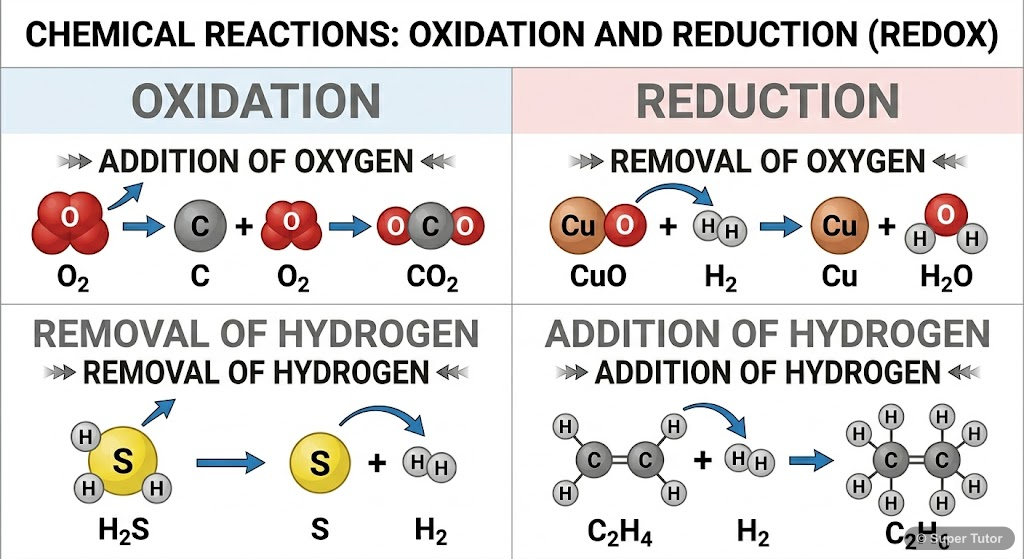
One of 6 illustrations for Redox Reactions in Super Tutor — alongside flashcards, concept maps and practice questions.
Redox Reactions – Complete Chapter Overview
The map in words
- Redox Reactions
- Definitions
- Classical View
- Oxidation adds O2 removes H2
- Reduction adds H2 removes O2
- Electronic Concept
- Oxidation loses electrons OIL
- Reduction gains electrons RIG
- Oxidising Agent gains electrons gets reduced
- Reducing Agent loses electrons gets oxidised
- Classical View
- Oxidation Number
- Free element ON is zero
- Monoatomic ion ON equals charge
- Fluorine always minus 1
- Alkali metals always plus 1
- Alkaline earth metals always plus 2
- Hydrogen plus 1 except hydrides minus 1
- Oxygen minus 2 except peroxides minus 1
- Sum in neutral molecule equals zero
- Sum in ion equals ionic charge
- Fractional ON is average value
- Types of Redox
- Combination A plus B to C
- Decomposition elemental product formed
- Displacement metal and nonmetal
- Disproportionation same element oxidised and reduced
- Balancing Methods
- Oxidation Number Method
- Increase in ON equals decrease in ON
- For molecular equations
- Ion Electron Method
- Split into half reactions
- Balance atoms then charge
- For ionic equations
- Oxidation Number Method
- Stoichiometry
- Equivalent Mass
- Oxidising agent formula mass by electrons gained
- Reducing agent formula mass by electrons lost
- Normality Relation N1V1 equals N2V2
- Molarity Relation M1V1 by n1 equals M2V2 by n2
- Equivalent Mass
- Definitions
Redox Reactions — Complete Concept Map
The map in words
- Redox Reactions
- Oxidation
- Classical View
- Gain of oxygen
- Loss of hydrogen
- Modern View
- Loss of electrons
- Increase in O N
- Reducing Agent
- Loses electrons
- Gets oxidised
- Classical View
- Reduction
- Classical View
- Loss of oxygen
- Gain of hydrogen
- Modern View
- Gain of electrons
- Decrease in O N
- Oxidising Agent
- Gains electrons
- Gets reduced
- Classical View
- Oxidation Number Rules
- Free element is zero
- F always minus one
- H plus one except hydrides
- O minus two except peroxides
- Alkali metals plus one
- Sum equals zero in molecule
- Sum equals charge in ion
- Types of Redox
- Combination A plus B gives C
- Decomposition C gives A plus B
- Displacement X plus YZ gives XZ plus Y
- Metal displacement
- Halogen displacement
- Disproportionation
- Same element oxidised and reduced
- Balancing Methods
- Oxidation Number Method
- Equalise electron change
- Molecular equations
- Ion Electron Method
- Two half reactions
- Acidic medium
- Basic medium
- Oxidation Number Method
- Stoichiometry
- Equivalent mass
- Normality N1V1 equals N2V2
- Mole concept
- Oxidation
Redox Reactions - Concept Overview
The map in words
- Redox Reactions
- Definitions
- Oxidation
- Loss of electrons
- Increase in O.N.
- Reduction
- Gain of electrons
- Decrease in O.N.
- Redox Reaction
- Simultaneous Ox-Red
- Electron Transfer
- Oxidation
- Oxidation Number
- Rules for Assignment
- Elementary state = 0
- Monoatomic ion = charge
- Alkali metals = +1
- Alkaline earth = +2
- Fluorine = -1
- Hydrogen = +1
- Oxygen = -2
- Determination
- Neutral molecules
- Polyatomic ions
- Complex compounds
- Rules for Assignment
- Types of Reactions
- Combination
- A + B = C
- Decomposition
- AB = A + B
- Displacement
- Metal displacement
- Hydrogen displacement
- Halogen displacement
- Disproportionation
- Self oxidation-reduction
- Same element
- Combination
- Balancing Methods
- Oxidation Number Method
- Identify changes
- Balance electrons
- Ion-Electron Method
- Write half-reactions
- Balance separately
- Acidic medium
- Basic medium
- Oxidation Number Method
- Applications
- Daily Life
- Combustion
- Batteries
- Corrosion
- Industry
- Metal extraction
- Electroplating
- Chemical synthesis
- Daily Life
- Definitions
Redox Reactions
The map in words
- Redox Reactions
- Oxidation and Reduction
- Oxidising Agent and Reducing Agent
- Oxidation Number
- Redox Reaction
- Types of Redox Reactions
- Competitive Electron Transfer
- Balancing Redox Equations
- Stoichiometry of Redox Reactions
Explore these maps interactively
Explore DiagramsFrequently Asked Questions
What are the important topics in Redox Reactions for ICSE Class 11 Chemistry?
What do the concept maps for Redox Reactions show?
How should I revise Redox Reactions for Class 11 exams?
Sources & Official References
Content is aligned to the official syllabus. Refer to the board website for the latest curriculum.
More resources for Redox Reactions
Practice Quiz
Test yourself with a quick quiz
Important Questions
Exam-style questions with answers
Revision Notes
Key points for last-minute revision
Formula Sheet
The chapter's formulas in one place
Chapter Summary
Understand the chapter at a glance
Study Plan
Step-by-step plan for this chapter
Flashcards
Quick-fire cards for active recall
Syllabus
What topics to cover
For serious students
Get the full Redox Reactions chapter — start free.
Quizzes, flashcards, an AI doubt solver and a study plan for ICSE Class 11 Chemistry. Free to start, no card needed.