Some Basic Concepts of Chemistry — Important Questions
ICSE · Class 11 · Chemistry
89 important questions from Some Basic Concepts of Chemistry for ICSE Class 11 Chemistry, with answers. Part of the ICSE Class 11 Chemistry syllabus.
Interactive on Super Tutor
Studying Some Basic Concepts of Chemistry? Get the full interactive chapter.
Quizzes, flashcards, AI doubt-solver and a step-by-step study plan — built for important questions and more.
Free trial, no card needed.
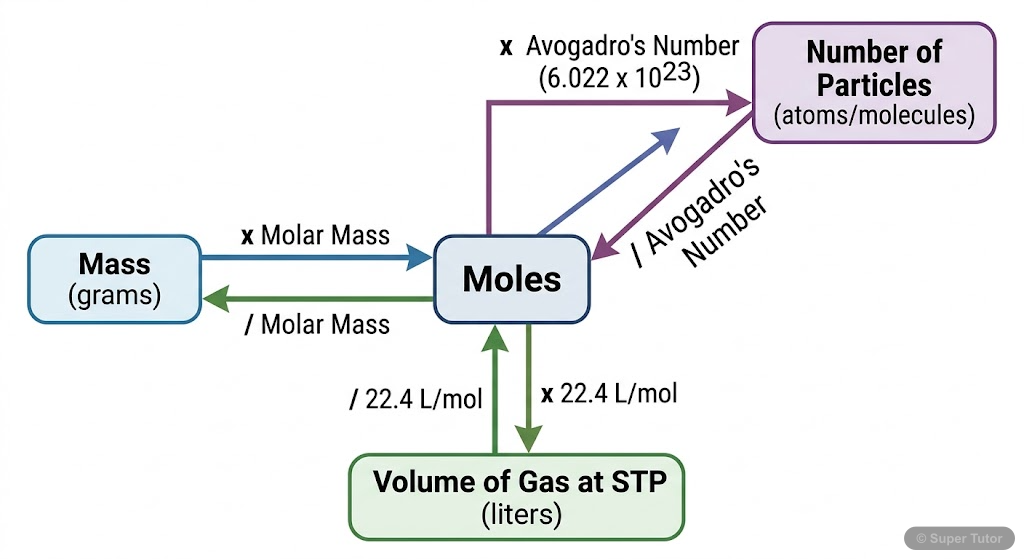
Learn better with visuals Super Tutor pairs illustrations like this with notes and quizzes for Some Basic Concepts of Chemistry.
Important Questions from Some Basic Concepts of Chemistry
According to Avogadro's hypothesis, under identical conditions of temperature and pressure, equal volumes of all gases contain:
Show answer
Equal number of molecules
Step 1: Avogadro's Hypothesis (1811) states that under identical conditions of temperature and pressure, equal volumes of all gases contain equal number of molecules. Step 2: The key word is 'molecules', not atoms — because different gases have different atomicities (e.g., He is monoatomic, O₂ is diatomic, O₃ is triatomic). Step 3: Equal atoms would be wrong because 1 L of He has 1 atom per molecule while 1 L of O₂ has 2 atoms per molecule — so atom count would differ. Step 4: Equal masses is wrong because different gases have different molar masses (e.g., H₂ = 2 g/mol, O₂ = 32 g/mol). Step 5:
The empirical formula of a compound is CH₂O and its molecular mass is 180 g/mol. What is its molecular formula?
Show answer
C₆H₁₂O₆
Step 1: First calculate the empirical formula mass. CH₂O → 12 + 2(1) + 16 = 30 g/mol. Step 2: Find n = Molecular mass / Empirical formula mass = 180 / 30 = 6. Step 3: Molecular formula = n × empirical formula = 6 × CH₂O = C₆H₁₂O₆. Step 4: C₆H₁₂O₆ is glucose — a very important biological molecule! This confirms the formula. Step 5: C₃H₆O₃ would give n = 3 (molecular mass = 90), and C₂H₄O₂ gives n = 2 (molecular mass = 60). Neither matches 180. The correct answer is C₆H₁₂O₆.
Which law states that 'matter can neither be created nor destroyed in a chemical reaction'?
Show answer
Law of Conservation of Mass
Step 1: The Law of Conservation of Mass was given by Antoine Lavoisier (1774). It states that in any physical or chemical change, matter is neither created nor destroyed — it just changes form. Step 2: This is why we balance chemical equations — the total mass of reactants must equal the total mass of products. Step 3: Example: CaCO₃ (100 g) → CaO (56 g) + CO₂ (44 g). Total products = 56 + 44 = 100 g = mass of reactant. Step 4: Law of Constant Proportion (Proust) deals with fixed ratios in a compound. Law of Multiple Proportions (Dalton) deals with two elements forming multiple compounds. Step
How many molecules are present in 0.5 moles of water (H₂O)? (Avogadro's number = 6.022 × 10²³)
Show answer
3.011 × 10²³
Step 1: The mole concept states that 1 mole of any substance contains 6.022 × 10²³ molecules (Avogadro's number). Step 2: Number of molecules = Number of moles × Avogadro's number. Step 3: Number of molecules = 0.5 × 6.022 × 10²³ = 3.011 × 10²³. Step 4: 6.022 × 10²³ would be the answer for 1 mole, not 0.5 mole — a common error. Step 5: 1.204 × 10²⁴ = 2 × 6.022 × 10²³, which would be 2 moles. Always multiply moles by Avogadro's number to get number of molecules.
+85 more questions on Some Basic Concepts of Chemistry (ICSE Class 11 Chemistry)
Practise AllFrequently Asked Questions
What are the important topics in Some Basic Concepts of Chemistry for ICSE Class 11 Chemistry?
How many important questions are there in Some Basic Concepts of Chemistry?
Sources & Official References
Content is aligned to the official syllabus. Refer to the board website for the latest curriculum.
More resources for Some Basic Concepts of Chemistry
Practice Quiz
Test yourself with a quick quiz
Revision Notes
Key points for last-minute revision
Formula Sheet
The chapter's formulas in one place
Chapter Summary
Understand the chapter at a glance
Concept Maps
See how topics connect
Study Plan
Step-by-step plan for this chapter
Flashcards
Quick-fire cards for active recall
Syllabus
What topics to cover
For serious students
Get the full Some Basic Concepts of Chemistry chapter — start free.
Quizzes, flashcards, an AI doubt solver and a study plan for ICSE Class 11 Chemistry. Free to start, no card needed.