Redox Reactions — Chapter Summary
ICSE · Class 11 · Chemistry
Summary of Redox Reactions for ICSE Class 11 Chemistry. Part of the ICSE Class 11 Chemistry syllabus. Redox reactions are chemical reactions in which.
Interactive on Super Tutor
Studying Redox Reactions? Get the full interactive chapter.
Quizzes, flashcards, AI doubt-solver and a step-by-step study plan — built for chapter summary and more.
Free trial, no card needed.
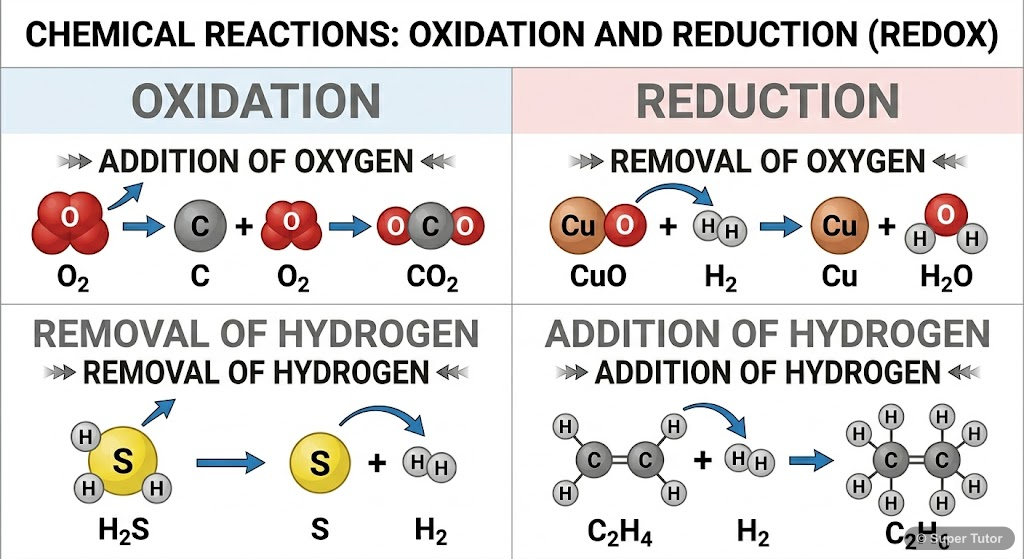
One of 6 illustrations for Redox Reactions in Super Tutor — alongside flashcards, concept maps and practice questions.
Overview
Redox reactions are chemical reactions in which oxidation and reduction happen together. Oxidation means loss of electrons or increase in oxidation number, while reduction means gain of electrons or decrease in oxidation number. These reactions are important in burning, rusting, metal extraction, ba
Key Concepts
Oxidation is the process in
Oxidation is the process in which a substance adds oxygen or removes hydrogen in the classical view. In the electronic view, it is loss of electrons.
Reduction is the process in
Reduction is the process in which a substance adds hydrogen or removes oxygen in the classical view. In the electronic view, it is gain of electrons.
An oxidising agent provides oxygen
An oxidising agent provides oxygen or removes hydrogen in the classical view. In the electronic view, it gains electrons and gets reduced. In the oxid
A reducing agent provides hydrogen
A reducing agent provides hydrogen or removes oxygen in the classical view. In the electronic view, it loses electrons and gets oxidised. In the oxida
A redox reaction is a reaction
A redox reaction is a reaction in which electrons are transferred from one reactant to another. It is also a reaction in which species undergo a chang
Learning Objectives
- Understand oxidation and reduction in classical, electronic, and oxidation number terms.
- Identify oxidising agents and reducing agents correctly.
- Use oxidation number rules to calculate oxidation states in molecules, ions, and compounds.
- Recognise different types of redox reactions such as combination, decomposition, displacement, and disproportionation.
- Balance redox equations by oxidation number method and ion electron method.
Frequently Asked Questions
What are the important topics in Redox Reactions for ICSE Class 11 Chemistry?
How should I revise Redox Reactions for Class 11 exams?
Sources & Official References
Content is aligned to the official syllabus. Refer to the board website for the latest curriculum.
More resources for Redox Reactions
Practice Quiz
Test yourself with a quick quiz
Important Questions
Exam-style questions with answers
Revision Notes
Key points for last-minute revision
Formula Sheet
The chapter's formulas in one place
Concept Maps
See how topics connect
Study Plan
Step-by-step plan for this chapter
Flashcards
Quick-fire cards for active recall
Syllabus
What topics to cover
For serious students
Get the full Redox Reactions chapter — start free.
Quizzes, flashcards, an AI doubt solver and a study plan for ICSE Class 11 Chemistry. Free to start, no card needed.