Exogenous Processes and Associated Landforms — Important Questions
ICSE · Class 11 · Geography
42 important questions from Exogenous Processes and Associated Landforms for ICSE Class 11 Geography, with answers. Includes multiple choice questions.
Interactive on Super Tutor
Studying Exogenous Processes and Associated Landforms? Get the full interactive chapter.
Quizzes, flashcards, AI doubt-solver and a step-by-step study plan — built for important questions and more.
Free trial, no card needed.
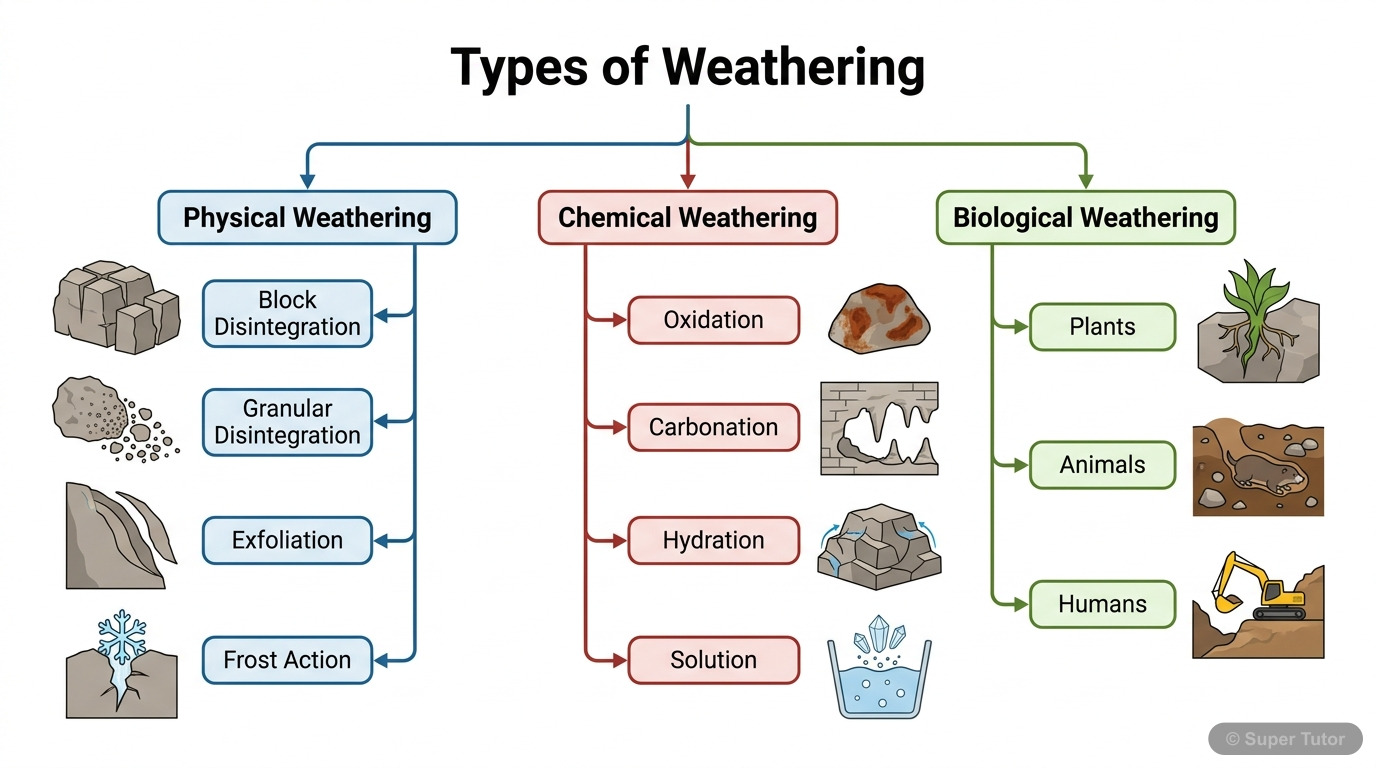
One of 3 illustrations for Exogenous Processes and Associated Landforms in Super Tutor — alongside flashcards, concept maps and practice questions.
Important Questions from Exogenous Processes and Associated Landforms
Weathering is a _______ process, while erosion is a _______ process.
Show answer
Static; Mobile
Step 1: Weathering is defined as the breaking of rocks by static agents of weather. Step 2: The key word is 'static' — in weathering, the rock material does not move (no transportation occurs). Step 3: The disintegrated material only falls down due to gravity but is not carried away. Step 4: Erosion, on the other hand, is a mobile process — it involves the picking up and transportation of weathered rock material from one place to another. Step 5: This is an important distinction: weathering breaks rocks IN PLACE, while erosion moves the broken material.
In which type of region is weathering by insolation (temperature changes) most common?
Show answer
Hot and dry desert areas
Step 1: Insolation weathering is caused by rapid changes in temperature — rocks expand when heated and contract when cooled. Step 2: For this to be effective, there must be extreme temperature changes between day and night. Step 3: Hot and dry desert areas experience very high temperatures during the day and very cold temperatures at night. Step 4: This rapid alternation of expansion and contraction creates cracks in rocks, leading to block disintegration or granular disintegration. Step 5: Tropical rainforests have humid conditions more suited to chemical weathering. Polar regions are too con
What is the process called when the outer layers of a rock peel off like the layers of an onion due to unequal expansion and contraction?
Show answer
Exfoliation
Step 1: Some rocks are poor conductors of heat. Step 2: As a result, when temperature changes, the outer layers expand or contract more than the inner layers. Step 3: This unequal expansion and contraction causes the outer layers to peel off from the rock in curved, concentric shells. Step 4: This process is called exfoliation, and it looks exactly like peeling layers off an onion. Step 5: Block disintegration is when rocks split into blocks, granular disintegration is when rocks break into small grains, and freeze-thaw is related to frost action — all are different types of physical weatherin
By approximately how much does the volume of water increase when it freezes?
Show answer
9%
Step 1: Frost action (freeze-thaw) is an important type of physical weathering in cold regions. Step 2: Water seeps into the cracks and joints of rocks during the day. Step 3: At night, when temperature drops below 0°C, this water freezes. Step 4: When water turns to ice, its volume increases by about 9% — on average, 9 cubic centimetres of water becomes 10 cubic centimetres of ice. Step 5: This expansion creates a bursting pressure of about 150 kg per square centimetre, which is enough to crack and rupture rocks. So 9% is the correct answer.
+38 more questions on Exogenous Processes and Associated Landforms (ICSE Class 11 Geography)
Practise AllFrequently Asked Questions
What are the important topics in Exogenous Processes and Associated Landforms for ICSE Class 11 Geography?
How many important questions are there in Exogenous Processes and Associated Landforms?
Sources & Official References
Content is aligned to the official syllabus. Refer to the board website for the latest curriculum.
More resources for Exogenous Processes and Associated Landforms
For serious students
Get the full Exogenous Processes and Associated Landforms chapter — start free.
Quizzes, flashcards, an AI doubt solver and a study plan for ICSE Class 11 Geography. Free to start, no card needed.