Exogenous Processes and Associated Landforms — Chapter Summary
ICSE · Class 11 · Geography
Summary of Exogenous Processes and Associated Landforms for ICSE Class 11 Geography. Part of the ICSE Class 11 Geography syllabus.
Interactive on Super Tutor
Studying Exogenous Processes and Associated Landforms? Get the full interactive chapter.
Quizzes, flashcards, AI doubt-solver and a step-by-step study plan — built for chapter summary and more.
Free trial, no card needed.
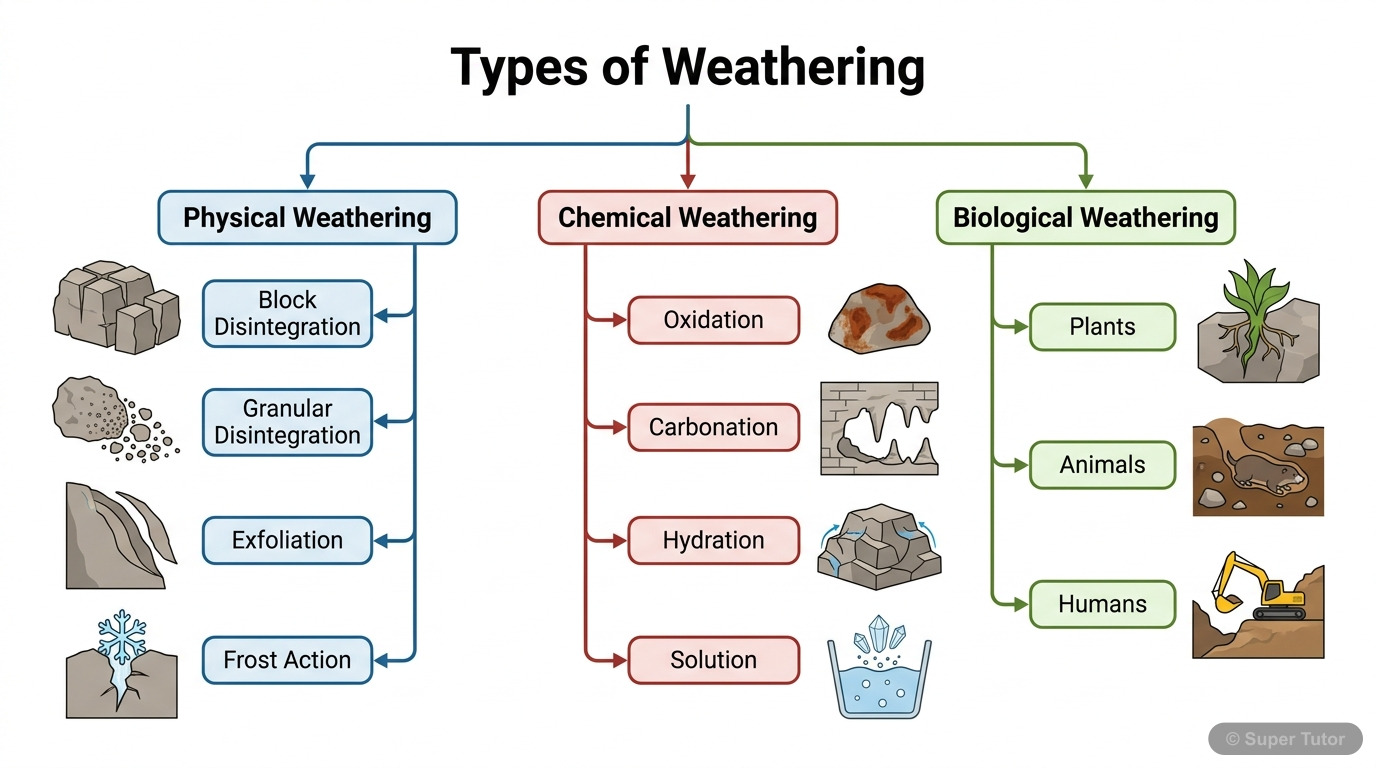
One of 3 illustrations for Exogenous Processes and Associated Landforms in Super Tutor — alongside flashcards, concept maps and practice questions.
Overview
Exogenous processes act on the surface of the Earth and shape landforms through weathering, erosion, transportation, and deposition. They obtain energy from the Sun and work continuously through agents such as rivers, glaciers, wind, underground water, and sea waves. These processes lower highlands,
Key Concepts
These are surface processes that act
These are surface processes that act on the Earth’s outer layer and create or modify landforms. They include weathering and denudation and are carried
Gradation is the process of removing
Gradation is the process of removing unevenness from the land surface and making it level. It works through the combined action of erosion and deposit
Degradation is the general wearing away
Degradation is the general wearing away of the land surface by external forces. It is also known as denudation and includes weathering, erosion, and t
Aggradation is deposition
Aggradation is deposition. Material eroded from one place is laid down in lowlands or depressions, raising their level.
Weathering is the breaking of rocks
Weathering is the breaking of rocks at the Earth’s surface by static agents. It involves disintegration and decomposition of rocks without movement, e
Learning Objectives
- Understand the meaning of exogenous processes and their energy source
- Explain gradation as the levelling of the land surface
- Distinguish between degradation, aggradation, weathering, erosion, and transportation
- Identify the three main types of weathering
- Recognize the agents and processes of physical, chemical, and biological weathering
Frequently Asked Questions
What are the important topics in Exogenous Processes and Associated Landforms for ICSE Class 11 Geography?
How should I revise Exogenous Processes and Associated Landforms for Class 11 exams?
Sources & Official References
Content is aligned to the official syllabus. Refer to the board website for the latest curriculum.
More resources for Exogenous Processes and Associated Landforms
For serious students
Get the full Exogenous Processes and Associated Landforms chapter — start free.
Quizzes, flashcards, an AI doubt solver and a study plan for ICSE Class 11 Geography. Free to start, no card needed.