Staff Motivation — Practice Quiz
ICSE · Class 12 · Business Studies
Try a 4-question quiz on Staff Motivation for ICSE Class 12 Business Studies: tap an answer to check it and see why. 43 questions in the full chapter test.
Interactive on Super Tutor
Studying Staff Motivation? Get the full interactive chapter.
Quizzes, flashcards, AI doubt-solver and a step-by-step study plan — built for practice quiz and more.
Free trial, no card needed.
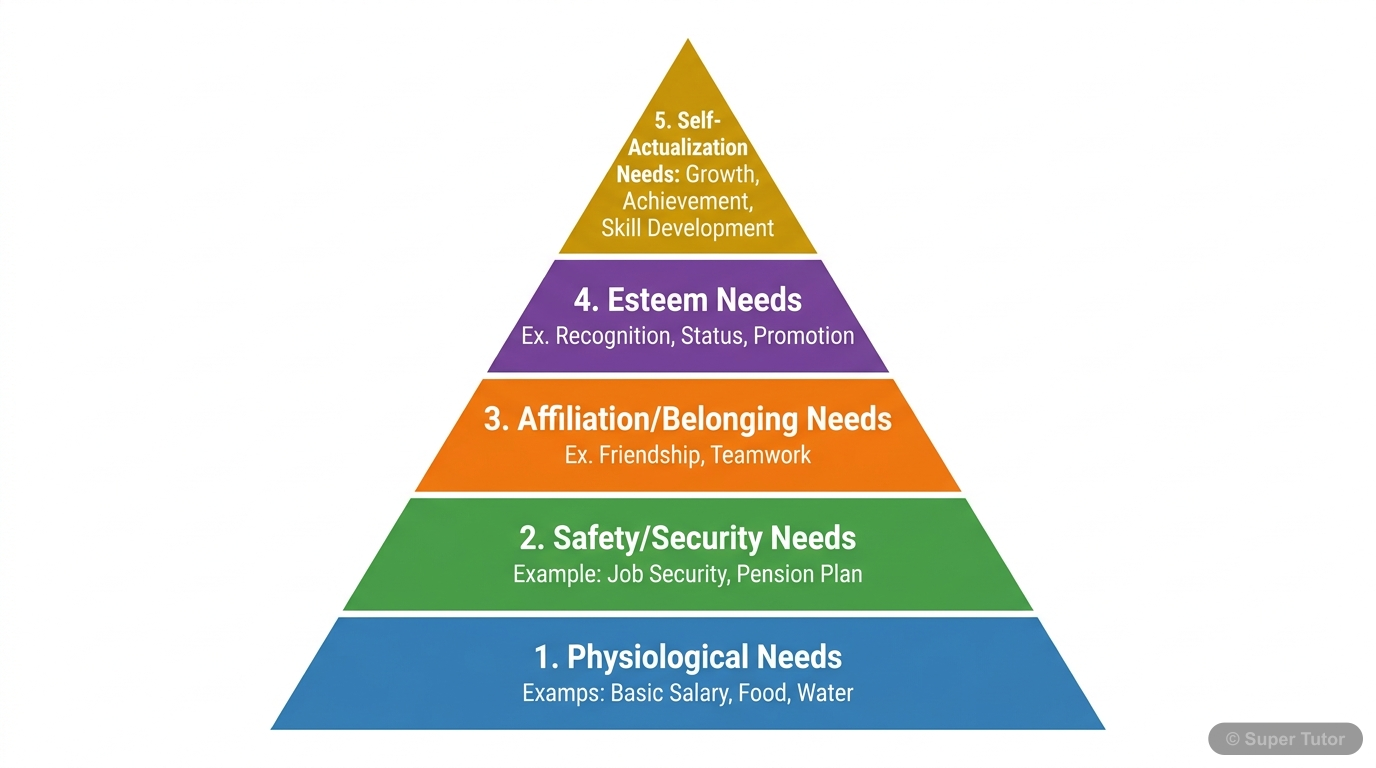
Learn better with visuals Super Tutor pairs illustrations like this with notes and quizzes for Staff Motivation.
Quick Quiz: Staff Motivation
0/4Tap an answer to check it instantly. No sign-up needed for these 4.
According to Maslow's Hierarchy of Needs, which of the following statements is MOST accurate regarding self-actualisation needs?
Herzberg's Two Factor Theory classifies 'salary' under which category, and what is the effect of its absence?
Which of the following is a key difference between motivation and morale, as explained in the chapter?
A manager in a large Indian company provides good working conditions, job security, and a fair salary to his employees, yet the employees are still not highly motivated. Which theory BEST explains this situation?
Sample Questions
Which of the following is a valid CRITICISM of Maslow's Theory of Hierarchy of Needs?
Show answer
The need priority order cannot be universally generalised as it depends on cultural values and individual personality.
Step 1: The chapter lists several criticisms of Maslow's theory. One key criticism is about cultural applicability. Step 2: The need priority order CANNOT be generalised for all cultures. What is a higher-level need for an Indian worker may be a lower-level need for an American worker. Studies show that workers in the USA operate at higher need levels and don't worry much about physiological and safety needs. Step 3: Also, movement in the hierarchy is NOT always upward. Some people value self-esteem more than love/belonging. Step 4: Why Option A is wrong – this criticism belongs to HERZBERG's
According to Herzberg's theory, what happens to job satisfaction and dissatisfaction when hygiene factors are fully provided?
Show answer
Employees experience NO job dissatisfaction, but this does NOT mean they experience job satisfaction.
Step 1: This question tests understanding of one of the most IMPORTANT and unique insights of Herzberg's theory. Step 2: Herzberg stressed that satisfaction and dissatisfaction are NOT two opposite ends of the SAME continuum. They are separate dimensions. Step 3: The opposite of job DISSATISFACTION is NOT job satisfaction – it is 'NO job dissatisfaction.' This means providing hygiene factors simply removes dissatisfaction; it does not create satisfaction. Step 4: Similarly, the opposite of job SATISFACTION is not dissatisfaction but 'absence of job satisfaction.' Step 5: Why Option A is wrong
Raman is a highly skilled software engineer who always seeks out projects where he can solve complex problems independently and develop new skills. According to Herzberg's theory, Raman is BEST described as a:
Show answer
Motivation seeker, because he is primarily motivated by job content factors like challenge and growth.
Step 1: Herzberg's theory recognises two personality types of employees based on what motivates them. Step 2: A 'MOTIVATION SEEKER' is motivated primarily by SATISFIERS or JOB CONTENT factors – these include challenging work, achievement, growth, responsibility, and recognition. Step 3: A 'MAINTENANCE SEEKER' is motivated primarily by factors SURROUNDING the job, i.e., the work environment – salary, working conditions, job security, interpersonal relations. Step 4: Raman seeks complex problems, independence, and skill development – all these are JOB CONTENT factors, making him a MOTIVATION SEE
Which of the following BEST explains why the chapter states that 'motivation is total, not piece-meal'?
Show answer
An employee is an indivisible unit with interrelated needs; satisfying only some needs partially does not truly motivate the person.
Step 1: The chapter explicitly states that 'Motivation is total, not piece-meal' as one of its key characteristics. Step 2: The reasoning is that a PERSON cannot be motivated in PARTS. An employee is an INDIVISIBLE unit. Step 3: Human needs are INTERRELATED – they are connected to each other. You cannot fully motivate someone by satisfying only certain needs partially. Step 4: For example, you cannot give an employee a high salary (physiological need) but ignore their need for recognition or job security, and expect full motivation. All needs are interconnected. Step 5: Why Option A is wrong –
+39 more questions on Staff Motivation (ICSE Class 12 Business Studies)
Practise AllFrequently Asked Questions
What are the important topics in Staff Motivation for ICSE Class 12 Business Studies?
How many practice questions are there for Staff Motivation?
Sources & Official References
Content is aligned to the official syllabus. Refer to the board website for the latest curriculum.
More resources for Staff Motivation
Important Questions
Exam-style questions with answers
Revision Notes
Key points for last-minute revision
Chapter Summary
Understand the chapter at a glance
Concept Maps
See how topics connect
Study Plan
Step-by-step plan for this chapter
Flashcards
Quick-fire cards for active recall
Syllabus
What topics to cover
For serious students
Get the full Staff Motivation chapter — start free.
Quizzes, flashcards, an AI doubt solver and a study plan for ICSE Class 12 Business Studies. Free to start, no card needed.