Consumer Behaviour Cardinal And Ordinal Utility Analysis — Revision Notes
ICSE · Class 12 · Economics
Consumer Behaviour Cardinal And Ordinal Utility Analysis revision notes for ICSE Class 12 Economics: 4 topics in quick points.
Interactive on Super Tutor
Studying Consumer Behaviour Cardinal And Ordinal Utility Analysis? Get the full interactive chapter.
Quizzes, flashcards, AI doubt-solver and a step-by-step study plan — built for revision notes and more.
Free trial, no card needed.
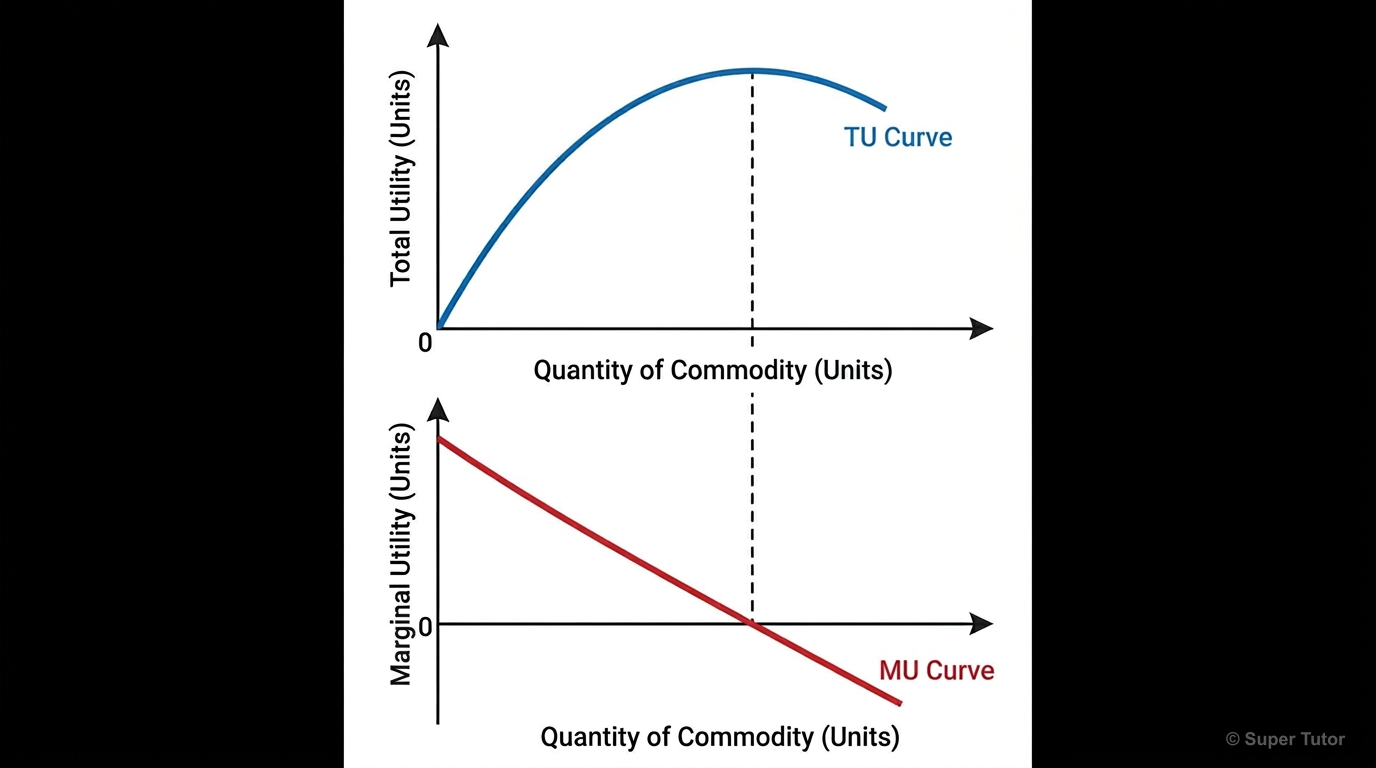
One of 10 illustrations for Consumer Behaviour Cardinal And Ordinal Utility Analysis in Super Tutor — alongside flashcards, concept maps and practice questions.
Key Topics to Revise
1. Utility and Cardinal Utility Analysis
- Utility is the measure of intensity of want of a good, that is, the desire to have a commodity.
- Utility is subjective, so it varies from person to person.
- Utility is different from usefulness and also different from pleasure.
2. Types of Utility and Relationship Between MU and TU
- Utility can be classified into total utility and marginal utility.
- Positive marginal utility means total utility rises with extra consumption.
- Zero marginal utility is the point of satiety or perfect saturation.
3. Law of Diminishing Marginal Utility
- The Law of Diminishing Marginal Utility is the fundamental law of utility analysis.
- It is a universal law of consumption applicable to all goods and services.
- Herman Heinrich Gossen, a French economist, was the first to formulate this principle in 1854, though the name was given by Marshall.
4. Law of Equi-marginal Utility and Consumer's Equilibrium under Cardinal Utility
- The law of equi-marginal utility was propounded in the nineteenth century by a French Engineer named Gossen.
- This law is an extension of the law of diminishing marginal utility.
- It is also called the law of substitution and the law of maximum satisfaction.
Get complete notes with diagrams and examples
Full NotesKey Concepts
Frequently Asked Questions
What are the important topics in Consumer Behaviour Cardinal And Ordinal Utility Analysis for ICSE Class 12 Economics?
How should I revise Consumer Behaviour Cardinal And Ordinal Utility Analysis for the ICSE Class 12 board exam?
Sources & Official References
Content is aligned to the official syllabus. Refer to the board website for the latest curriculum.
More resources for Consumer Behaviour Cardinal And Ordinal Utility Analysis
Practice Quiz
Test yourself with a quick quiz
Important Questions
Exam-style questions with answers
Formula Sheet
The chapter's formulas in one place
Chapter Summary
Understand the chapter at a glance
Concept Maps
See how topics connect
Study Plan
Step-by-step plan for this chapter
Flashcards
Quick-fire cards for active recall
Syllabus
What topics to cover
For serious students
Get the full Consumer Behaviour Cardinal And Ordinal Utility Analysis chapter — start free.
Quizzes, flashcards, an AI doubt solver and a study plan for ICSE Class 12 Economics. Free to start, no card needed.