Consumer Behaviour Cardinal And Ordinal Utility Analysis — Chapter Summary
ICSE · Class 12 · Economics
Summary of Consumer Behaviour Cardinal And Ordinal Utility Analysis for ICSE Class 12 Economics. Part of the ICSE Class 12 Economics syllabus.
Interactive on Super Tutor
Studying Consumer Behaviour Cardinal And Ordinal Utility Analysis? Get the full interactive chapter.
Quizzes, flashcards, AI doubt-solver and a step-by-step study plan — built for chapter summary and more.
Free trial, no card needed.
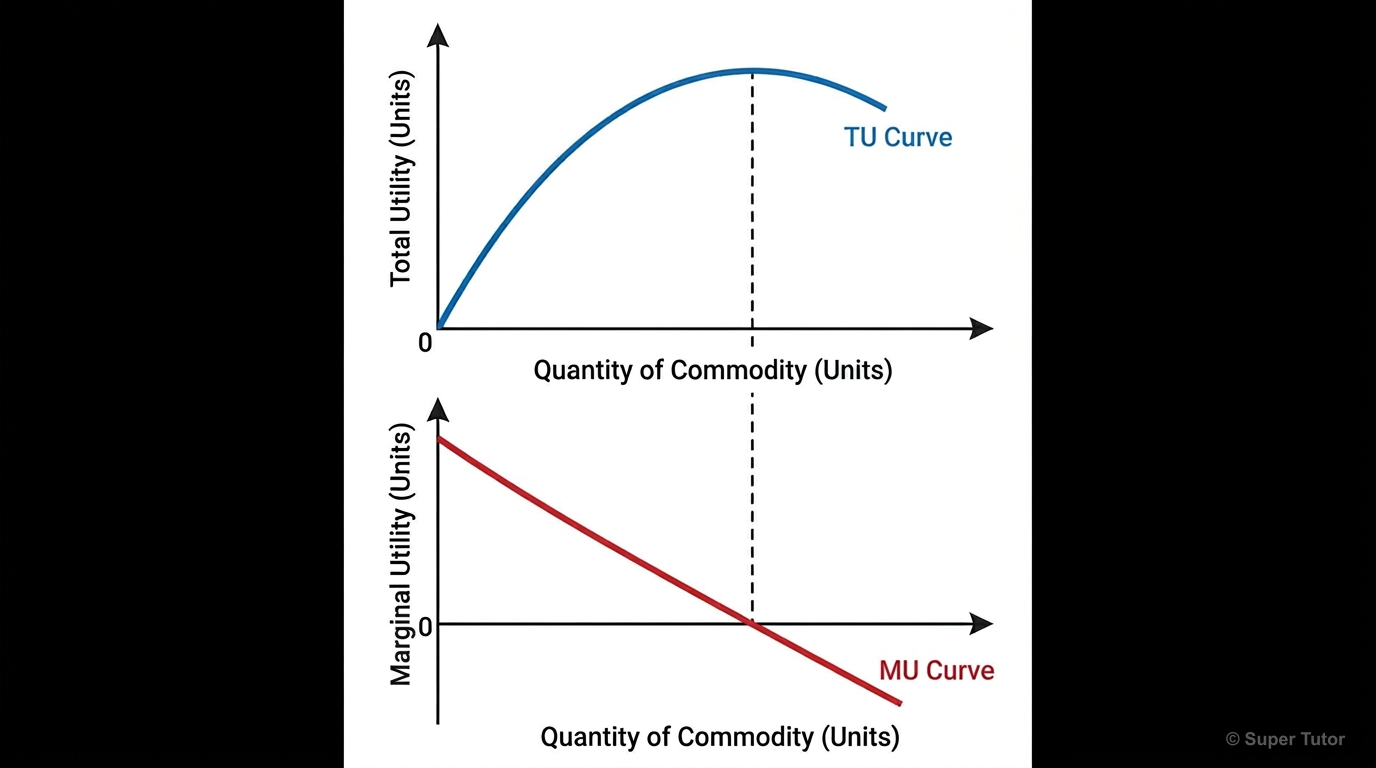
One of 10 illustrations for Consumer Behaviour Cardinal And Ordinal Utility Analysis in Super Tutor — alongside flashcards, concept maps and practice questions.
Overview
Consumer behaviour is the process whereby individuals decide what and how much to purchase goods and services for personal consumption. Three approaches are used to study consumer behaviour: Utility Analysis or Cardinal Utility Analysis, Indifference Curve Analysis or Ordinal Utility Approach, and R
Key Concepts
Utility is the measure of intensity
Utility is the measure of intensity of want of a good, meaning the desire to have a commodity. It is subjective, relative, and different from usefulne
Cardinal utility is the utility where
Cardinal utility is the utility where satisfaction derived from consumption of a good can be expressed in numbers. Some economists measure it in imagi
Total utility is the total satisfaction
Total utility is the total satisfaction obtained from consuming a certain number of units of a commodity. It is the sum of marginal utilities from all
Marginal utility is addition made
Marginal utility is addition made to total utility by consuming one more unit of a commodity. It is calculated as MU = ΔTU/ΔQ.
Marginal utility may be positive
Marginal utility may be positive, zero, or negative. Zero marginal utility is the point of satiety, and negative marginal utility is also called disut
Learning Objectives
- Understand the meaning and characteristics of utility
- Differentiate between total utility and marginal utility
- Explain the Law of Diminishing Marginal Utility and its assumptions, causes, limitations, and importance
- Explain the Law of Equi-marginal Utility and its role in consumer equilibrium
- Understand consumer’s equilibrium under cardinal utility analysis
Frequently Asked Questions
What are the important topics in Consumer Behaviour Cardinal And Ordinal Utility Analysis for ICSE Class 12 Economics?
How should I revise Consumer Behaviour Cardinal And Ordinal Utility Analysis for the ICSE Class 12 board exam?
Sources & Official References
Content is aligned to the official syllabus. Refer to the board website for the latest curriculum.
More resources for Consumer Behaviour Cardinal And Ordinal Utility Analysis
Practice Quiz
Test yourself with a quick quiz
Important Questions
Exam-style questions with answers
Revision Notes
Key points for last-minute revision
Formula Sheet
The chapter's formulas in one place
Concept Maps
See how topics connect
Study Plan
Step-by-step plan for this chapter
Flashcards
Quick-fire cards for active recall
Syllabus
What topics to cover
For serious students
Get the full Consumer Behaviour Cardinal And Ordinal Utility Analysis chapter — start free.
Quizzes, flashcards, an AI doubt solver and a study plan for ICSE Class 12 Economics. Free to start, no card needed.