The origins of the First World War — Important Questions
ICSE · Class 12 · History
45 important questions from The origins of the First World War for ICSE Class 12 History, with answers. Written for the board exams 2027.
Interactive on Super Tutor
Studying The origins of the First World War? Get the full interactive chapter.
Quizzes, flashcards, AI doubt-solver and a step-by-step study plan — built for important questions and more.
Free trial, no card needed.
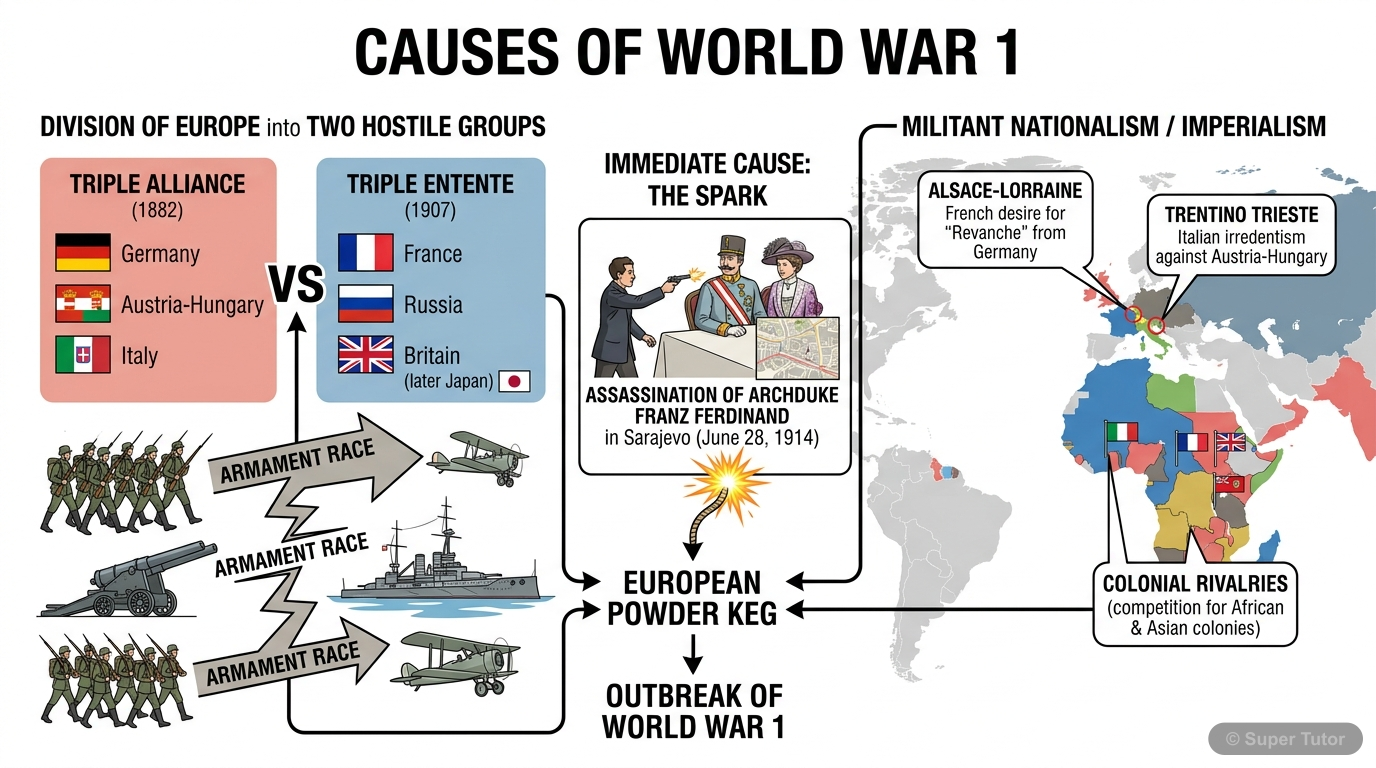
Learn better with visuals Super Tutor pairs illustrations like this with notes and quizzes for The origins of the First World War.
Important Questions from The origins of the First World War
Historian Alexander Watson, in 'Ring of Steel', makes a specific claim about Austria-Hungary's role in July 1914. Which of the following best represents Watson's argument?
Show answer
Austria-Hungary's leaders alone actively planned from early July 1914 to go to war, pursuing a Balkan rather than a world war with single-minded determination
Step 1: Alexander Watson's 'Ring of Steel' (2014) focuses specifically on Habsburg decision-making in July 1914. Step 2: Watson argues that 'Austria-Hungary's leaders were exceptional, for they alone actively planned from early July 1914 to take their country to war.' Step 3: Crucially, Watson specifies that the war Austria-Hungary wanted was a Balkan war (against Serbia), not necessarily a world war, but they pursued it 'with startlingly single-minded determination.' Step 4: Watson also noted 'the ease with which they contemplated war' as particularly disconcerting. Step 5: This view contradi
The annexation of Bosnia-Herzegovina in 1908 by Austria-Hungary had a significant unintended consequence for the broader alliance system. What was this consequence?
Show answer
Germany's humiliation of Russia over the annexation pushed Russia firmly towards Britain and France
Step 1: Austria formally annexed Bosnia-Herzegovina in 1908, which Russia and Serbia strongly opposed as it violated existing agreements. Step 2: In spring 1909, Germany issued what amounted to an ultimatum to Russia, demanding it formally acknowledge the annexation. Russia, still weakened after its defeat by Japan in 1904-5 and the 1905 Revolution, had no choice but to comply. Step 3: This public humiliation of Russia had an unintended but critical consequence – it pushed Russia decisively closer to Britain and France. Step 4: As the chapter notes, 'Germany's willingness to humiliate Russia w
Paul Kennedy's data on British manufacturing output reveals a striking decline in Britain's global economic position between 1880 and 1913. According to Kennedy, what was Britain's share of world manufacturing output in 1913, and what had it been in 1880?
Show answer
Fell from 22.9% in 1880 to 13.6% in 1913
Step 1: Kennedy's data is specifically cited in the chapter to illustrate Britain's relative economic decline. Step 2: The exact figures given are: 'Whereas in 1880 the United Kingdom still contained 22.9 per cent of world manufacturing output, that figure had shrunk to 13.6 per cent by 1913.' Step 3: Similarly, its share of world trade fell from 23.2% in 1880 to 14.1% in 1911-1913. Step 4: Kennedy emphasised that Britain was not declining absolutely – it was 'not because it wasn't growing, but because others were growing faster', particularly the USA and Germany. Step 5: This relative decline
Which of the following best explains the strategic significance of the Schlieffen Plan in the context of Britain's entry into the First World War?
Show answer
The plan involved marching through neutral Belgium to outflank France, violating the 1839 Treaty of London and triggering Britain's declaration of war
Step 1: The Schlieffen Plan, drawn up as early as 1904 and perfected by winter 1905, was Germany's core military strategy based on a two-front war scenario. Step 2: The plan's key feature was outflanking French defences by marching through neutral Belgium, reasoning that Russia would take several weeks to fully mobilise, allowing a quick defeat of France first. Step 3: Belgium's neutrality was guaranteed by the Treaty of London (1839), which Britain was a signatory to. Violating this treaty was what the chapter refers to as 'a piece of paper'. Step 4: Germany hoped Britain would remain neutral
+41 more questions on The origins of the First World War (ICSE Class 12 History)
Practise AllFrequently Asked Questions
What are the important topics in The origins of the First World War for ICSE Class 12 History?
How many important questions are there in The origins of the First World War?
Sources & Official References
Content is aligned to the official syllabus. Refer to the board website for the latest curriculum.
More resources for The origins of the First World War
For serious students
Get the full The origins of the First World War chapter — start free.
Quizzes, flashcards, an AI doubt solver and a study plan for ICSE Class 12 History. Free to start, no card needed.