Chapter 1 of 28
Revision Notes
The origins of the First World War — Revision Notes
ICSE · Class 12 · History
The origins of the First World War revision notes for ICSE Class 12 History: 4 topics in quick points. Part of the ICSE Class 12 History syllabus.
45 questions44 flashcards5 concepts
Interactive on Super Tutor
Studying The origins of the First World War? Get the full interactive chapter.
Quizzes, flashcards, AI doubt-solver and a step-by-step study plan — built for revision notes and more.
Free trial, no card needed.
Super Tutor
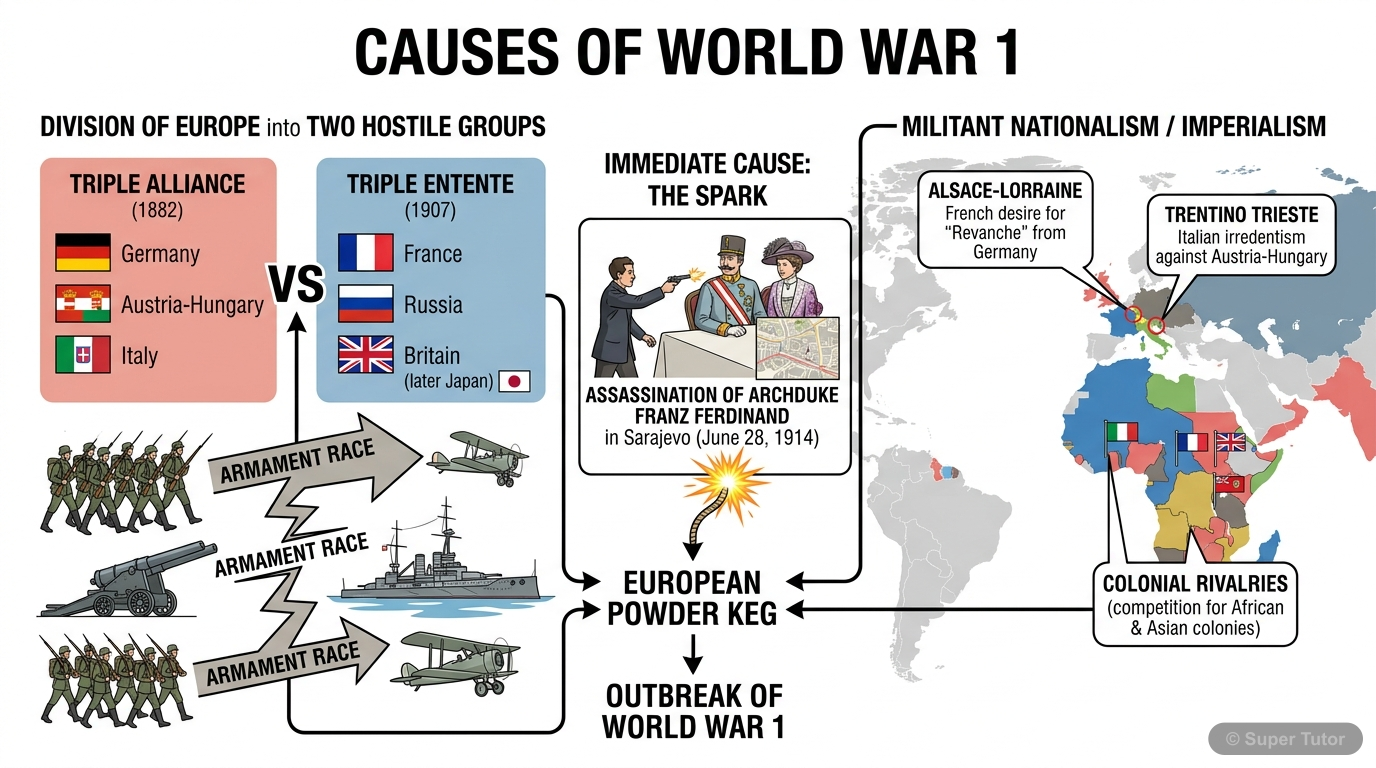
Learn better with visuals Super Tutor pairs illustrations like this with notes and quizzes for The origins of the First World War.
Key Topics to Revise
1
1. Long-term background causes
- The creation of Germany in 1871 changed the balance of power in Europe and increased tension among the Great Powers.
- Europe was divided into two armed camps between 1882 and 1907.
- The naval race began in 1897 and increased rivalry, especially between Germany and Britain.
2
2. Alliance blocs and diplomatic tensions
- The Triple Alliance was formed in 1882 by Germany, Austria, and Italy.
- The Franco-Russian Alliance was fully established in 1893 after earlier agreements.
- The Anglo-Japanese Alliance was signed in 1902.
3
3. The arms race and naval expansion
- The German army was already strong in 1888, but the navy was much smaller.
- By 1913 the German navy had expanded greatly and became central to policy.
- The 1912 navy regulations planned for 61 capital ships, 40 small cruisers, 144 torpedo boats, and 72 submarines.
4
4. Crisis points before 1914
- Morocco became a source of tension in 1905-6 and again in 1911.
- The first Moroccan crisis began when Germany tried to challenge France's position and test the Entente Cordiale.
- The second Moroccan crisis began when Kiderlen-Wachter sent the gunboat Panther to Agadir in 1911.
Get complete notes with diagrams and examples
Full NotesKey Concepts
The war did not begin suddenlyEurope divided into two armed campsFrom 1897Germany and the United States grewThe crises of 1905
Frequently Asked Questions
What are the important topics in The origins of the First World War for ICSE Class 12 History?
Key topics in The origins of the First World War include Long-term background causes, Alliance blocs and diplomatic tensions, The arms race and naval expansion, Crisis points before 1914. Study these first, then practise questions on each for the ICSE Class 12 board exam.
How should I revise The origins of the First World War for the ICSE Class 12 board exam?
Learn the core ideas first, then work through the 45 practice questions on The origins of the First World War. Revise definitions regularly and use flashcards for quick recall before the exam.
Sources & Official References
Content is aligned to the official syllabus. Refer to the board website for the latest curriculum.
More resources for The origins of the First World War
For serious students
Get the full The origins of the First World War chapter — start free.
Quizzes, flashcards, an AI doubt solver and a study plan for ICSE Class 12 History. Free to start, no card needed.