The origins of the First World War — Study Plan
ICSE · Class 12 · History
A step-by-step study plan for The origins of the First World War, ICSE Class 12 History: what to learn first, what to practise and when to revise.
Interactive on Super Tutor
Studying The origins of the First World War? Get the full interactive chapter.
Quizzes, flashcards, AI doubt-solver and a step-by-step study plan — built for study plan and more.
Free trial, no card needed.
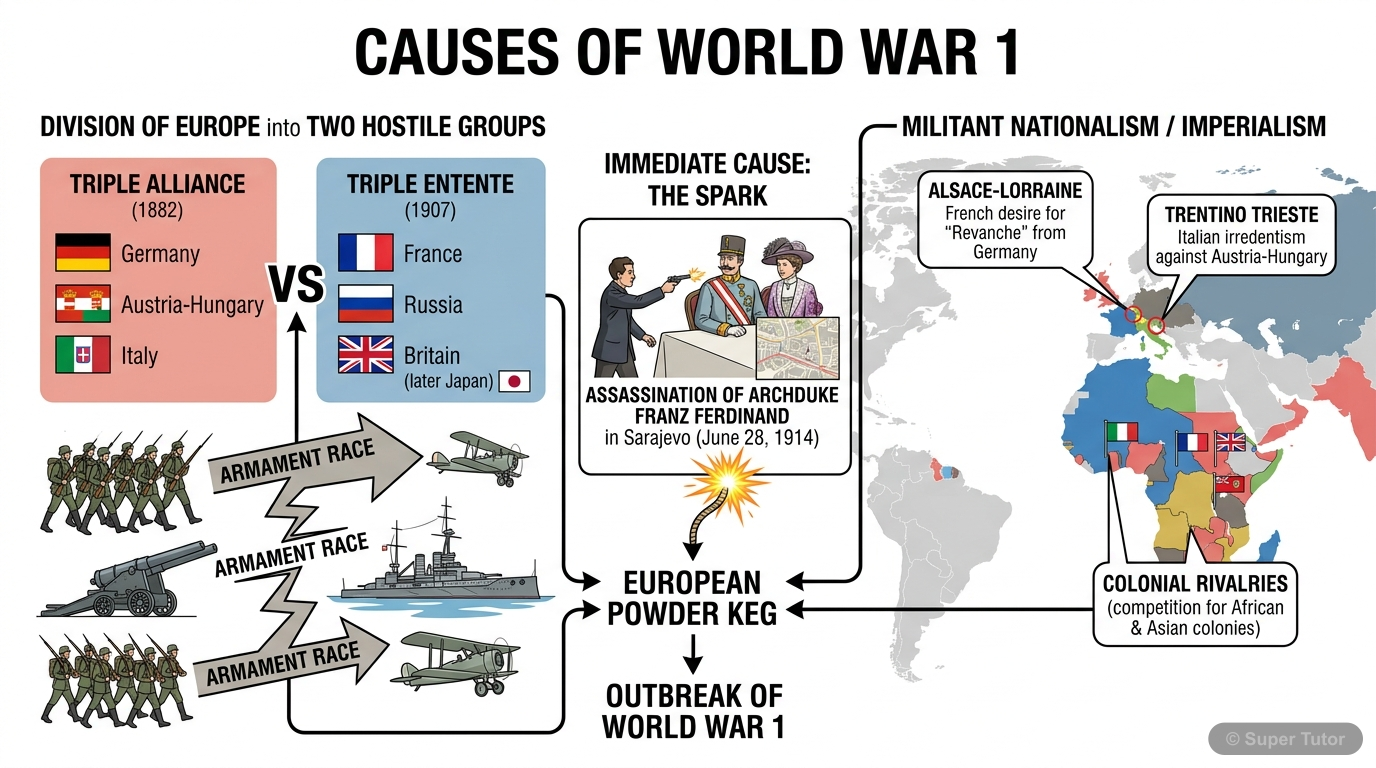
Learn better with visuals Super Tutor pairs illustrations like this with notes and quizzes for The origins of the First World War.
Study Plan
Learn the Theory
Read the textbook chapter carefully. Note down definitions, formulas and key ideas. Focus on: 1. Long-term background causes, 2. Alliance blocs and diplomatic tensions, 3. The arms race and naval expansion.
Practise
Solve the textbook exercises and extra practice questions. There are 45 questions available for this chapter.
Revise & Test
Revise key points without looking at your notes. Take a practice quiz and mark weak areas for another pass.
Spaced Revision
Come back to The origins of the First World War after a week. Use flashcards for quick recall and try past exam questions on this chapter.
What to Focus On
- Germany’s rise after 1871 changed the European balance of power.
- Wilhelm II ruled from 1888 to 1918 and encouraged a more aggressive international atmosphere.
- Europe was divided into two armed camps by 1907.
- Industrial power was seen as a source of military strength.
- Britain’s economic dominance declined relatively before 1914.
- Germany’s rapid growth worried Britain and France.
- The alliance system divided Europe into two camps.
- The Triple Alliance was formed in 1882 and renewed in 1907 and 1912.
- The Franco-Russian Alliance was formalized in 1893.
Common Mistakes to Avoid
Germany alone caused the First World War.
The alliance system automatically caused war the moment one country was attacked.
Italy had to fight for the Triple Alliance in 1914.
Memory Tips
The two armed camps in Europe were formed through alliances from 1882 to 1907
Triple Alliance, Franco-Russian Alliance, Anglo-Japanese Alliance, Entente Cordiale, Anglo-Russian Entente
The Triple Alliance was renewed in 1907 and 1912, but Italy was not compelled to fight in August 1914
Germany allowed the Reinsurance Treaty with Russia to lapse in 1890, helping push Russia toward France
Want a personalised study plan?
Super Tutor builds a day-by-day plan for ICSE Class 12 History that fits your exam date and pace.
Create My Study PlanFrequently Asked Questions
What are the important topics in The origins of the First World War for ICSE Class 12 History?
How should I revise The origins of the First World War for the ICSE Class 12 board exam?
Sources & Official References
Content is aligned to the official syllabus. Refer to the board website for the latest curriculum.
More resources for The origins of the First World War
Practice Quiz
Test yourself with a quick quiz
Important Questions
Exam-style questions with answers
Revision Notes
Key points for last-minute revision
Chapter Summary
Understand the chapter at a glance
Concept Maps
See how topics connect
Flashcards
Quick-fire cards for active recall
Syllabus
What topics to cover
For serious students
Get the full The origins of the First World War chapter — start free.
Quizzes, flashcards, an AI doubt solver and a study plan for ICSE Class 12 History. Free to start, no card needed.