Attitude, Prejudice and Stereotype
ICSE · Class 12 · Psychology
Most important questions from Attitude, Prejudice and Stereotype for ICSE Class 12 Psychology board exam 2026. MCQs, short answer, and long answer questions with marks.
Interactive on Super Tutor
Studying Attitude, Prejudice and Stereotype? Get the full interactive chapter.
Quizzes, flashcards, AI doubt-solver and a step-by-step study plan — built for important questions and more.
1,000+ Class 12 students started this chapter today
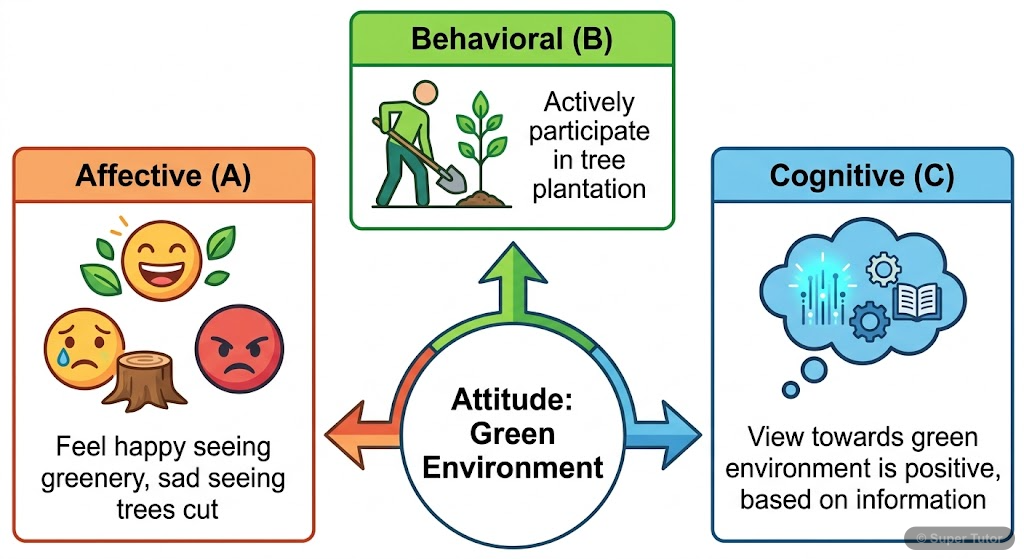
This is just one of 5+ visuals inside Super Tutor's Attitude, Prejudice and Stereotype chapter
Explore the full setSample Questions
When a child copies the negative attitude of his parent towards a neighbour simply by observing the parent's repeated reactions, which process of attitude formation is at work?
Show answer
Classical conditioning
Step 1: Classical conditioning involves learning through association. Step 2: The child initially has no attitude towards the neighbour. Step 3: By repeatedly seeing the parent's negative reactions associated with the neighbour, the child learns to link the neighbour with negativity. Step 4: This is learning by association, which is the hallmark of classical conditioning. Step 5: Operant conditioning involves rewards/punishments, not just observation. Cognitive evaluation involves consciously thinking about pros and cons. Social comparison involves comparing with peers. So the correct answer i
According to Bem's Self-Perception Theory, how do people form attitudes?
Show answer
By observing their own behaviour to infer their feelings
Step 1: Bem's Self-Perception Theory is unique because it says we look at our own behaviour to understand our attitudes. Step 2: When we are uncertain about how we feel, we observe what we do and then decide what we must feel. Step 3: For example, if you help someone repeatedly, you conclude you must like them. Step 4: Option A describes social comparison theory. Option B describes operant conditioning. Option D describes cognitive evaluation. Step 5: Therefore, the correct answer is observing one's own behaviour to infer feelings.
Cognitive dissonance occurs when:
Show answer
A person identifies a discrepancy between two attitudes or between attitude and behaviour
Step 1: The chapter defines cognitive dissonance as the discomfort felt when there is inconsistency. Step 2: This inconsistency is either between two held attitudes or between an attitude and a behaviour. Step 3: Example: A smoker (behaviour) knows smoking causes cancer (attitude) – this conflict creates dissonance. Step 4: Option A is wrong – dissonance requires a conflict, not unrelated beliefs. Option C describes persuasion. Option D describes modeling. Step 5: The correct answer is the discrepancy between attitudes or attitude and behaviour.
Which of the following is the BEST example of cognitive dissonance?
Show answer
A person who believes in healthy eating but regularly eats junk food
Step 1: Cognitive dissonance requires a conflict between attitude and behaviour (or between two attitudes). Step 2: Option B shows a clear conflict – the attitude is 'healthy eating is good' but the behaviour is 'eating junk food.' Step 3: Option A shows attitude and behaviour in harmony – no dissonance. Step 4: Option C shows attitude (dislike) and behaviour (avoidance) in harmony – no dissonance. Step 5: Option D is an example of modeling, not dissonance. Hence Option B is the correct example of cognitive dissonance.
+40 more questions available
Practice AllFrequently Asked Questions
What are the important topics in Attitude, Prejudice and Stereotype for ICSE Class 12 Psychology?
How to score full marks in Attitude, Prejudice and Stereotype — ICSE Class 12 Psychology?
How many important questions are there in Attitude, Prejudice and Stereotype?
Sources & Official References
Content is aligned to the official syllabus. Refer to the board website for the latest curriculum.
More resources for Attitude, Prejudice and Stereotype
Practice Quiz
Test yourself with a quick quiz
Revision Notes
Key points for last-minute revision
Formula Sheet
All formulas in one place
Chapter Summary
Understand the chapter at a glance
Concept Maps
See how topics connect visually
Study Plan
Step-by-step plan to ace this chapter
Flashcards
Quick-fire cards for active recall
Syllabus
What topics to cover
NCERT Solutions
Every textbook question solved step by step
For serious students
Get the full Attitude, Prejudice and Stereotype chapter — for free.
Quizzes, flashcards, AI doubt-solver and a step-by-step study plan for ICSE Class 12 Psychology.