Attitude, Prejudice and Stereotype — Chapter Summary
ICSE · Class 12 · Psychology
Summary of Attitude, Prejudice and Stereotype for ICSE Class 12 Psychology. Part of the ICSE Class 12 Psychology syllabus.
Interactive on Super Tutor
Studying Attitude, Prejudice and Stereotype? Get the full interactive chapter.
Quizzes, flashcards, AI doubt-solver and a step-by-step study plan — built for chapter summary and more.
Free trial, no card needed.
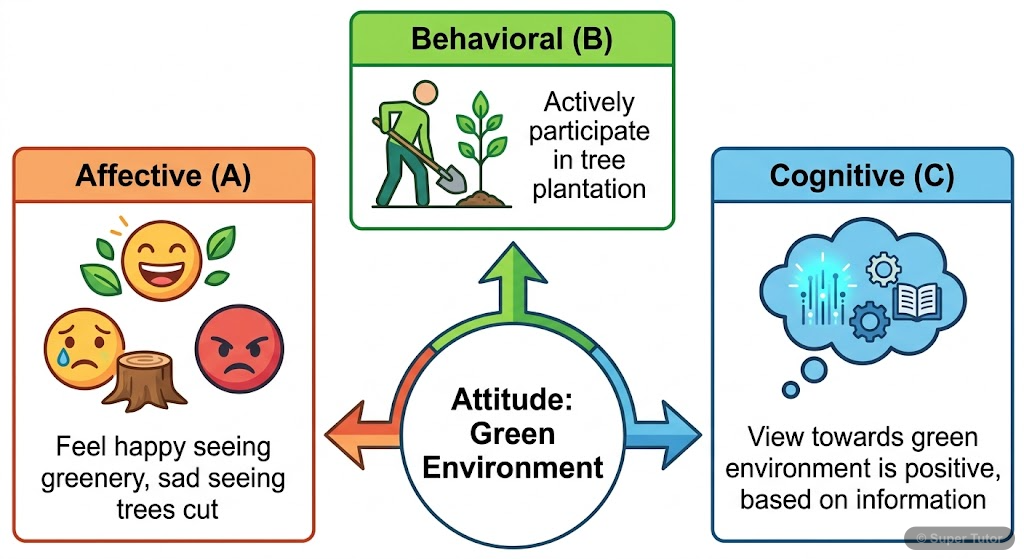
Learn better with visuals Super Tutor pairs illustrations like this with notes and quizzes for Attitude, Prejudice and Stereotype.
Overview
Attitude is a lasting evaluation toward any object, person, or situation. It includes likes, dislikes, positive reactions, and negative reactions shaped by experience. Prejudice is a preconceived judgement about people because they belong to a social group. Stereotype is the cognitive part of this p
Key Concepts
Attitude is a lasting evaluation toward
Attitude is a lasting evaluation toward an object, person, or situation. It may be favourable or unfavourable, and it can also be ambivalent, containi
The affective component is the feeling
The affective component is the feeling part, the cognitive component is the belief or thought part, and the behavioural component is the action part.
Perception is the foundation of thinking
Perception is the foundation of thinking, while attitude is the manifestation of that thinking. The relation is linear: Perception leads to belief, be
Belief is broader than attitude
Belief is broader than attitude and includes knowledge, opinion, and faith. Beliefs form the cognitive part of attitude, but all beliefs do not become
Attitudes are generally measured by Likert
Attitudes are generally measured by Likert scales, which use statements ranging from favourable to unfavourable.
Learning Objectives
- Define attitude, prejudice, stereotype, and discrimination
- Identify the three components of attitude: cognitive, affective, and behavioural
- Understand how attitudes are formed through learning, evaluation, need satisfaction, and self-perception
- Explain how attitudes change through persuasion and cognitive dissonance
- Distinguish between prejudice, stereotype, and discrimination
Frequently Asked Questions
What are the important topics in Attitude, Prejudice and Stereotype for ICSE Class 12 Psychology?
How should I revise Attitude, Prejudice and Stereotype for the ICSE Class 12 board exam?
Sources & Official References
Content is aligned to the official syllabus. Refer to the board website for the latest curriculum.
More resources for Attitude, Prejudice and Stereotype
For serious students
Get the full Attitude, Prejudice and Stereotype chapter — start free.
Quizzes, flashcards, an AI doubt solver and a study plan for ICSE Class 12 Psychology. Free to start, no card needed.