Social thought and Social Behaviour
ICSE · Class 12 · Psychology
Most important questions from Social thought and Social Behaviour for ICSE Class 12 Psychology board exam 2026. MCQs, short answer, and long answer questions with marks.
Interactive on Super Tutor
Studying Social thought and Social Behaviour? Get the full interactive chapter.
Quizzes, flashcards, AI doubt-solver and a step-by-step study plan — built for important questions and more.
1,000+ Class 12 students started this chapter today
This is just one of 5+ visuals inside Super Tutor's Social thought and Social Behaviour chapter
Explore the full setSample Questions
In Milgram's obedience experiment, what was the role of the 'experimenter' and what was the highest percentage of participants who obeyed till the maximum shock level?
Show answer
The experimenter was an actor playing authority figure; 65% obeyed till 450 volts
Step 1: In Milgram's experiment, three roles existed – the Teacher (real participant), the Learner (confederate strapped to electric chair), and the Experimenter (an actor representing authority). Step 2: The experimenter gave four escalating orders when the teacher (participant) was reluctant – from 'Please continue' to 'You have no other choice but to continue.' Step 3: The key result: 65% of participants (teachers) continued to the maximum level of 450 volts. ALL participants administered shocks up to 300 volts. Step 4: Option A has wrong percentage (75% is Asch's result). Option C confuses
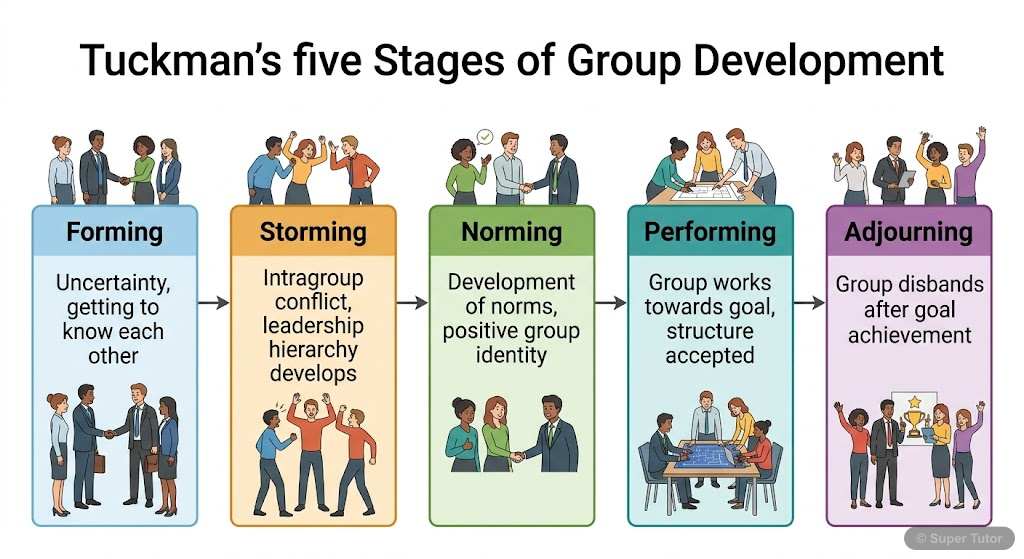
Which stage of group formation involves members resolving conflicts about leadership and decision-making authority within the group?
Show answer
Storming stage
Step 1: Group formation goes through five stages: Forming → Storming → Norming → Performing → Adjourning. Step 2: Forming stage = initial meeting, excitement, and apprehensions about how the group will work. Step 3: Storming stage = conflicts arise about leadership, resource control, and the path to achieve goals. Dissidents leave and only like-minded members remain. Step 4: Norming stage = group develops accepted norms of behaviour. Step 5: Performing stage = group actively works toward its goals. The question asks about conflict over leadership and authority, which clearly matches the Stormi
Automatic vigilance bias is best explained by which of the following situations?
Show answer
A person who was once bitten by a dog fears all dogs and only notices threatening behaviour in dogs, ignoring their playful actions
Step 1: Automatic vigilance bias is the tendency to automatically and disproportionately attend to NEGATIVE components of a stimulus, ignoring positive or neutral aspects. Step 2: In Option B, the person had a threatening experience (dog bite) and now only notices the negative aspects (threatening behaviour) of dogs, completely ignoring positive ones (playful actions). This is a perfect example of automatic vigilance bias. Step 3: Option A describes false consensus bias (overestimating agreement). Step 4: Option C describes upward counterfactual thinking (imagining better alternative outcomes)
Herbert Kelman identified three types of social influence. Which of the following correctly pairs the type of influence with its description?
Show answer
Compliance = appearing to agree publicly but privately disagreeing; Identification = being influenced by someone liked and respected
Step 1: Herbert Kelman (1958) identified three varieties of social influence. Step 2: COMPLIANCE = People appear to publicly agree with others but secretly maintain their own dissenting private opinion. They go along to avoid conflict, not out of genuine agreement. Step 3: IDENTIFICATION = People are influenced by someone who is liked, admired, or respected – like a celebrity endorsing a product. Step 4: INTERNALIZATION = People genuinely accept beliefs both privately AND publicly. They truly agree and internalise the belief. Step 5: Options A, C, and D mix up or reverse these definitions. Onl
+39 more questions available
Practice AllFrequently Asked Questions
What are the important topics in Social thought and Social Behaviour for ICSE Class 12 Psychology?
How to score full marks in Social thought and Social Behaviour — ICSE Class 12 Psychology?
How many important questions are there in Social thought and Social Behaviour?
Sources & Official References
Content is aligned to the official syllabus. Refer to the board website for the latest curriculum.
More resources for Social thought and Social Behaviour
Practice Quiz
Test yourself with a quick quiz
Revision Notes
Key points for last-minute revision
Formula Sheet
All formulas in one place
Chapter Summary
Understand the chapter at a glance
Concept Maps
See how topics connect visually
Study Plan
Step-by-step plan to ace this chapter
Flashcards
Quick-fire cards for active recall
Syllabus
What topics to cover
NCERT Solutions
Every textbook question solved step by step
For serious students
Get the full Social thought and Social Behaviour chapter — for free.
Quizzes, flashcards, AI doubt-solver and a step-by-step study plan for ICSE Class 12 Psychology.