Cell - The Structure and Functions — Flashcards
ICSE · Class 6 · Biology
30 flashcards for Cell - The Structure and Functions (ICSE Class 6 Biology) to test yourself on key terms and facts. Sample: "What is a cell?"
Interactive on Super Tutor
Studying Cell - The Structure and Functions? Get the full interactive chapter.
Quizzes, flashcards, AI doubt-solver and a step-by-step study plan — built for flashcards and more.
Free trial, no card needed.
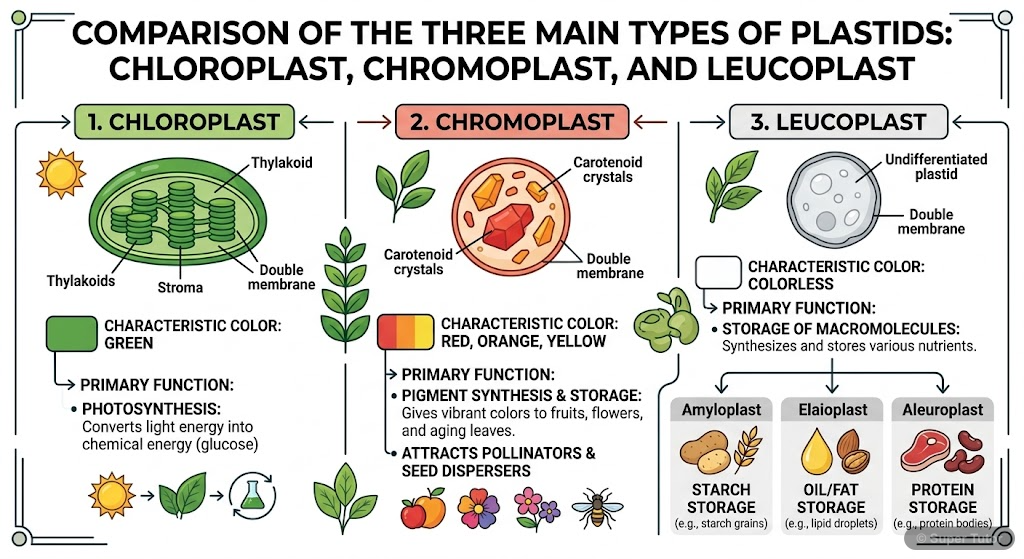
One of 2 illustrations for Cell - The Structure and Functions in Super Tutor — alongside flashcards, concept maps and practice questions.
What is a cell?
Answer
A cell is the basic structural and functional unit of all living organisms. It is the smallest unit that can perform all life processes. For example, our body is made up of billions of cells working t…
Who discovered the cell and how?
Answer
Robert Hooke discovered the cell in 1665. He used a simple microscope to observe a thin slice of cork and saw box-like structures that reminded him of monks' rooms, which he called 'cells'.
Why are cells called the building blocks of life?
Answer
Cells are called building blocks because all living things are made of cells. Just like bricks build a house, cells build the body of every organism — from tiny bacteria to large trees and animals.
What is the difference between unicellular and multicellular organisms?
Answer
Unicellular organisms are made of only one cell (e.g., Amoeba, Paramecium), while multicellular organisms are made of many cells (e.g., humans, plants). In multicellular organisms, different cells per…
Give two examples each of unicellular and multicellular organisms.
Answer
Unicellular: Amoeba, Paramecium. Multicellular: Human, Neem tree. Unicellular organisms do all life functions in one cell, while multicellular organisms divide work among specialized cells.
What is protoplasm?
Answer
Protoplasm is the living substance inside a cell. It includes the cytoplasm and nucleus. It is jelly-like and carries out all life activities like growth and reproduction.
Name the three main parts of a cell.
Answer
The three main parts of a cell are: (1) Cell membrane, (2) Cytoplasm, and (3) Nucleus. These are present in both plant and animal cells.
What is the function of the cell membrane?
Answer
The cell membrane is a thin, flexible layer that surrounds the cell. It controls what enters and exits the cell. It is selectively permeable, meaning only certain substances can pass through.
+22 more flashcards
Practise AllFrequently Asked Questions
What are the important topics in Cell - The Structure and Functions for ICSE Class 6 Biology?
How many flashcards are available for Cell - The Structure and Functions?
How should I revise Cell - The Structure and Functions for Class 6 exams?
Sources & Official References
Content is aligned to the official syllabus. Refer to the board website for the latest curriculum.
More resources for Cell - The Structure and Functions
Practice Quiz
Test yourself with a quick quiz
Important Questions
Exam-style questions with answers
Revision Notes
Key points for last-minute revision
Chapter Summary
Understand the chapter at a glance
Concept Maps
See how topics connect
Study Plan
Step-by-step plan for this chapter
Syllabus
What topics to cover
For serious students
Get the full Cell - The Structure and Functions chapter — start free.
Quizzes, flashcards, an AI doubt solver and a study plan for ICSE Class 6 Biology. Free to start, no card needed.