Cell - The Structure and Functions — Syllabus
ICSE · Class 6 · Biology
What Cell - The Structure and Functions covers in ICSE Class 6 Biology: 4 topics, for the 2026-27 session. Part of the ICSE Class 6 Biology syllabus.
Interactive on Super Tutor
Studying Cell - The Structure and Functions? Get the full interactive chapter.
Quizzes, flashcards, AI doubt-solver and a step-by-step study plan — built for syllabus and more.
Free trial, no card needed.
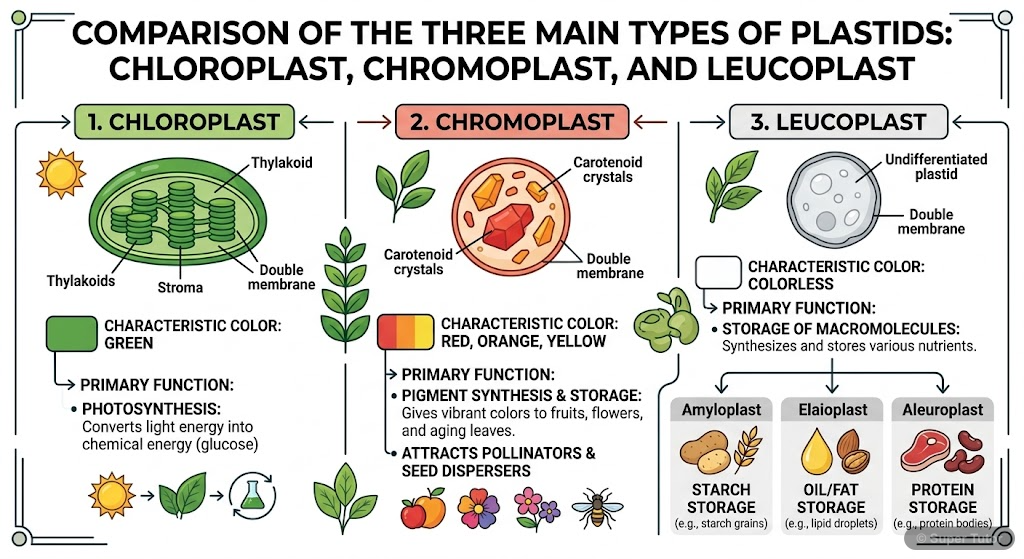
One of 2 illustrations for Cell - The Structure and Functions in Super Tutor — alongside flashcards, concept maps and practice questions.
Topics in Cell - The Structure and Functions
Discovery of the Cell
- Robert Hooke discovered cells in 1665 while observing a thin slice of cork under a microscope.
- He saw box-like structures and called them 'cells' because they looked like small rooms (like monks' cells in a monastery).
- Antonie van Leeuwenhoek was the first to observe living cells, such as bacteria and red blood cells, using a simple microscope.
Cell Shape, Size, and Number
- Cells vary in shape (spherical, oval, spindle-shaped, irregular, rectangular) depending on their function.
- Red blood cells are spherical to carry more oxygen; nerve cells are long to transmit signals.
- Amoeba has an irregular (amoeboid) shape and can change it to move and eat.
Cell Theory
- Proposed by Schleiden, Schwann, and Virchow.
- All living organisms are made of one or more cells.
- The cell is the structural and functional unit of life.
Structure of a Cell
- All cells have three main parts: cell membrane, cytoplasm, and nucleus.
- Plant cells have additional structures: cell wall, large vacuole, and plastids.
- Animal cells lack cell wall and plastids; they have small vacuoles.
Key Concepts
Central concept: Cell
Work through every topic in Cell - The Structure and Functions with notes and quizzes
Start This ChapterFrequently Asked Questions
What are the important topics in Cell - The Structure and Functions for ICSE Class 6 Biology?
How should I revise Cell - The Structure and Functions for Class 6 exams?
Sources & Official References
Content is aligned to the official syllabus. Refer to the board website for the latest curriculum.
More resources for Cell - The Structure and Functions
Practice Quiz
Test yourself with a quick quiz
Important Questions
Exam-style questions with answers
Revision Notes
Key points for last-minute revision
Chapter Summary
Understand the chapter at a glance
Concept Maps
See how topics connect
Study Plan
Step-by-step plan for this chapter
Flashcards
Quick-fire cards for active recall
For serious students
Get the full Cell - The Structure and Functions chapter — start free.
Quizzes, flashcards, an AI doubt solver and a study plan for ICSE Class 6 Biology. Free to start, no card needed.