Chapter 3 of 8
Revision Notes
Cell - The Structure and Functions — Revision Notes
ICSE · Class 6 · Biology
Cell - The Structure and Functions revision notes for ICSE Class 6 Biology: 4 topics in quick points. Part of the ICSE Class 6 Biology syllabus.
94 questions30 flashcards4 concepts
Interactive on Super Tutor
Studying Cell - The Structure and Functions? Get the full interactive chapter.
Quizzes, flashcards, AI doubt-solver and a step-by-step study plan — built for revision notes and more.
Free trial, no card needed.
Super Tutor
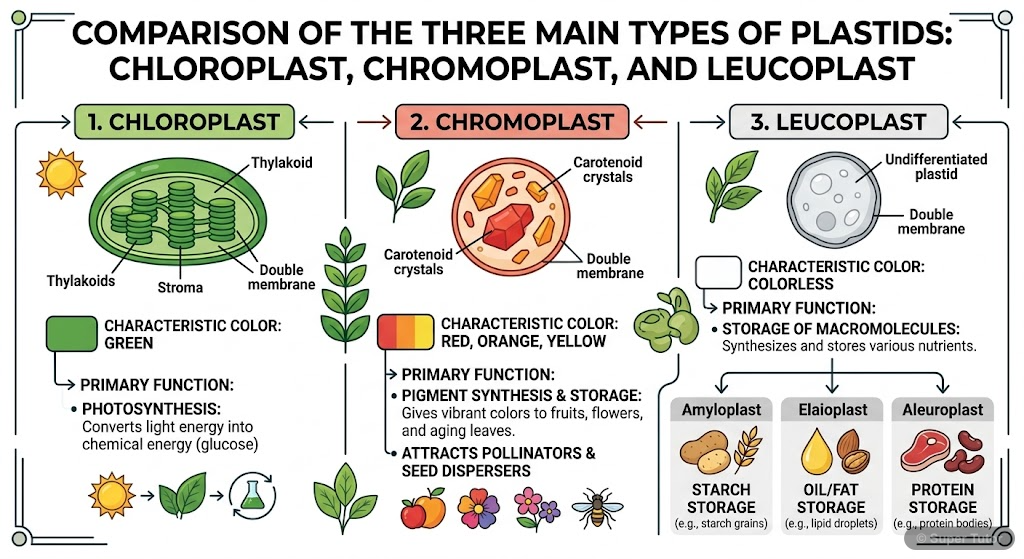
One of 2 illustrations for Cell - The Structure and Functions in Super Tutor — alongside flashcards, concept maps and practice questions.
Key Topics to Revise
1
Discovery of the Cell
- Robert Hooke discovered cells in 1665 while observing a thin slice of cork under a microscope.
- He saw box-like structures and called them 'cells' because they looked like small rooms (like monks' cells in a monastery).
- Antonie van Leeuwenhoek was the first to observe living cells, such as bacteria and red blood cells, using a simple microscope.
2
Cell Shape, Size, and Number
- Cells vary in shape (spherical, oval, spindle-shaped, irregular, rectangular) depending on their function.
- Red blood cells are spherical to carry more oxygen; nerve cells are long to transmit signals.
- Amoeba has an irregular (amoeboid) shape and can change it to move and eat.
3
Cell Theory
- Proposed by Schleiden, Schwann, and Virchow.
- All living organisms are made of one or more cells.
- The cell is the structural and functional unit of life.
4
Structure of a Cell
- All cells have three main parts: cell membrane, cytoplasm, and nucleus.
- Plant cells have additional structures: cell wall, large vacuole, and plastids.
- Animal cells lack cell wall and plastids; they have small vacuoles.
Get complete notes with diagrams and examples
Full NotesKey Concepts
Robert Hooke first discovered cellsEvery cell has three main partsInside the cytoplasm are small structuresPlant cells have a cell wall
Frequently Asked Questions
What are the important topics in Cell - The Structure and Functions for ICSE Class 6 Biology?
Key topics in Cell - The Structure and Functions include Discovery of the Cell, Cell Shape, Size, and Number, Cell Theory, Structure of a Cell. Study these first, then practise questions on each for Class 6 exams.
How should I revise Cell - The Structure and Functions for Class 6 exams?
Learn the core ideas first, then work through the 94 practice questions on Cell - The Structure and Functions. Revise definitions regularly and use flashcards for quick recall before the exam.
Sources & Official References
Content is aligned to the official syllabus. Refer to the board website for the latest curriculum.
More resources for Cell - The Structure and Functions
For serious students
Get the full Cell - The Structure and Functions chapter — start free.
Quizzes, flashcards, an AI doubt solver and a study plan for ICSE Class 6 Biology. Free to start, no card needed.