Water Bodies — Flashcards
ICSE · Class 6 · Geography
30 flashcards for Water Bodies (ICSE Class 6 Geography) to test yourself on key terms and facts. Sample: "Why is Earth called the 'Blue Planet'?"
Interactive on Super Tutor
Studying Water Bodies? Get the full interactive chapter.
Quizzes, flashcards, AI doubt-solver and a step-by-step study plan — built for flashcards and more.
Free trial, no card needed.
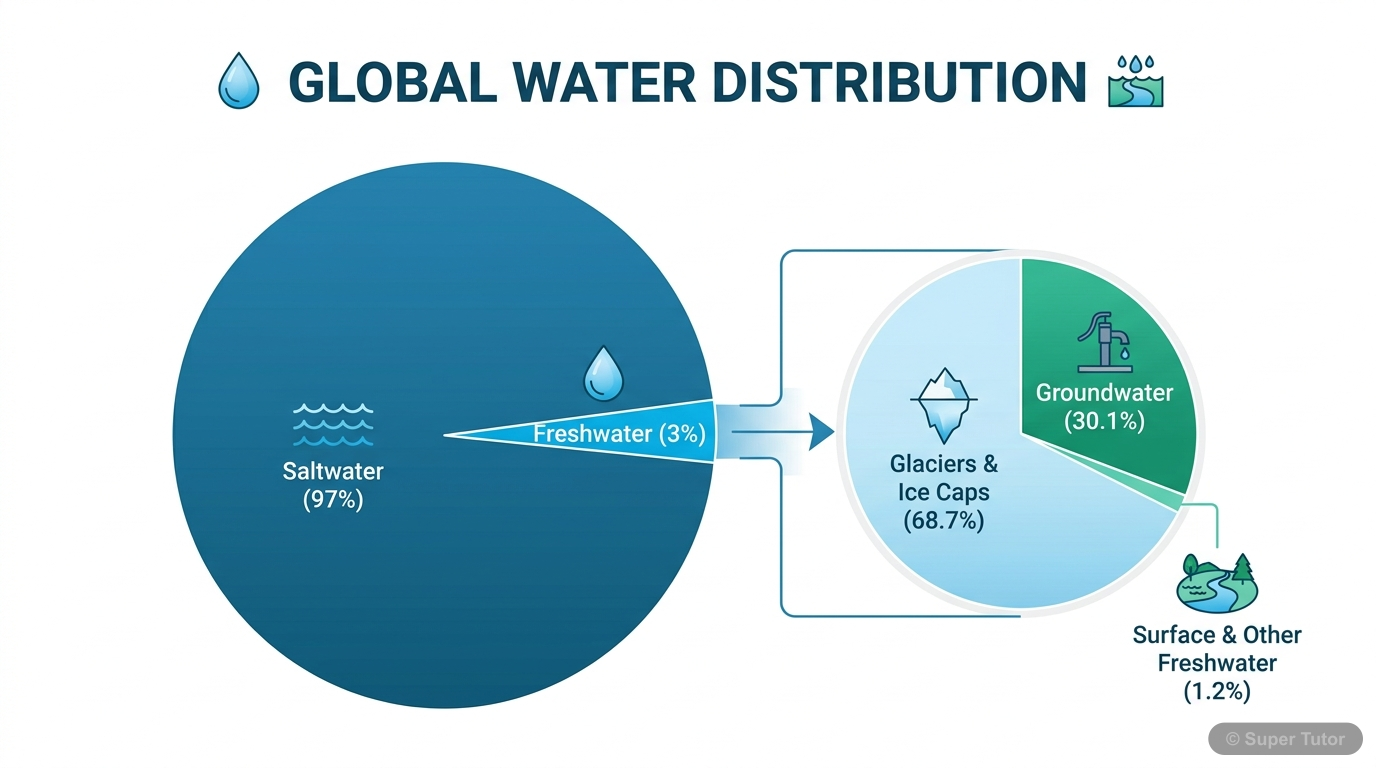
An illustration from Super Tutor's Water Bodies chapter — alongside flashcards, concept maps and practice questions.
Why is Earth called the 'Blue Planet'?
Answer
Earth is called the 'Blue Planet' because about 71% of its surface is covered with water. Most of this water is found in oceans and seas, giving Earth a blue appearance when seen from space.
What is a water body?
Answer
A water body is any large accumulation of water on Earth’s surface. Examples include oceans, seas, lakes, and rivers. These can be saltwater or freshwater and play a vital role in the environment and …
What is sea level?
Answer
Sea level is the average height of the ocean's surface. It is used as a reference point to measure the elevation of land (like mountains) or depth of oceans. For example, Mount Everest is 8,849 meters…
Explain the water cycle in simple terms.
Answer
The water cycle is the continuous movement of water on Earth. Water evaporates from oceans, forms clouds, falls as rain or snow, and flows back into oceans through rivers or underground. This cycle co…
What are the five major oceans of the world?
Answer
The five major oceans are: Pacific Ocean, Atlantic Ocean, Indian Ocean, Arctic Ocean, and Southern Ocean. The Pacific is the largest and deepest, while the Arctic is the smallest and coldest.
Why is the Pacific Ocean important?
Answer
The Pacific Ocean is the largest and deepest ocean. It influences global weather, supports rich marine life, and has many islands. It also contains the Ring of Fire, an area with frequent volcanic and…
What makes the Atlantic Ocean unique?
Answer
The Atlantic Ocean is the second-largest ocean and has an S-shape. It is the saltiest major ocean and serves as a major trade route. Many big rivers like the Amazon and Mississippi flow into it.
Why is the Indian Ocean important for India?
Answer
The Indian Ocean is crucial for India’s climate, trade, and fishing. It brings monsoon rains, hosts major ports like Mumbai and Chennai, and is rich in oil and marine resources.
+22 more flashcards
Practise AllFrequently Asked Questions
What are the important topics in Water Bodies for ICSE Class 6 Geography?
How many flashcards are available for Water Bodies?
How should I revise Water Bodies for Class 6 exams?
Sources & Official References
Content is aligned to the official syllabus. Refer to the board website for the latest curriculum.
More resources for Water Bodies
Practice Quiz
Test yourself with a quick quiz
Important Questions
Exam-style questions with answers
Revision Notes
Key points for last-minute revision
Chapter Summary
Understand the chapter at a glance
Concept Maps
See how topics connect
Study Plan
Step-by-step plan for this chapter
Syllabus
What topics to cover
For serious students
Get the full Water Bodies chapter — start free.
Quizzes, flashcards, an AI doubt solver and a study plan for ICSE Class 6 Geography. Free to start, no card needed.