Language of Chemistry
ICSE · Class 7 · Chemistry
Most important questions from Language of Chemistry for ICSE Class 7 Chemistry board exam 2026. MCQs, short answer, and long answer questions with marks.
Interactive on Super Tutor
Studying Language of Chemistry? Get the full interactive chapter.
Quizzes, flashcards, AI doubt-solver and a step-by-step study plan — built for important questions and more.
1,000+ Class 7 students started this chapter today
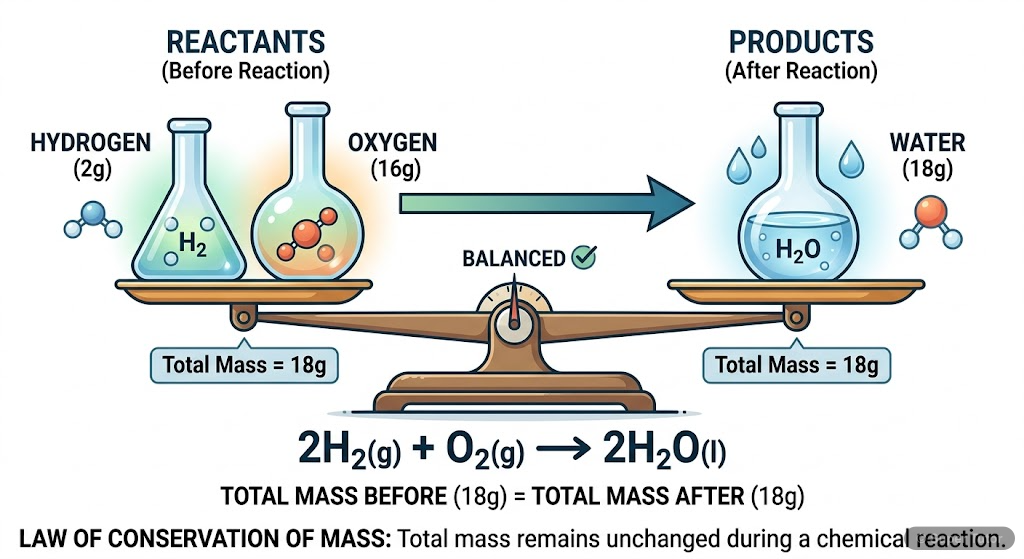
Learn better with visuals Super Tutor has hundreds of illustrations like this across every chapter — all free to try.
Get startedSample Questions
When copper carbonate (green solid) is heated, what change in colour is observed?
Show answer
Green to black
Step 1: Copper carbonate is a green-coloured solid compound. Step 2: When it is heated, a chemical reaction takes place – this is a thermal decomposition reaction. Step 3: The green copper carbonate breaks down into copper oxide (a black solid) and carbon dioxide gas (which escapes). Step 4: Word equation: Copper carbonate → Copper oxide + Carbon dioxide. Step 5: The change in colour from green to black is a characteristic sign that a chemical reaction has occurred. White, blue, and red are incorrect because none of the products of this reaction have those colours.
What is the characteristic observation when baking soda (sodium bicarbonate) is mixed with vinegar (acetic acid)?
Show answer
A strong effervescence (bubbles) is observed due to CO₂ gas
Step 1: Baking soda (sodium bicarbonate) is a compound commonly used in cooking and baking. Step 2: When it reacts with acetic acid (vinegar), a chemical reaction takes place. Step 3: One of the products of this reaction is carbon dioxide (CO₂) gas. Step 4: This CO₂ gas escapes rapidly from the liquid, causing strong effervescence (bubbling). Step 5: The word equation is: Sodium bicarbonate + Acetic acid → Sodium acetate + Water + Carbon dioxide. A yellow precipitate would form in a different reaction (like potassium iodide + lead acetate), and pungent smell is associated with ammonia, not CO₂
When potassium iodide solution is added to lead acetate solution, which type of solid is formed?
Show answer
A yellow precipitate of lead iodide
Step 1: When two solutions are mixed and an insoluble solid forms, that solid is called a precipitate. Step 2: Potassium iodide solution (KI) and lead acetate solution are both clear liquids. Step 3: When they are mixed, a chemical reaction takes place and lead iodide is formed. Step 4: Lead iodide is an insoluble yellow solid, so it appears as a bright yellow precipitate at the bottom of the solution. Step 5: The word equation is: Potassium iodide + Lead acetate → Lead iodide (yellow precipitate) + Potassium acetate. A white precipitate forms in other reactions like barium chloride + sodium s
Which of the following reactions is an example of an ENDOTHERMIC reaction?
Show answer
Heating of calcium carbonate to form calcium oxide and CO₂
Step 1: Chemical reactions can be classified based on energy change. Step 2: Exothermic reactions release energy (heat or light) to the surroundings – examples include burning of coal, magnesium burning, and adding water to quick lime. Step 3: Endothermic reactions absorb energy from the surroundings – heat must be supplied for the reaction to proceed. Step 4: Heating calcium carbonate to form calcium oxide and carbon dioxide requires continuous supply of heat, so it is endothermic. Step 5: Word equation: Calcium carbonate → Calcium oxide + Carbon dioxide (heat is absorbed). The other three op
+40 more questions available
Practice AllFrequently Asked Questions
What are the important topics in Language of Chemistry for ICSE Class 7 Chemistry?
How to score full marks in Language of Chemistry — ICSE Class 7 Chemistry?
How many important questions are there in Language of Chemistry?
Sources & Official References
Content is aligned to the official syllabus. Refer to the board website for the latest curriculum.
More resources for Language of Chemistry
Practice Quiz
Test yourself with a quick quiz
Revision Notes
Key points for last-minute revision
Formula Sheet
All formulas in one place
Chapter Summary
Understand the chapter at a glance
Concept Maps
See how topics connect visually
Study Plan
Step-by-step plan to ace this chapter
Flashcards
Quick-fire cards for active recall
Syllabus
What topics to cover
NCERT Solutions
Every textbook question solved step by step
For serious students
Get the full Language of Chemistry chapter — for free.
Quizzes, flashcards, AI doubt-solver and a step-by-step study plan for ICSE Class 7 Chemistry.