Language of Chemistry — Flashcards
ICSE · Class 7 · Chemistry
36 flashcards for Language of Chemistry (ICSE Class 7 Chemistry) to test yourself on key terms and facts. Sample: "What is a chemical reaction?"
Interactive on Super Tutor
Studying Language of Chemistry? Get the full interactive chapter.
Quizzes, flashcards, AI doubt-solver and a step-by-step study plan — built for flashcards and more.
Free trial, no card needed.
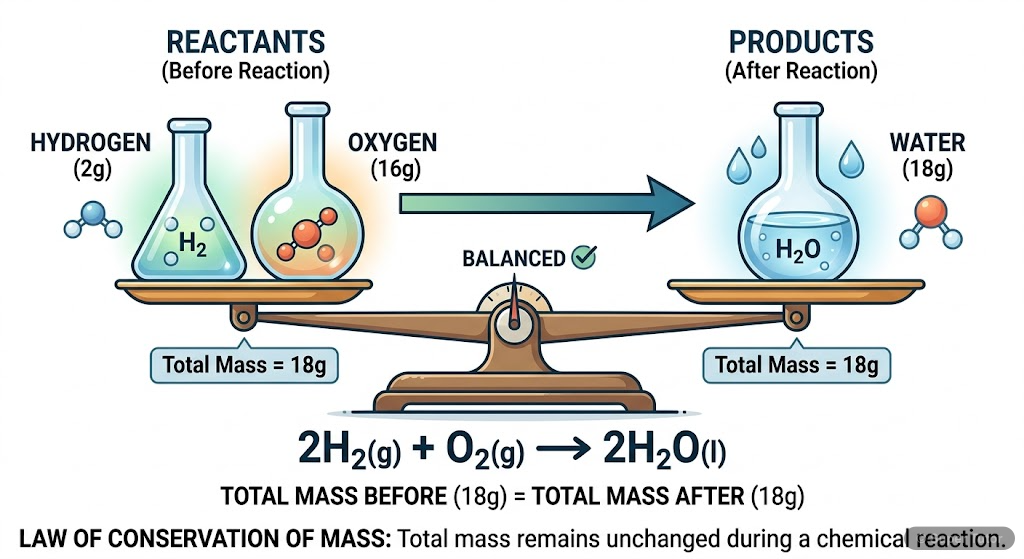
Learn better with visuals Super Tutor pairs illustrations like this with notes and quizzes for Language of Chemistry.
What is a chemical reaction?
Answer
A chemical reaction is any chemical change in matter that transforms it into one or more new substances. Matter changes form, and energy is also involved.
What are reactants and products?
Answer
Reactants are the substances that undergo chemical change. Products are the new substances formed after the reaction. Reactants are written on the left side of a chemical equation, and products are wr…
Write the general scheme of a chemical reaction.
Answer
Reactants --Chemical Change--> Products Reactants are the substances that change, and products are the new substances formed.
What is a word equation?
Answer
A word equation is a chemical reaction written using the names of reactants and products. Word equations do not require balancing. Example: Hydrogen + Oxygen → Water…
Write the word equation for hydrogen and oxygen forming water.
Answer
Hydrogen + Oxygen → Water Reactants: Hydrogen, Oxygen Product: Water…
What happens when mercuric oxide is heated?
Answer
Mercuric oxide decomposes on heating to give mercury and oxygen. Mercuric oxide --heat--> Mercury + Oxygen Reactant: Mercuric oxide Products: Mercury, Oxygen…
What happens when potassium chlorate is heated with manganese dioxide?
Answer
Potassium chlorate decomposes faster on heating in the presence of manganese dioxide. Potassium chlorate --heat/MnO2--> Potassium chloride + Oxygen MnO2 acts as a catalyst and does not undergo any che…
What is a catalyst?
Answer
A catalyst is a substance that changes the rate of a chemical reaction without itself undergoing any chemical change. Manganese dioxide is a catalyst in the decomposition of potassium chlorate.
+28 more flashcards
Practise AllFrequently Asked Questions
What are the important topics in Language of Chemistry for ICSE Class 7 Chemistry?
How many flashcards are available for Language of Chemistry?
How should I revise Language of Chemistry for Class 7 exams?
Sources & Official References
Content is aligned to the official syllabus. Refer to the board website for the latest curriculum.
More resources for Language of Chemistry
Practice Quiz
Test yourself with a quick quiz
Important Questions
Exam-style questions with answers
Revision Notes
Key points for last-minute revision
Chapter Summary
Understand the chapter at a glance
Concept Maps
See how topics connect
Study Plan
Step-by-step plan for this chapter
Syllabus
What topics to cover
For serious students
Get the full Language of Chemistry chapter — start free.
Quizzes, flashcards, an AI doubt solver and a study plan for ICSE Class 7 Chemistry. Free to start, no card needed.