Language of Chemistry — Chapter Summary
ICSE · Class 7 · Chemistry
Summary of Language of Chemistry for ICSE Class 7 Chemistry. Key concepts: A chemical reaction is, Reactants are the substances and A word equation writes.
Interactive on Super Tutor
Studying Language of Chemistry? Get the full interactive chapter.
Quizzes, flashcards, AI doubt-solver and a step-by-step study plan — built for chapter summary and more.
Free trial, no card needed.
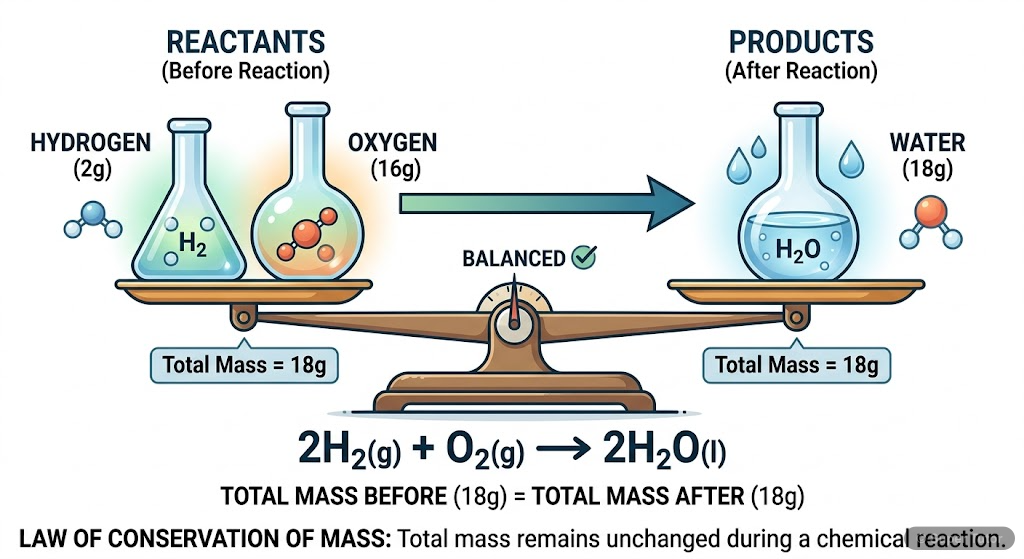
Learn better with visuals Super Tutor pairs illustrations like this with notes and quizzes for Language of Chemistry.
Overview
Chemistry uses symbols, formulae, and equations to describe substances and the changes they undergo. A chemical reaction forms new substances called products from starting substances called reactants. Chemical equations make these changes shorter and easier to write, while still showing the main fac
Key Concepts
A chemical reaction is a chemical
A chemical reaction is a chemical change in matter that forms one or more new substances. During the reaction, matter changes form and energy is also
Reactants are the substances that undergo
Reactants are the substances that undergo chemical change and are written on the left side of a chemical equation. Products are the new substances for
A word equation writes the names
A word equation writes the names of reactants and products instead of symbols and formulae. Word equations do not require balancing.
A chemical equation uses symbols
A chemical equation uses symbols and formulae to represent a reaction. It is a short-hand form that saves space, time, and energy.
A skeletal equation is an unbalanced
A skeletal equation is an unbalanced chemical equation. For example, H2 + Cl2 → HCl is skeletal because the number of atoms on both sides is not equal
Learning Objectives
- Identify reactants and products in a chemical reaction
- Write a reaction as a word equation
- Understand why symbols and formulae are used in chemical equations
- Recognise common characteristics of chemical reactions
- Distinguish between skeletal and balanced equations
Frequently Asked Questions
What are the important topics in Language of Chemistry for ICSE Class 7 Chemistry?
How should I revise Language of Chemistry for Class 7 exams?
Sources & Official References
Content is aligned to the official syllabus. Refer to the board website for the latest curriculum.
More resources for Language of Chemistry
For serious students
Get the full Language of Chemistry chapter — start free.
Quizzes, flashcards, an AI doubt solver and a study plan for ICSE Class 7 Chemistry. Free to start, no card needed.