Physical and Chemical Changes
ICSE · Class 7 · Chemistry
Most important questions from Physical and Chemical Changes for ICSE Class 7 Chemistry board exam 2026. MCQs, short answer, and long answer questions with marks.
Interactive on Super Tutor
Studying Physical and Chemical Changes? Get the full interactive chapter.
Quizzes, flashcards, AI doubt-solver and a step-by-step study plan — built for important questions and more.
1,000+ Class 7 students started this chapter today
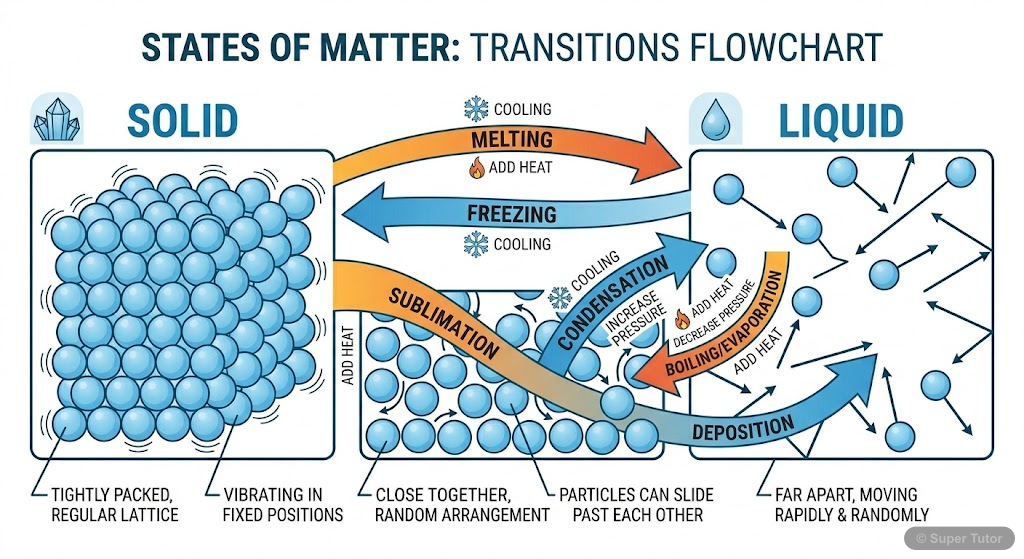
This is just one of 5+ visuals inside Super Tutor's Physical and Chemical Changes chapter
Explore the full setSample Questions
Iron filings and sulphur powder are mixed and then heated together. Which of the following observations proves that a chemical change has occurred (and NOT just a physical mixing)?
Show answer
The colour of the mixture changes from yellow-grey to black, and the product (iron sulphide) is not attracted to a magnet and does not dissolve in carbon disulphide.
Step 1: The reaction is: Fe(s) + S(s) → FeS(s). Iron sulphide, a new compound, is formed with completely different properties. Step 2: Iron is greyish-black and magnetic; sulphur is yellow and dissolves in carbon disulphide. But iron sulphide (FeS) is black, non-magnetic, and does not dissolve in carbon disulphide. Step 3: These completely different properties confirm a chemical change has occurred. Step 4: Option B is wrong — heat being released can also occur in physical changes (like dissolving quick lime); it alone does not prove a chemical change. Step 5: Option C is wrong — this would be
Quick lime (calcium oxide, CaO) is added to water. The beaker becomes very hot. A white solid partially dissolves to form lime water. Which of the following CORRECTLY identifies the type of change and the reason?
Show answer
It is a chemical change because CaO reacts with water to form a new substance, calcium hydroxide Ca(OH)₂, with a large release of heat energy.
Step 1: The reaction is: CaO(s) + H₂O(l) → Ca(OH)₂(s/aq) + Heat. This is called the slaking of lime. Step 2: Calcium hydroxide (slaked lime) is a NEW substance with different properties from calcium oxide. Step 3: The large amount of heat released is a strong indicator of a chemical change (exothermic reaction). Step 4: Option A is wrong — dissolving salt is physical because no new substance forms; here Ca(OH)₂ is a new compound. Option C is wrong — the heat is produced due to a chemical reaction, not friction. Step 5: Option D is wrong — the key indicator of a chemical change is the formation
The process of sublimation of ammonium chloride is classified as a physical change. Which reason CORRECTLY justifies this classification?
Show answer
Ammonium chloride changes directly from solid to gas on heating, but on cooling the vapour changes back into solid ammonium chloride — no new substance is formed, so it is a physical change.
Step 1: Sublimation is the process where a solid changes directly into a gas (vapour) on heating without passing through the liquid state. Step 2: For ammonium chloride: NH₄Cl(s) ⇌ NH₄Cl(g). The same compound exists in both states — no new substance is formed. Step 3: When the vapour is cooled, it deposits back as solid ammonium chloride (called the sublimate) — this proves the change is reversible and temporary, both characteristics of a physical change. Step 4: Option B describes thermal decomposition of ammonium chloride (which can happen at very high temperatures), but simple sublimation a
Respiration in living beings is classified as a chemical change. The correct balanced equation for aerobic respiration is:
Show answer
C₆H₁₂O₆ + 6O₂ → 6CO₂ + 6H₂O + Energy
Step 1: Aerobic respiration uses glucose (C₆H₁₂O₆) and oxygen (O₂) as reactants. Step 2: The products are carbon dioxide (CO₂), water (H₂O), and energy. Step 3: Balancing: 1 glucose + 6 O₂ → 6 CO₂ + 6 H₂O. Check: Left side — 6C, 12H, 18O. Right side — 6C (in CO₂), 12H (in H₂O), 12+6=18O. Balanced! Step 4: This is a chemical change because entirely new substances (CO₂ and H₂O) are formed from glucose, and the change is irreversible — you cannot get glucose back from CO₂ and H₂O in our body cells. Step 5: Option B is wrong — water is a product, not a reactant. Option C is wrong — hydrogen gas (H
+41 more questions available
Practice AllFrequently Asked Questions
What are the important topics in Physical and Chemical Changes for ICSE Class 7 Chemistry?
How to score full marks in Physical and Chemical Changes — ICSE Class 7 Chemistry?
How many important questions are there in Physical and Chemical Changes?
Sources & Official References
Content is aligned to the official syllabus. Refer to the board website for the latest curriculum.
More resources for Physical and Chemical Changes
Practice Quiz
Test yourself with a quick quiz
Revision Notes
Key points for last-minute revision
Formula Sheet
All formulas in one place
Chapter Summary
Understand the chapter at a glance
Concept Maps
See how topics connect visually
Study Plan
Step-by-step plan to ace this chapter
Flashcards
Quick-fire cards for active recall
Syllabus
What topics to cover
NCERT Solutions
Every textbook question solved step by step
For serious students
Get the full Physical and Chemical Changes chapter — for free.
Quizzes, flashcards, AI doubt-solver and a step-by-step study plan for ICSE Class 7 Chemistry.