Weather and Climate — Chapter Summary
ICSE · Class 7 · Geography
Summary of Weather and Climate for ICSE Class 7 Geography. Key concepts: Weather is the day, Climate is the average weather and The main elements are.
Interactive on Super Tutor
Studying Weather and Climate? Get the full interactive chapter.
Quizzes, flashcards, AI doubt-solver and a step-by-step study plan — built for chapter summary and more.
Free trial, no card needed.
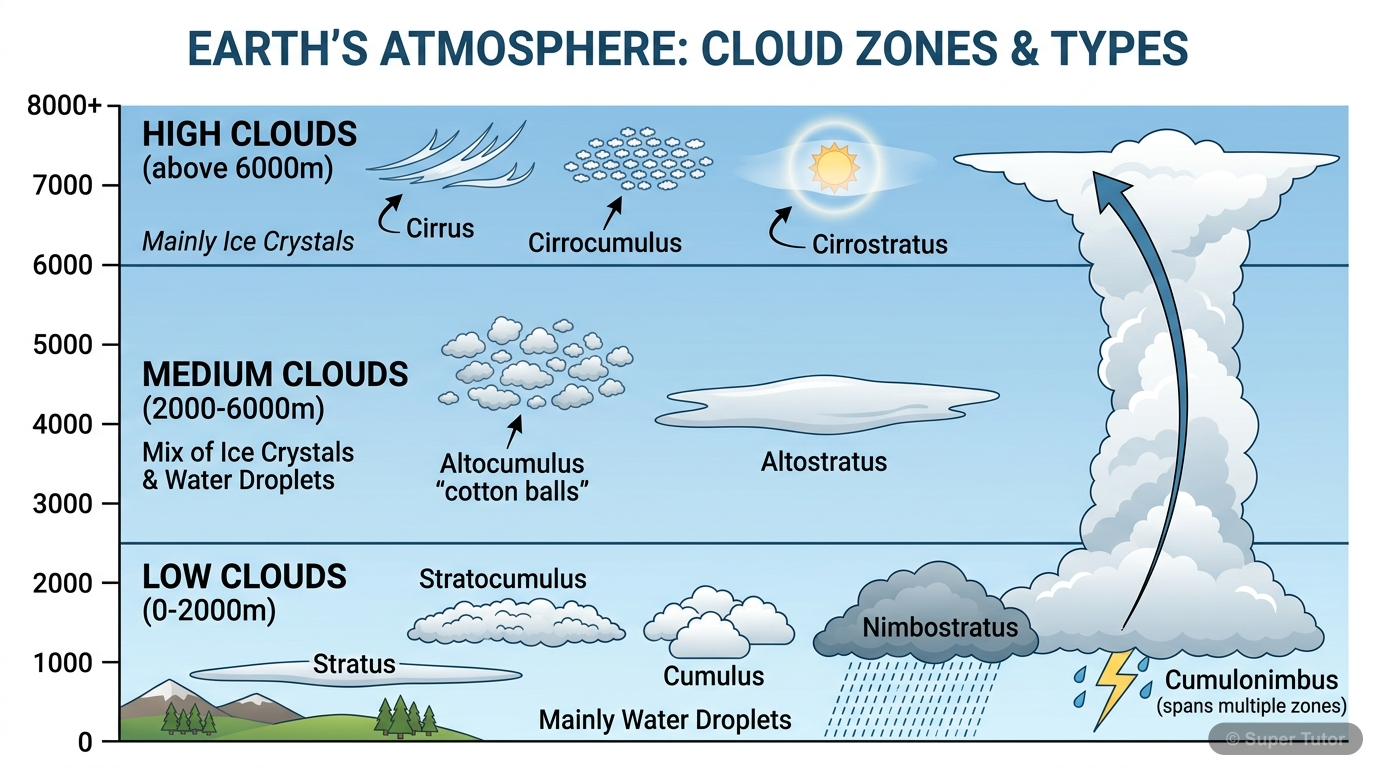
Learn better with visuals Super Tutor pairs illustrations like this with notes and quizzes for Weather and Climate.
Overview
Weather is the short-term condition of the atmosphere at a particular place and time. Climate is the average weather pattern of a place over a long period, usually 25 to 30 years. Weather changes quickly, while climate gives the general pattern of a region. The chapter explains the main elements of
Key Concepts
Weather is the day
Weather is the day-to-day condition of the atmosphere at a place. It includes temperature, pressure, winds, humidity, rainfall, sunshine, and clouds.
Climate is the average weather pattern
Climate is the average weather pattern of a place over a long period. A minimum period of 30 years is considered desirable, and climate may also be de
The main elements are temperature
The main elements are temperature, atmospheric pressure, prevailing winds, humidity, precipitation, sunshine, and clouds.
Temperature means how hot or cold
Temperature means how hot or cold a place is. It is measured by a thermometer. In Celsius, water freezes at 0°C and boils at 100°C. In Fahrenheit, wat
Atmospheric pressure is the force exerted
Atmospheric pressure is the force exerted by the air column on the earth's surface. It is measured most accurately by a mercury barometer and recorded
Learning Objectives
- To understand the difference between weather and climate
- To identify the main elements of weather and climate
- To learn the use of weather instruments such as thermometer, barometer, hygrometer, rain gauge, wind vane, and anemometer
- To understand how sunshine duration, rainfall, temperature, and pressure are recorded
- To recognise isotherms, isohyets, isobars, and isohels on weather maps
Frequently Asked Questions
What are the important topics in Weather and Climate for ICSE Class 7 Geography?
How should I revise Weather and Climate for Class 7 exams?
Sources & Official References
Content is aligned to the official syllabus. Refer to the board website for the latest curriculum.
More resources for Weather and Climate
For serious students
Get the full Weather and Climate chapter — start free.
Quizzes, flashcards, an AI doubt solver and a study plan for ICSE Class 7 Geography. Free to start, no card needed.