Weather and Climate — Practice Quiz
ICSE · Class 7 · Geography
Try a 4-question quiz on Weather and Climate for ICSE Class 7 Geography: tap an answer to check it and see why. 45 questions in the full chapter test.
Interactive on Super Tutor
Studying Weather and Climate? Get the full interactive chapter.
Quizzes, flashcards, AI doubt-solver and a step-by-step study plan — built for practice quiz and more.
Free trial, no card needed.
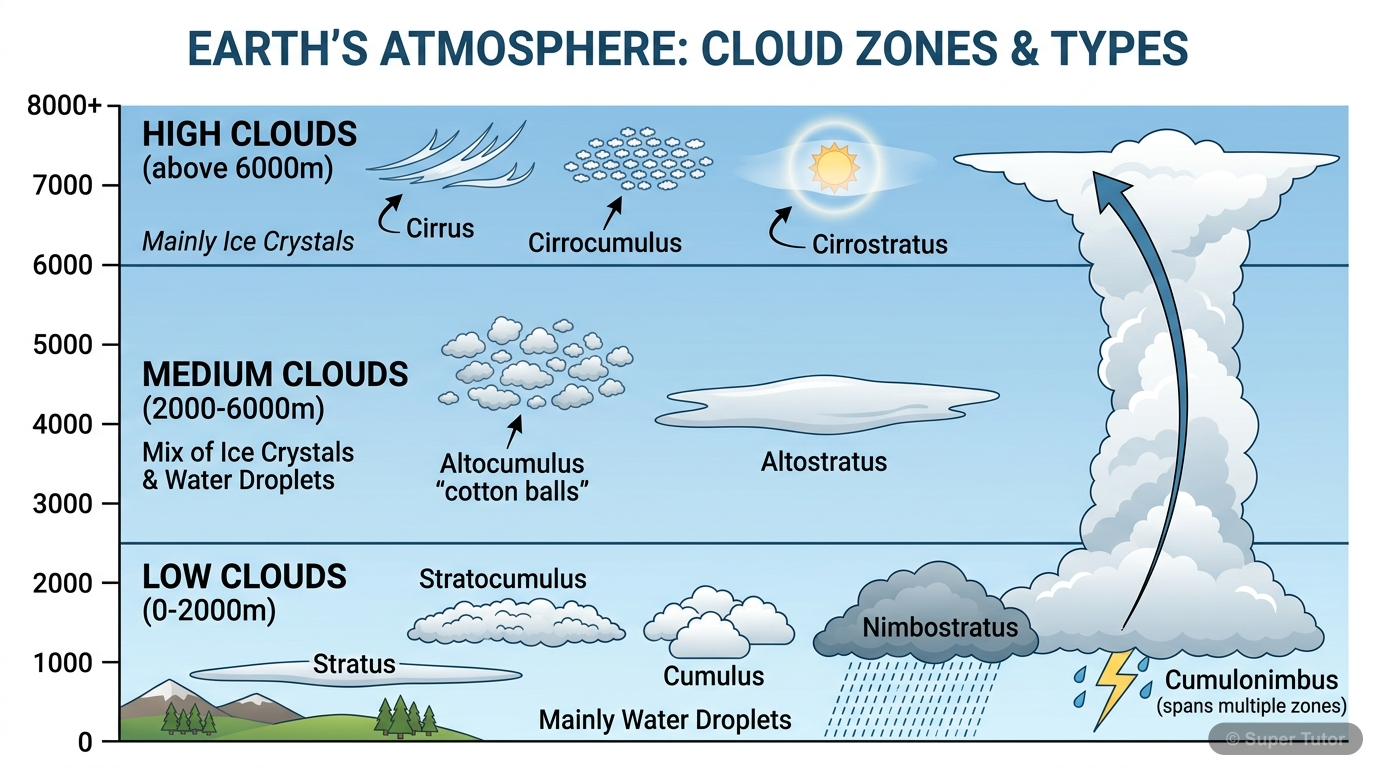
Learn better with visuals Super Tutor pairs illustrations like this with notes and quizzes for Weather and Climate.
Quick Quiz: Weather and Climate
0/4Tap an answer to check it instantly. No sign-up needed for these 4.
What is the main difference between weather and climate?
Which instrument is used to measure atmospheric pressure?
Relative humidity is expressed in which unit?
An isotherm on a weather map connects places having:
Sample Questions
Which type of cloud is feathery and forms at very high levels of 5 to 10 km, made of tiny ice crystals?
Show answer
Cirrus
Step 1: Cirrus clouds are high-altitude clouds that form between 5 to 10 km above the earth. Step 2: They are made of tiny ice crystals (not water droplets) because the temperature is very cold at that height. Step 3: They appear feathery or fibrous, like wisps of cotton floating in the sky. Step 4: Cumulus clouds are cauliflower-shaped with great vertical height — not feathery. Stratus clouds are sheet-like clouds at low levels. Nimbus clouds are dark rain clouds. Step 5: So the correct answer is Cirrus.
What does an anemometer measure?
Show answer
Wind speed
Step 1: Wind has two important properties — direction and speed. Different instruments measure each. Step 2: An anemometer measures wind speed. It has 3 or 4 metal cups mounted on a pole that spin when wind blows. The faster they spin, the stronger the wind. Step 3: Wind speed is measured in knots. (1 knot = 1 nautical mile per hour). Step 4: Wind direction is measured by a wind vane (or weather cock), not an anemometer. Step 5: Rainfall is measured by a rain gauge, and atmospheric pressure is measured by a barometer — both different instruments.
The atmospheric pressure at normal sea level is:
Show answer
1013 millibars
Step 1: Atmospheric pressure is measured in millibars (mb) by meteorologists. Step 2: At normal sea level, the standard atmospheric pressure is 1013 millibars. Step 3: This 1013 mb is equivalent to 76 cm of mercury column in a mercury barometer. Step 4: Option A (1034) is a distractor — 1034 gm/sq cm refers to the mass of air, not the mb pressure value. Step 5: 760 refers to millimetres of mercury (76 cm), not millibars. 101 is not a standard measurement used in meteorology for sea level pressure.
According to Ferrel's Law, in which direction are winds deflected in the Northern Hemisphere?
Show answer
To the right
Step 1: The Earth rotates at different speeds at the equator and at mid-latitudes. Step 2: This difference in speed creates a force called the Coriolis force, described by Ferrel's Law. Step 3: Due to this force, winds do not blow in a straight line — they get deflected. Step 4: In the Northern Hemisphere, winds are deflected to the RIGHT of their original direction. Step 5: In the Southern Hemisphere, winds are deflected to the LEFT. This is an important rule for understanding global wind patterns.
+41 more questions on Weather and Climate (ICSE Class 7 Geography)
Practise AllFrequently Asked Questions
What are the important topics in Weather and Climate for ICSE Class 7 Geography?
How many practice questions are there for Weather and Climate?
Sources & Official References
Content is aligned to the official syllabus. Refer to the board website for the latest curriculum.
More resources for Weather and Climate
Important Questions
Exam-style questions with answers
Revision Notes
Key points for last-minute revision
Chapter Summary
Understand the chapter at a glance
Concept Maps
See how topics connect
Study Plan
Step-by-step plan for this chapter
Flashcards
Quick-fire cards for active recall
Syllabus
What topics to cover
For serious students
Get the full Weather and Climate chapter — start free.
Quizzes, flashcards, an AI doubt solver and a study plan for ICSE Class 7 Geography. Free to start, no card needed.