Industries — Practice Quiz
ICSE · Class 7 · Geography
Try a 4-question quiz on Industries for ICSE Class 7 Geography: tap an answer to check it and see why. 45 questions in the full chapter test.
Interactive on Super Tutor
Studying Industries? Get the full interactive chapter.
Quizzes, flashcards, AI doubt-solver and a step-by-step study plan — built for practice quiz and more.
Free trial, no card needed.
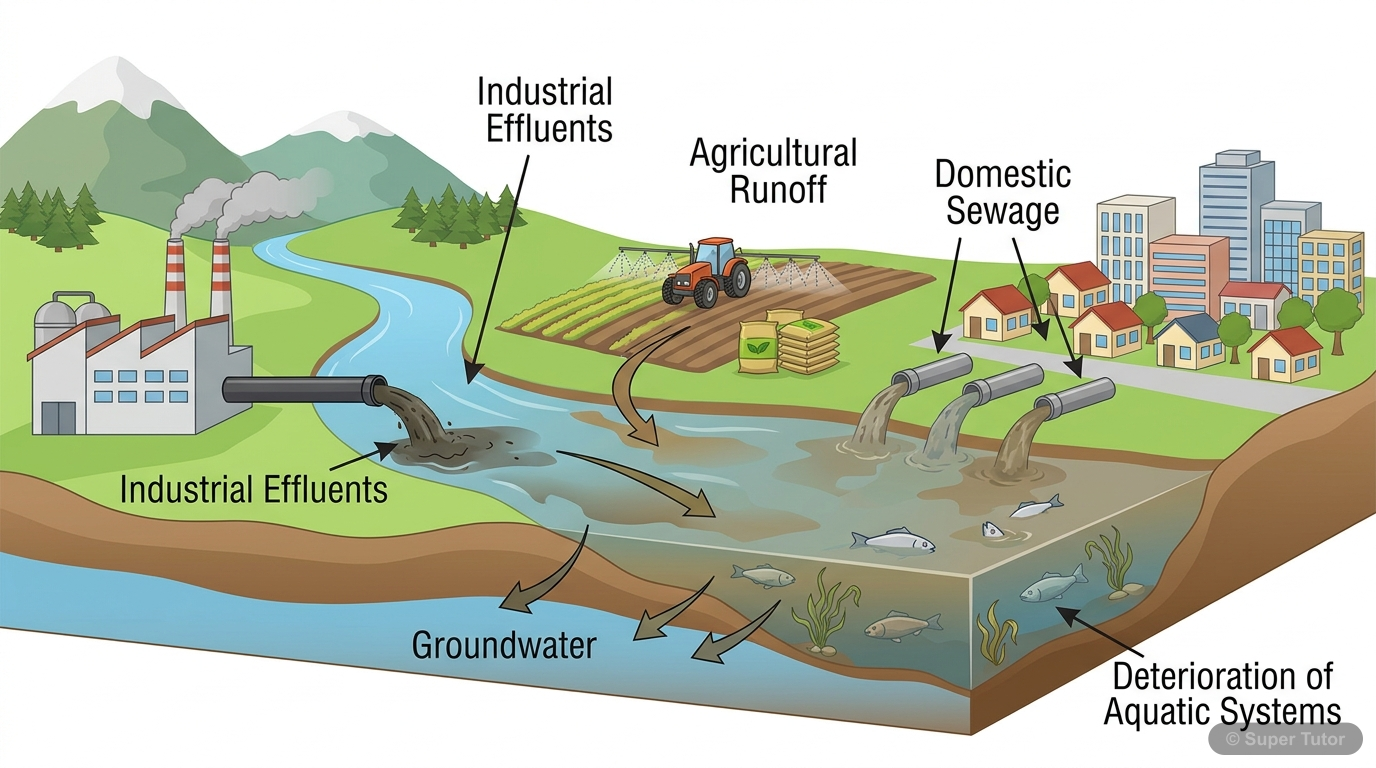
Learn better with visuals Super Tutor pairs illustrations like this with notes and quizzes for Industries.
Quick Quiz: Industries
0/4Tap an answer to check it instantly. No sign-up needed for these 4.
Which of the following correctly explains why the sugar industry is always located near sugarcane fields?
Mumbai is called the 'Cottonopolis of India'. Which combination of geographical factors makes Mumbai the most important cotton textile centre?
Osaka in Japan is known as the 'Manchester of Japan'. What is the primary reason Japan's textile industry is considered export-oriented?
Which of the following diseases is directly caused by water contaminated with mercury, as mentioned in the context of industrial water pollution?
Sample Questions
Bengaluru is called the 'Silicon Valley of India'. Which of the following factors is NOT responsible for making Bengaluru the IT hub of India?
Show answer
Proximity to major iron ore and coalfields of Karnataka
Step 1: The question asks us to identify the factor that is NOT responsible for Bengaluru's IT growth — this means we need to find the incorrect or irrelevant factor. Step 2: Bengaluru became an IT hub because of skilled labour, strong educational institutions, government support, mild climate, and presence of existing high-tech industries — all mentioned in the textbook. Step 3: Option A is valid — public sector units like BEL, HAL, ITI were set up in Bengaluru from the 1950s. Step 4: Option B is valid — a highly educated workforce in science and engineering is key for IT. Step 5: Option D is
The technique 'Flue Gas Sulphurisation' is used in industries to control which specific air pollutant?
Show answer
Sulphur dioxide produced by combustion of fossil fuels
Step 1: The textbook specifically states that 'Sulphur dioxide produced by combustion of fossil fuels can be removed from gases by Flue Gas Sulphurisation method.' Step 2: Sulphur dioxide (SO₂) is formed when coal and other sulphur-containing fossil fuels are burned in factories. Step 3: Flue Gas Sulphurisation (FGS) is a process that removes SO₂ from exhaust gases (flue gases) before they are released into the atmosphere through chimneys. Step 4: Carbon monoxide, nitrogen oxide, and lead oxide are different pollutants with their own control methods — they are not removed by Flue Gas Sulphuris
Which of the following best explains why large-scale iron and steel industries set up entire townships near their plants?
Show answer
To ensure a continuous and adequate supply of labour by providing housing and facilities to workers
Step 1: Iron and steel is a large-scale, capital-intensive industry that requires a huge and continuous workforce. Step 2: These plants are often located in areas far from large cities (e.g., Jamshedpur, Bhilai) where natural labour supply may not be readily available. Step 3: To attract and retain workers, the companies build entire townships with housing, schools, hospitals, and other amenities near the plant. Step 4: This ensures that the labour supply is stable and workers do not have to travel long distances — keeping production running smoothly. Step 5: Option A is incorrect because town
In the context of the fishing industry, the convergence of which two ocean currents makes the North West Atlantic one of the world's richest fishing grounds?
Show answer
The Gulf Stream and the Labrador Current
Step 1: The textbook states that 'the convergence of the Gulf Stream and the Labrador current in this region increases productivity of fish' in the North West Atlantic. Step 2: The Gulf Stream is a warm ocean current flowing from the tropics northward, while the Labrador Current is a cold current flowing from the Arctic southward. Step 3: When warm and cold currents meet, they cause an upwelling of nutrient-rich water from the ocean floor. This upwelling supports the growth of plankton, which is the primary food for fish. Step 4: This makes the Grand Bank and Georges Bank in the North West Atl
+41 more questions on Industries (ICSE Class 7 Geography)
Practise AllFrequently Asked Questions
What are the important topics in Industries for ICSE Class 7 Geography?
How many practice questions are there for Industries?
Sources & Official References
Content is aligned to the official syllabus. Refer to the board website for the latest curriculum.
More resources for Industries
Important Questions
Exam-style questions with answers
Revision Notes
Key points for last-minute revision
Chapter Summary
Understand the chapter at a glance
Concept Maps
See how topics connect
Study Plan
Step-by-step plan for this chapter
Flashcards
Quick-fire cards for active recall
Syllabus
What topics to cover
For serious students
Get the full Industries chapter — start free.
Quizzes, flashcards, an AI doubt solver and a study plan for ICSE Class 7 Geography. Free to start, no card needed.