Heat
ICSE · Class 7 · Physics
Most important questions from Heat for ICSE Class 7 Physics board exam 2026. MCQs, short answer, and long answer questions with marks.
Interactive on Super Tutor
Studying Heat? Get the full interactive chapter.
Quizzes, flashcards, AI doubt-solver and a step-by-step study plan — built for important questions and more.
1,000+ Class 7 students started this chapter today
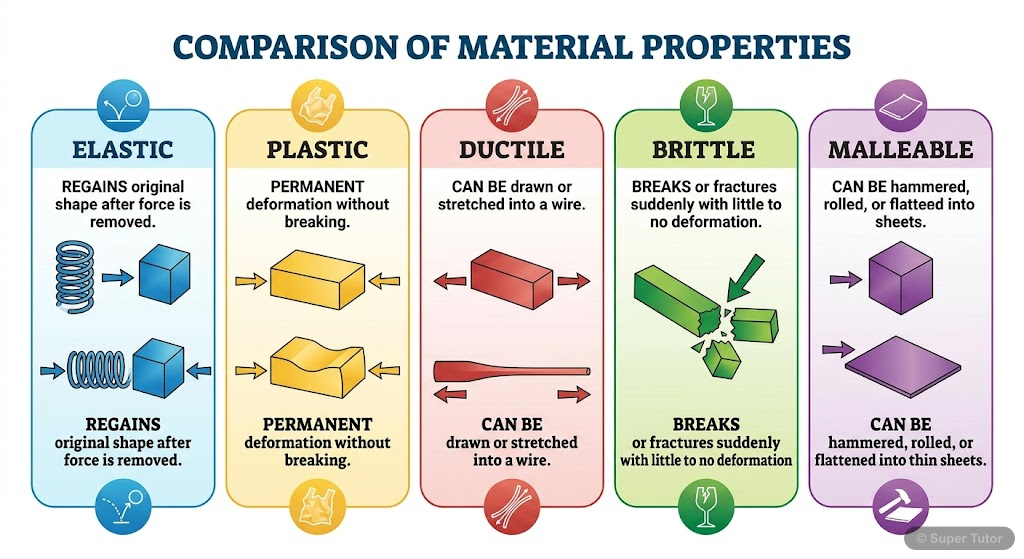
Learn better with visuals Super Tutor has hundreds of illustrations like this across every chapter — all free to try.
Get startedSample Questions
During the melting of ice at 0°C, heat is continuously supplied to it. Which of the following correctly explains what happens to this heat?
Show answer
The heat is used to break intermolecular bonds and change the state from solid to liquid at constant temperature
Step 1: During change of state, the temperature remains constant — this is the key concept. Step 2: The heat absorbed during melting is called latent heat. Step 3: This latent heat is used to overcome the forces of attraction (intermolecular bonds) between molecules of the solid, converting it to liquid without raising the temperature. Step 4: The first option is wrong — temperature does NOT rise during melting; it stays at 0°C. The third option is wrong — stored potential energy concept is partially true but the heat is not 'released when water boils'. The fourth option is wrong — the heat is
A steel girder on a bridge is 20 m long in winter at 5°C. In summer, at 45°C, the girder expands. Why is one end of the girder placed on rollers instead of being fixed? Which physical phenomenon makes this design necessary?
Show answer
Thermal expansion causes the girder to increase in length, and rollers allow free expansion to prevent structural damage
Step 1: When temperature rises, solids expand — this is called thermal expansion. Step 2: A steel girder fixed at both ends cannot expand freely. The expansion force would cause it to buckle or damage the pillars. Step 3: By placing one end on rollers, the girder can slide freely when it expands in summer or contracts in winter, without exerting force on the support pillars. Step 4: Convection does not move solid girders. Radiation does not cause mass loss in steel. Rollers do not help in heat conduction — they help in movement.
In Activity 12 from the chapter, when the top portion of a test tube containing water and ice at the bottom is heated, the water at the top boils but the ice at the bottom does not melt. What does this prove?
Show answer
Water is a bad conductor of heat, so heat does not reach the bottom of the test tube
Step 1: In this experiment, the test tube is heated near its mouth (top). Step 2: Water at the top boils, but ice at the bottom remains unmelted. Step 3: This can only happen if heat does not travel easily downward through the water — proving water is a bad conductor of heat. Step 4: Conduction in water is very poor, and convection currents (warm water rising, cold sinking) would not carry heat to the bottom. Convection moves heat upward, not downward. Ice melts at 0°C, not at a temperature higher than 100°C.
A thermos flask keeps hot tea hot for several hours. Which combination of features correctly prevents ALL three modes of heat transfer?
Show answer
Vacuum between walls (prevents conduction and convection), shiny surfaces (prevent radiation), cork stopper (prevents convection through the mouth)
Step 1: Conduction and convection both require a medium (matter). Vacuum has no medium, so it prevents BOTH conduction and convection between the walls. Step 2: Radiation does not need a medium. To reduce radiation, the surfaces of both walls are made shiny — shiny surfaces reflect heat radiation instead of absorbing it. Step 3: The cork stopper prevents hot air from escaping through the mouth, stopping convection at the opening. Step 4: Option A incorrectly assigns vacuum to preventing radiation. Option C incorrectly says shiny surfaces prevent conduction. Option D incorrectly claims a cork a
+41 more questions available
Practice AllFrequently Asked Questions
What are the important topics in Heat for ICSE Class 7 Physics?
How to score full marks in Heat — ICSE Class 7 Physics?
How many important questions are there in Heat?
Sources & Official References
Content is aligned to the official syllabus. Refer to the board website for the latest curriculum.
More resources for Heat
Practice Quiz
Test yourself with a quick quiz
Revision Notes
Key points for last-minute revision
Formula Sheet
All formulas in one place
Chapter Summary
Understand the chapter at a glance
Concept Maps
See how topics connect visually
Study Plan
Step-by-step plan to ace this chapter
Flashcards
Quick-fire cards for active recall
Syllabus
What topics to cover
NCERT Solutions
Every textbook question solved step by step
For serious students
Get the full Heat chapter — for free.
Quizzes, flashcards, AI doubt-solver and a step-by-step study plan for ICSE Class 7 Physics.