Chapter 4 of 14
Revision Notes
The Union Executive — Revision Notes
ICSE · Class 8 · History & Civics
The Union Executive revision notes for ICSE Class 8 History & Civics: 4 topics in quick points. Part of the ICSE Class 8 History & Civics syllabus.
42 questions30 flashcards5 concepts
Interactive on Super Tutor
Studying The Union Executive? Get the full interactive chapter.
Quizzes, flashcards, AI doubt-solver and a step-by-step study plan — built for revision notes and more.
Free trial, no card needed.
Super Tutor
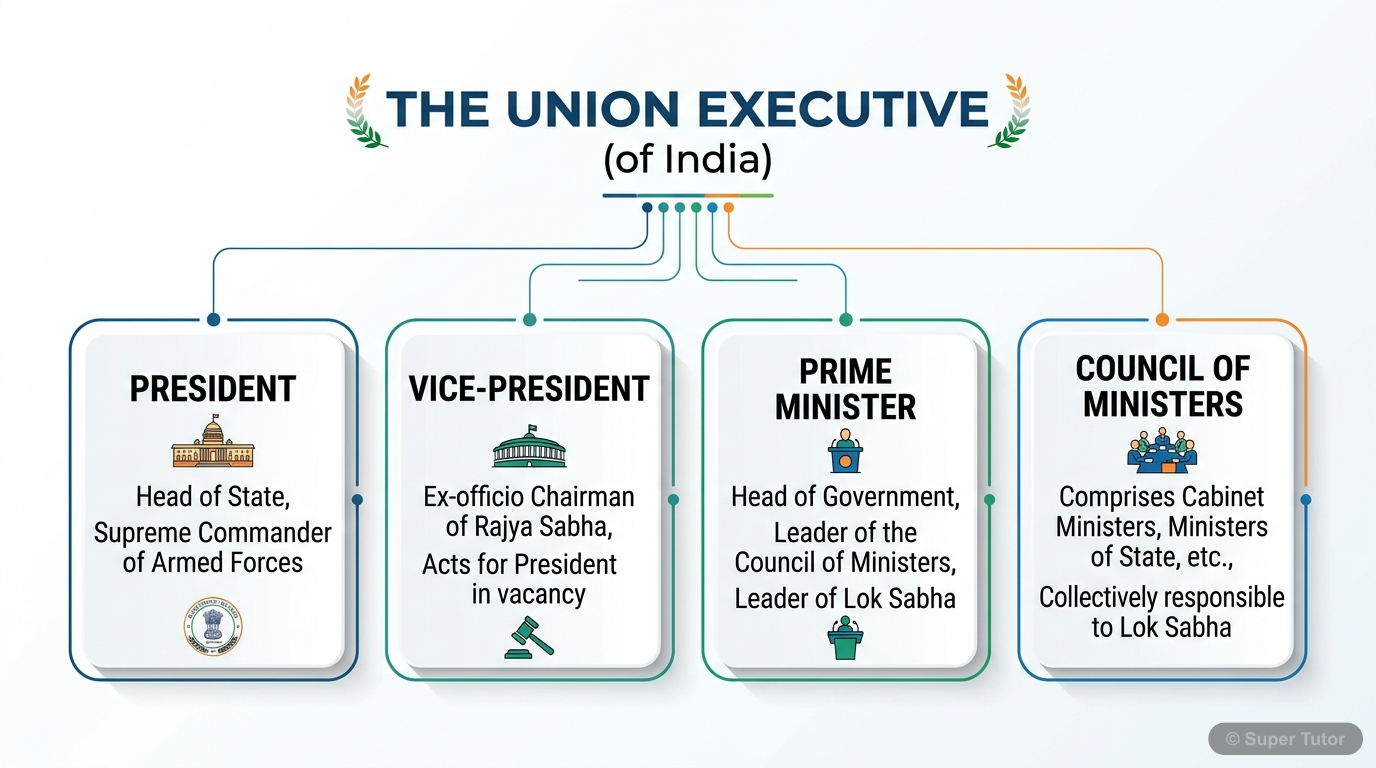
Learn better with visuals Super Tutor pairs illustrations like this with notes and quizzes for The Union Executive.
Key Topics to Revise
1
1. Meaning and Composition of the Union Executive
- The executive carries out and enforces the laws made by the legislature.
- The Union Executive of the Government of India consists of the President, the Vice-President, the Prime Minister, and the Council of Ministers.
- The President is the constitutional or nominal head of the Union Executive.
2
2. The President of India
- The President is the constitutional head of the Indian Union.
- The President is only a nominal head, and acts on the advice of the Council of Ministers.
- To become President, a person must be a citizen of India, at least 35 years of age, and not hold any office of profit under the central or state government.
3
3. The Vice-President of India
- In the absence of the President, the Vice-President carries out the President's functions.
- The Vice-President is elected by members of both Houses of Parliament.
- The Vice-President must be an Indian citizen and must have completed 35 years of age.
4
4. The Prime Minister and the Council of Ministers
- The leader of the party or coalition with absolute majority in the Lok Sabha is appointed Prime Minister by the President.
- In the parliamentary form of government, the Prime Minister is the real head of the Indian government.
- The Prime Minister is the leader of the Lok Sabha and of the largest party or coalition represented in it.
Get complete notes with diagrams and examples
Full NotesKey Concepts
The President is the constitutional headThe President appoints the Prime MinisterThe ViceThe Prime Minister is the realThe Council of Ministers
Frequently Asked Questions
What are the important topics in The Union Executive for ICSE Class 8 History & Civics?
Key topics in The Union Executive include Meaning and Composition of the Union Executive, The President of India, The Vice-President of India, The Prime Minister and the Council of Ministers. Study these first, then practise questions on each for Class 8 exams.
How should I revise The Union Executive for Class 8 exams?
Learn the core ideas first, then work through the 42 practice questions on The Union Executive. Revise definitions regularly and use flashcards for quick recall before the exam.
Sources & Official References
Content is aligned to the official syllabus. Refer to the board website for the latest curriculum.
More resources for The Union Executive
For serious students
Get the full The Union Executive chapter — start free.
Quizzes, flashcards, an AI doubt solver and a study plan for ICSE Class 8 History & Civics. Free to start, no card needed.