Skeleton Movement and Locomotion — Study Plan
ICSE · Class 9 · Biology
A step-by-step study plan for Skeleton Movement and Locomotion, ICSE Class 9 Biology: what to learn first, what to practise and when to revise.
Interactive on Super Tutor
Studying Skeleton Movement and Locomotion? Get the full interactive chapter.
Quizzes, flashcards, AI doubt-solver and a step-by-step study plan — built for study plan and more.
Free trial, no card needed.
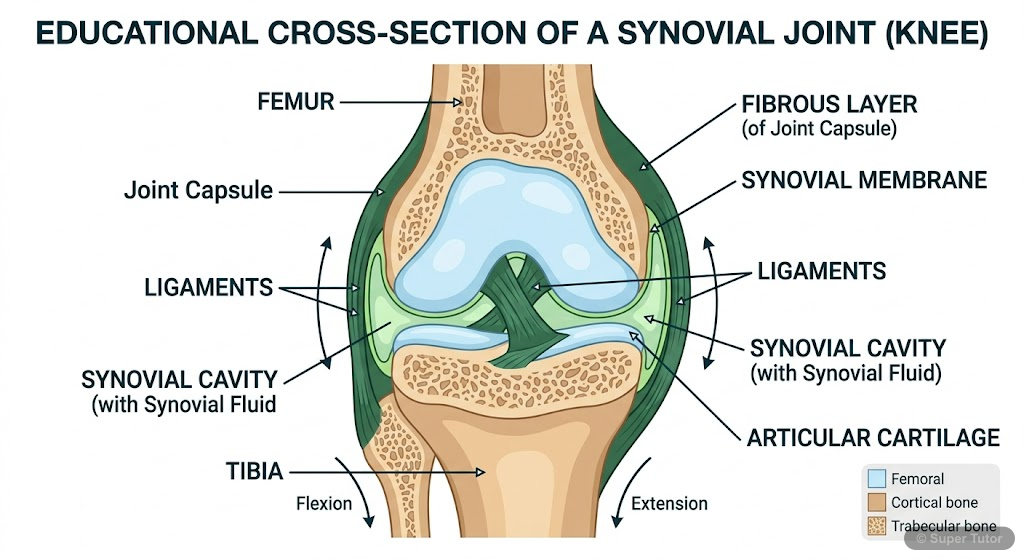
Learn better with visuals Super Tutor pairs illustrations like this with notes and quizzes for Skeleton Movement and Locomotion.
Study Plan
Learn the Theory
Read the textbook chapter carefully. Note down definitions, formulas and key ideas. Focus on: Functions of the Human Skeleton, Bone Structure and Types of Bones, Human Skeleton and Its Divisions.
Practise
Solve the textbook exercises and extra practice questions. There are 41 questions available for this chapter.
Revise & Test
Revise key points without looking at your notes. Take a practice quiz and mark weak areas for another pass.
Spaced Revision
Come back to Skeleton Movement and Locomotion after a week. Use flashcards for quick recall and try past exam questions on this chapter.
What to Focus On
- Support and shape are basic functions of the skeleton.
- The skull, vertebral column, and ribs protect important organs.
- Muscles attached to bones help in movement.
- Skeleton includes bones, cartilages, and ligaments.
- Cartilage gives support and shape but is flexible.
- Ligaments connect bones to each other.
- Bone contains organic and inorganic parts.
- The inorganic part is mainly calcium and phosphorus compounds.
- Decalcified bone becomes soft and flexible.
Common Mistakes to Avoid
The axial skeleton includes the shoulder girdle and hip girdle.
The human skeleton has only 206 bones in every bone-count table, so any other total must be wrong.
The patella is just a regular long bone like the femur or tibia.
Memory Tips
Functions of the skeleton
Axial skeleton parts
Regions and count of vertebrae
Atlas and axis
Want a personalised study plan?
Super Tutor builds a day-by-day plan for ICSE Class 9 Biology that fits your exam date and pace.
Create My Study PlanFrequently Asked Questions
What are the important topics in Skeleton Movement and Locomotion for ICSE Class 9 Biology?
How should I revise Skeleton Movement and Locomotion for Class 9 exams?
Sources & Official References
Content is aligned to the official syllabus. Refer to the board website for the latest curriculum.
More resources for Skeleton Movement and Locomotion
Practice Quiz
Test yourself with a quick quiz
Important Questions
Exam-style questions with answers
Revision Notes
Key points for last-minute revision
Chapter Summary
Understand the chapter at a glance
Concept Maps
See how topics connect
Flashcards
Quick-fire cards for active recall
Syllabus
What topics to cover
For serious students
Get the full Skeleton Movement and Locomotion chapter — start free.
Quizzes, flashcards, an AI doubt solver and a study plan for ICSE Class 9 Biology. Free to start, no card needed.