Chapter 12 of 19
Revision Notes
Skeleton Movement and Locomotion — Revision Notes
ICSE · Class 9 · Biology
Skeleton Movement and Locomotion revision notes for ICSE Class 9 Biology: 4 topics in quick points. Part of the ICSE Class 9 Biology syllabus.
41 questions48 flashcards5 concepts
Interactive on Super Tutor
Studying Skeleton Movement and Locomotion? Get the full interactive chapter.
Quizzes, flashcards, AI doubt-solver and a step-by-step study plan — built for revision notes and more.
Free trial, no card needed.
Super Tutor
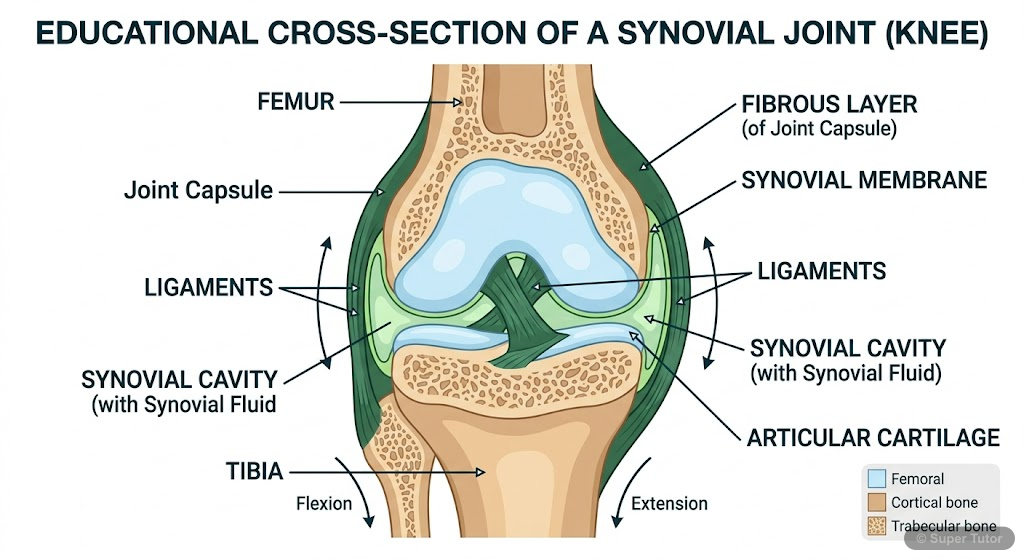
Learn better with visuals Super Tutor pairs illustrations like this with notes and quizzes for Skeleton Movement and Locomotion.
Key Topics to Revise
1
Functions of the Human Skeleton
- The skeleton provides support or framework to all soft parts and gives the body a definite shape.
- Several delicate and important organs are protected by bones.
- The skull protects the brain, the vertebral column protects the spinal cord, and the ribs protect the heart and lungs.
2
Bone Structure and Types of Bones
- Bone is the chief component of the skeleton.
- Bone contains organic and inorganic material.
- The inorganic part makes up nearly two-thirds of the entire bone substance and includes mainly calcium and phosphorus compounds.
3
Human Skeleton and Its Divisions
- The human skeleton consists of 206 bones including three very tiny bones in each ear.
- The skeleton has two main divisions: axial skeleton and appendicular skeleton.
- The axial skeleton includes the skull, vertebral column, ribs, and sternum.
4
Joints and Their Types
- A joint is the point at which two separate bones meet.
- There are three major categories of joints: immovable, partially movable, and freely movable.
- Immovable joints allow no movement between bones.
Get complete notes with diagrams and examples
Full NotesKey Concepts
The skeleton provides support and shapeBone is hard and rigid becauseBones are classified as longThe axial skeleton includes the skullThe appendicular skeleton includes the bones
Frequently Asked Questions
What are the important topics in Skeleton Movement and Locomotion for ICSE Class 9 Biology?
Key topics in Skeleton Movement and Locomotion include Functions of the Human Skeleton, Bone Structure and Types of Bones, Human Skeleton and Its Divisions, Joints and Their Types. Study these first, then practise questions on each for Class 9 exams.
How should I revise Skeleton Movement and Locomotion for Class 9 exams?
Learn the core ideas first, then work through the 41 practice questions on Skeleton Movement and Locomotion. Revise definitions regularly and use flashcards for quick recall before the exam.
Sources & Official References
Content is aligned to the official syllabus. Refer to the board website for the latest curriculum.
More resources for Skeleton Movement and Locomotion
For serious students
Get the full Skeleton Movement and Locomotion chapter — start free.
Quizzes, flashcards, an AI doubt solver and a study plan for ICSE Class 9 Biology. Free to start, no card needed.