Skeleton Movement and Locomotion — Chapter Summary
ICSE · Class 9 · Biology
Summary of Skeleton Movement and Locomotion for ICSE Class 9 Biology. Part of the ICSE Class 9 Biology syllabus.
Interactive on Super Tutor
Studying Skeleton Movement and Locomotion? Get the full interactive chapter.
Quizzes, flashcards, AI doubt-solver and a step-by-step study plan — built for chapter summary and more.
Free trial, no card needed.
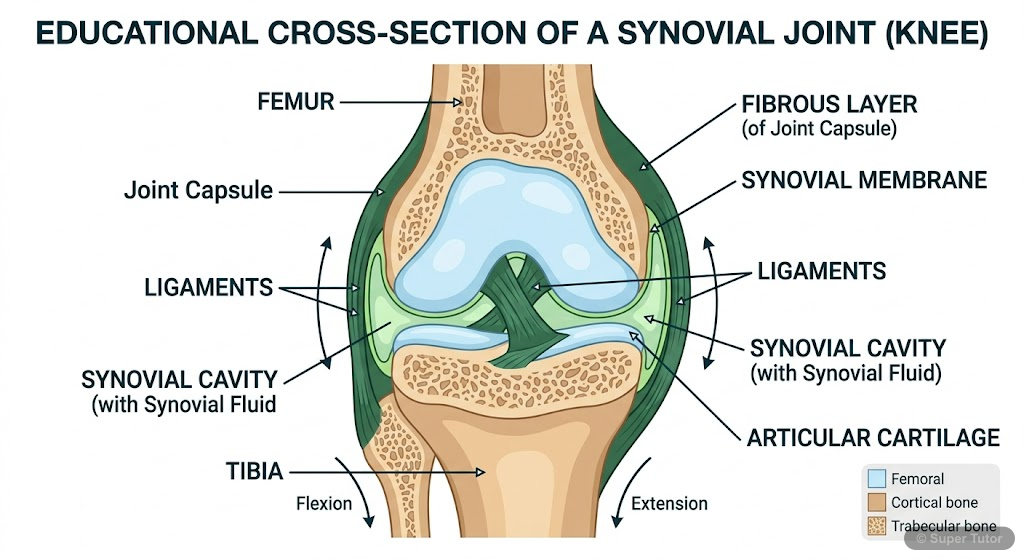
Learn better with visuals Super Tutor pairs illustrations like this with notes and quizzes for Skeleton Movement and Locomotion.
Overview
The human skeleton gives the body support, shape, protection, movement, leverage, blood cell formation, and mineral storage. Movement happens through the combined action of bones, joints, muscles, ligaments, cartilage, and tendons. The skeleton is divided into axial skeleton and appendicular skeleto
Key Concepts
The skeleton provides support and shape
The skeleton provides support and shape, protects delicate organs, helps in movement, acts as a lever system, forms blood cells in marrow, and stores
Bone is hard and rigid because
Bone is hard and rigid because it has both organic and inorganic material. The inorganic part forms nearly two-thirds of bone substance. If mineral pa
Bones are classified as long
Bones are classified as long, short, flat, and irregular. Long bones have a shaft and ends, short bones are box-like and spongy, flat bones have two c
The axial skeleton includes the skull
The axial skeleton includes the skull, vertebral column, ribs, and sternum. The skull has a cranium with eight bones and a face with fourteen bones. T
The appendicular skeleton includes the bones
The appendicular skeleton includes the bones of the limbs and girdles. The forelimb has humerus, radius, ulna, carpals, metacarpals, and phalanges. Th
Learning Objectives
- Understand the main functions of the human skeleton.
- Identify the parts of the axial skeleton and appendicular skeleton.
- Describe the structure and types of bones in the human body.
- Classify joints and relate each type to its movement.
- Explain how muscles work with bones to produce movement.
Frequently Asked Questions
What are the important topics in Skeleton Movement and Locomotion for ICSE Class 9 Biology?
How should I revise Skeleton Movement and Locomotion for Class 9 exams?
Sources & Official References
Content is aligned to the official syllabus. Refer to the board website for the latest curriculum.
More resources for Skeleton Movement and Locomotion
For serious students
Get the full Skeleton Movement and Locomotion chapter — start free.
Quizzes, flashcards, an AI doubt solver and a study plan for ICSE Class 9 Biology. Free to start, no card needed.