Study of Gas Laws — Practice Quiz
ICSE · Class 9 · Chemistry
Try a 4-question quiz on Study of Gas Laws for ICSE Class 9 Chemistry: tap an answer to check it and see why. 42 questions in the full chapter test.
Interactive on Super Tutor
Studying Study of Gas Laws? Get the full interactive chapter.
Quizzes, flashcards, AI doubt-solver and a step-by-step study plan — built for practice quiz and more.
Free trial, no card needed.
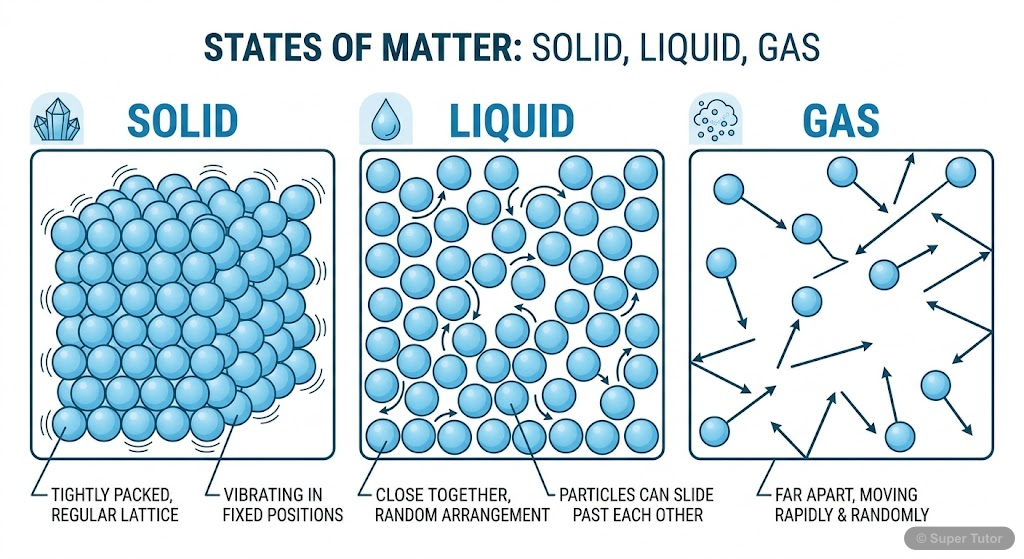
One of 12 illustrations for Study of Gas Laws in Super Tutor — alongside flashcards, concept maps and practice questions.
Quick Quiz: Study of Gas Laws
0/4Tap an answer to check it instantly. No sign-up needed for these 4.
What happens to the volume of a gas when pressure is doubled at constant temperature?
What is the value of absolute zero?
A gas occupies 100 mL at 760 mm Hg. What volume will it occupy at 380 mm Hg at the same temperature?
Which graph represents Boyle's Law?
Sample Questions
Which of the following are characteristics of gases?
Show answer
No fixed shape, No fixed volume, Highly compressible
Gases have no fixed shape or volume, are highly compressible due to large inter-particle spaces, and have low density with particles far apart.
Convert 27°C to Kelvin scale.
Show answer
300 K
To convert Celsius to Kelvin, add 273 to the Celsius value. So, 27°C + 273 = 300 K. Kelvin values are written without the degree sign.
At constant pressure, volume of a gas is directly proportional to temperature.
Show answer
True
This is Charles's Law - at constant pressure, volume is directly proportional to absolute temperature (V ∝ T).
Standard Temperature and Pressure (STP) conditions are:
Show answer
0°C and 760 mm Hg, 273 K and 1 atm, 0°C and 76 cm Hg
Standard temperature and pressure are given in the chapter as 0°C or 273 K for temperature and 1 atmospheric unit (atm) or 760 mm Hg for pressure. Since 1 atm is also equal to 76 cm Hg, that pair is included as well. The other options do not match the standard conditions stated for STP.
+38 more questions on Study of Gas Laws (ICSE Class 9 Chemistry)
Practise AllFrequently Asked Questions
What are the important topics in Study of Gas Laws for ICSE Class 9 Chemistry?
How many practice questions are there for Study of Gas Laws?
Sources & Official References
Content is aligned to the official syllabus. Refer to the board website for the latest curriculum.
More resources for Study of Gas Laws
Important Questions
Exam-style questions with answers
Revision Notes
Key points for last-minute revision
Formula Sheet
The chapter's formulas in one place
Chapter Summary
Understand the chapter at a glance
Concept Maps
See how topics connect
Study Plan
Step-by-step plan for this chapter
Flashcards
Quick-fire cards for active recall
Syllabus
What topics to cover
For serious students
Get the full Study of Gas Laws chapter — start free.
Quizzes, flashcards, an AI doubt solver and a study plan for ICSE Class 9 Chemistry. Free to start, no card needed.