Water — Practice Quiz
ICSE · Class 9 · Chemistry
Try a 4-question quiz on Water for ICSE Class 9 Chemistry: tap an answer to check it and see why. 43 questions in the full chapter test.
Interactive on Super Tutor
Studying Water? Get the full interactive chapter.
Quizzes, flashcards, AI doubt-solver and a step-by-step study plan — built for practice quiz and more.
Free trial, no card needed.
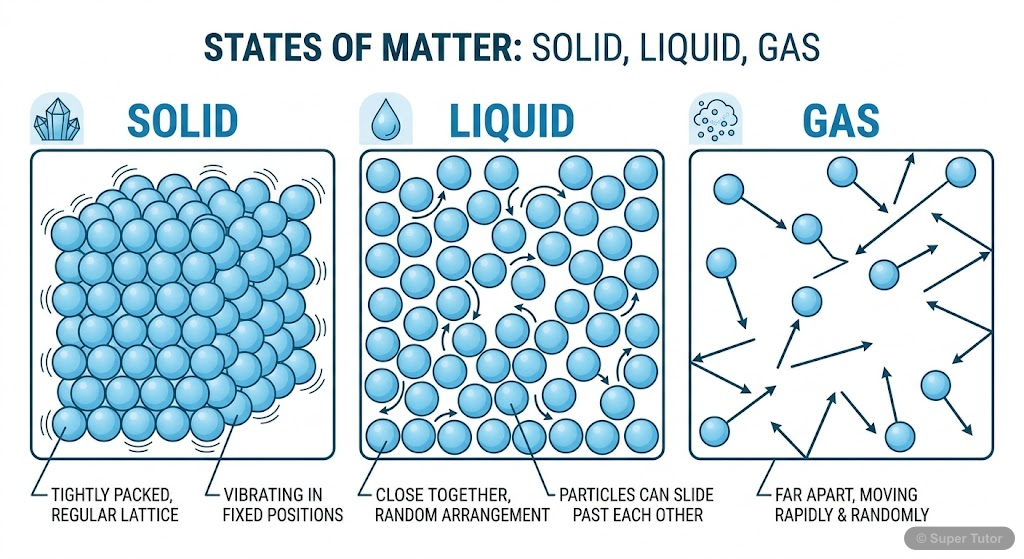
One of 17 illustrations for Water in Super Tutor — alongside flashcards, concept maps and practice questions.
Quick Quiz: Water
0/4Tap an answer to check it instantly. No sign-up needed for these 4.
What is the molecular formula of water?
At what temperature does pure water boil under normal pressure?
What happens to the density of water at 4°C?
Water is called a universal solvent because:
Sample Questions
Which of the following are examples of hydrated substances?
Show answer
CuSO4·5H2O (Blue vitriol), Na2CO3·10H2O (Washing soda), MgSO4·7H2O (Epsom salt)
Hydrated substances contain water of crystallization. CuSO4·5H2O, Na2CO3·10H2O, and MgSO4·7H2O all contain water molecules. NaCl and KNO3 are anhydrous substances without water of crystallization.
Which of the following are characteristics of a true solution?
Show answer
It is homogeneous, It is clear and transparent, Solute particles are very small
A true solution is homogeneous, clear, transparent, and contains very small solute particles (about 10⁻¹⁰ m). It does not scatter light and cannot be separated by filtration.
What is efflorescence?
Show answer
Loss of water of crystallization on exposure to air
Efflorescence is the phenomenon where hydrated substances lose their water of crystallization when exposed to dry air, causing them to crumble into powder. Examples include washing soda and Glauber's salt.
Hard water contains dissolved salts of:
Show answer
Calcium, Magnesium
Hard water contains dissolved salts of calcium and magnesium, such as their bicarbonates, sulfates, or chlorides. Sodium and potassium salts do not cause water hardness.
+39 more questions on Water (ICSE Class 9 Chemistry)
Practise AllFrequently Asked Questions
What are the important topics in Water for ICSE Class 9 Chemistry?
How many practice questions are there for Water?
Sources & Official References
Content is aligned to the official syllabus. Refer to the board website for the latest curriculum.
More resources for Water
Important Questions
Exam-style questions with answers
Revision Notes
Key points for last-minute revision
Formula Sheet
The chapter's formulas in one place
Chapter Summary
Understand the chapter at a glance
Concept Maps
See how topics connect
Study Plan
Step-by-step plan for this chapter
Flashcards
Quick-fire cards for active recall
Syllabus
What topics to cover
For serious students
Get the full Water chapter — start free.
Quizzes, flashcards, an AI doubt solver and a study plan for ICSE Class 9 Chemistry. Free to start, no card needed.